LunarWeave
Yemen's Electricity Already Runs On Oil
When the Saudi-led coalition told civilians to leave a Yemen Petroleum Company site on the western edge of Sanaa, then — according to Houthi media and an AFP correspondent — struck it, the target was an oil facility. Dawn reported that the coalition had not confirmed the strike. That reporting does not establish that the depot was a power plant. It does raise a sharper question about the war now expanding around oil sites and airports: which of these countries actually generates its electricity from oil?
The answer, in IRENA generation data, is Yemen — and more so than a decade ago. In 2023, oil produced 88.8% of Yemen's electricity. Natural gas, which had supplied about a third of the system in 2014, had all but vanished from the record. Saudi Arabia still burns a great deal of oil for power, but gas is now the majority fuel. Iran, whose tankers and mediation offers filled the same week of news, generated about four-fifths of its electricity from gas and only about one-seventh from oil.
If oil infrastructure is a military target, Yemen is the combatant whose lights already depend on it.
A collapse in gas, not a boom in oil
IRENA measures gross electricity generation, on-grid and off-grid, in gigawatt-hours. Adding its renewable and non-renewable totals for Yemen gives 8,683 GWh in 2014: 5,724 GWh from oil (65.9%) and 2,948 GWh from gas (34.0%). Solar photovoltaic was 11 GWh.
Three years later, recorded gas-fired generation had fallen to 63 GWh — a 98% drop. Oil output fell too, to 3,704 GWh, but it became almost the entire remaining system. Total generation in 2017 was 3,967 GWh, less than half the 2014 figure.
By 2023, output had recovered only to 5,115 GWh, still 41% below 2014. Oil supplied 4,542 GWh, or 88.8%. Solar photovoltaic — which, in IRENA's Yemen tables, equals all renewable generation — supplied 510 GWh, or 10.0%. Gas remained at 63 GWh, the same number IRENA has carried every year from 2017 through 2024. That constant is a residual after a collapse; it should not be read as a freshly metered annual total.
Yemen did not replace lost gas with a surge of oil so much as it lost most of the gas and a large share of total power, then kept burning oil. The fighting that intensified in 2015 is the obvious backdrop. These figures do not identify which plants were damaged, which fuel shipments stopped, or how much of the solar is rooftop kits filling in for a broken grid.
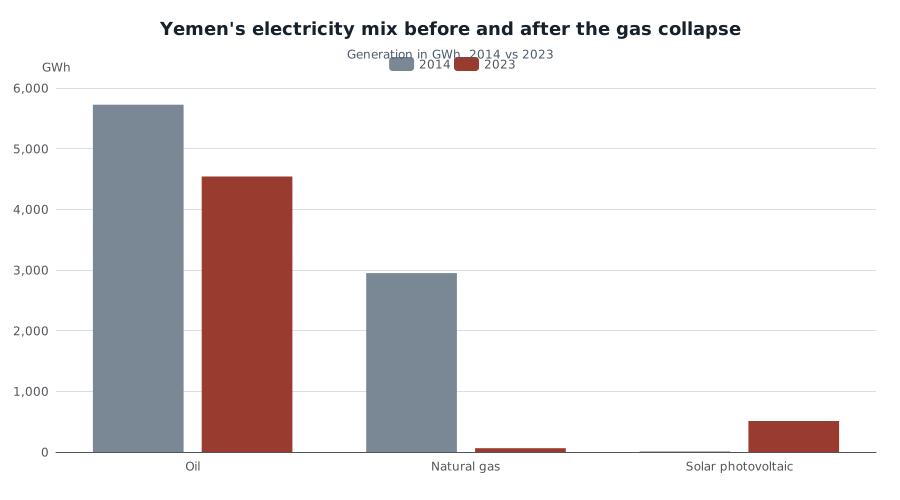
Yemen electricity generation by fuel, 2014 versus 2023, in gigawatt-hours. Source: IRENASTAT. Oil stayed the largest source while gas-fired output fell from 2,948 GWh to 63 GWh. Solar photovoltaic equals IRENA's total renewable figure for Yemen. IRENA records the 63 GWh gas figure unchanged from 2017 through 2024.
The striker moved off oil. The country being struck did not.
Yemen's entire 2023 system, at 5,115 GWh, is tiny next to Saudi oil-fired generation alone (182 TWh). Scale is not the same as dependence. As a share of the Saudi grid, oil has been shrinking. In 2014, oil was 62.1% of Saudi electricity; by 2023 it was 40.8%, with gas at 57.8%. The kingdom still burns oil for power. On IRENA's figures it is no longer an oil-majority grid.
Iran's mix is more gas still. Oil was 21.7% of Iranian generation in 2014 and 14.8% in 2023. Gas supplied 78.6%. Nuclear (1.6%), coal and renewables fill the rest. Whatever else a tanker war does to oil trade, Iran's domestic electricity is not an oil story in the way Yemen's is.
The paths crossed after 2016. Yemen's oil share jumped above 88% once recorded gas generation collapsed and has stayed there. Saudi Arabia's oil share drifted down through the 40s. Iran's stayed low, with a partial rebound in 2022–23 that still left oil well under one-sixth of generation.
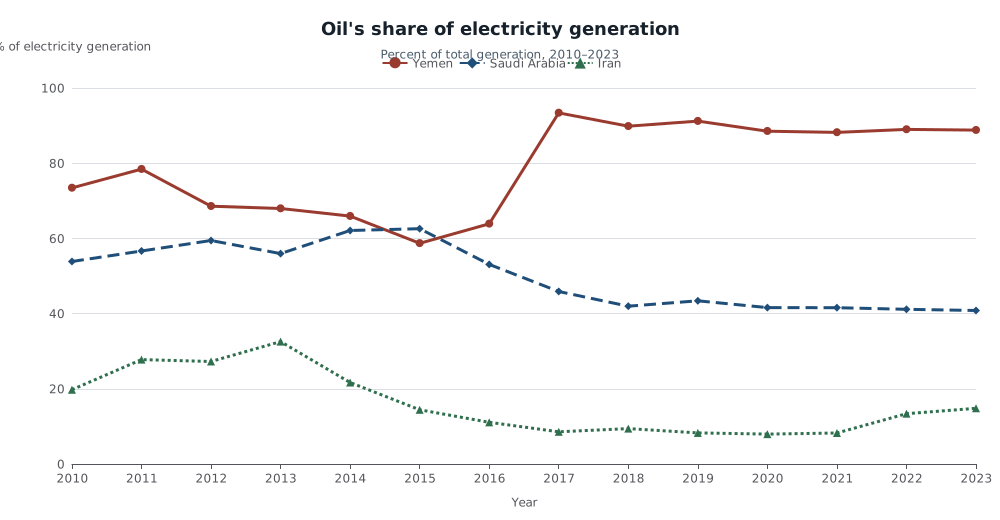
Oil-fired electricity as a percent of total generation, 2010–2023. Source: IRENASTAT. Yemen's oil share jumped after 2016 as recorded gas generation collapsed; Saudi Arabia's oil share fell as gas took over; Iran remained majority-gas. IRENA holds Yemen gas generation at 63 GWh from 2017 onward.
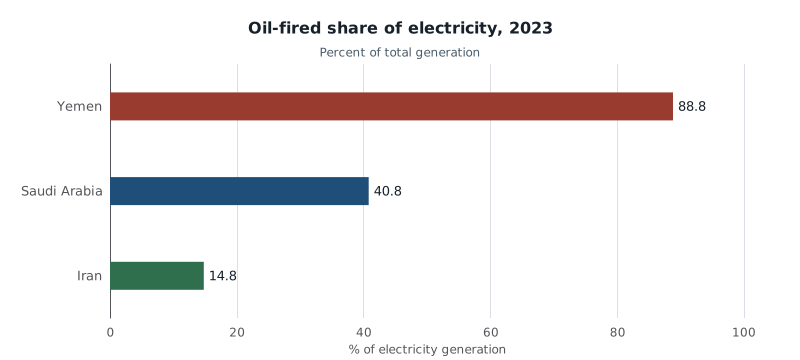
Oil-fired electricity as a share of total generation in 2023. Units: percent of GWh. Source: IRENASTAT. Total generation is IRENA renewable plus non-renewable electricity. 2024 generation is preliminary and is not shown.
| Country | Oil | Gas | Other | Total generation |
|---|---|---|---|---|
| Yemen | 88.8% | 1.2% | 10.0% | 5,115 GWh |
| Saudi Arabia | 40.8% | 57.8% | 1.4% | 444,985 GWh |
| Iran | 14.8% | 78.6% | 6.6% | 385,242 GWh |
Shares of 2023 electricity generation. “Other” in Yemen is solar photovoltaic; in Saudi Arabia it is almost entirely renewables; in Iran it is renewables, nuclear and coal. Source: IRENASTAT.
What a petroleum-company strike does not prove
Houthi-affiliated television named the Al-Sabaha oil-company site west of Sanaa. As reported, that is a fuel-handling facility. It is not identified here as a generator. IRENA's annual generation figures cannot say whether that strike cut electricity in October 2026, and they are not 2026 conditions. The last year used for comparison is 2023, because IRENA labels 2024 generation preliminary — and several 2024 series for Yemen and Iran simply repeat 2023.
The comparison is still the one that changes how the week's targeting should be read. Oil sites are being warned, evacuated and hit. The country whose electricity is still almost nine-tenths oil-fired is Yemen.
Sources and methods
This is a retrospective analysis, written on 14 October 2026, of a 13 October 2026 news day. It uses IRENASTAT electricity generation from a pinned snapshot whose latest complete comparison year is 2023. IRENA's table notes state that electricity generation (GWh) is gross output from plants, combined heat and power, and distributed generators, including on-grid and off-grid production and electricity used in the energy industry. 2024 generation is preliminary.
Total generation is IRENA's total renewable series plus total non-renewable series, which reconcile with the fuel series used here for 2023. Missing years are omitted, not treated as zero. Yemen coal and hydropower series returned no rows in this snapshot; they are not interpreted as zeros. Yemen's 2023 mix is fully accounted for by oil, gas and solar photovoltaic.
The Sanaa strike is attributed to contemporaneous reporting, not to IRENA. These generation shares do not measure oil exports, refinery throughput, or the military value of any named facility.
Research Date
The displayed date matches the related news edition. Research was completed 2026-10-14.
Related news: Daily · 2026-10-13
More Research
The Fuel Bill Is National. The Oil Paycheck Is Texas.
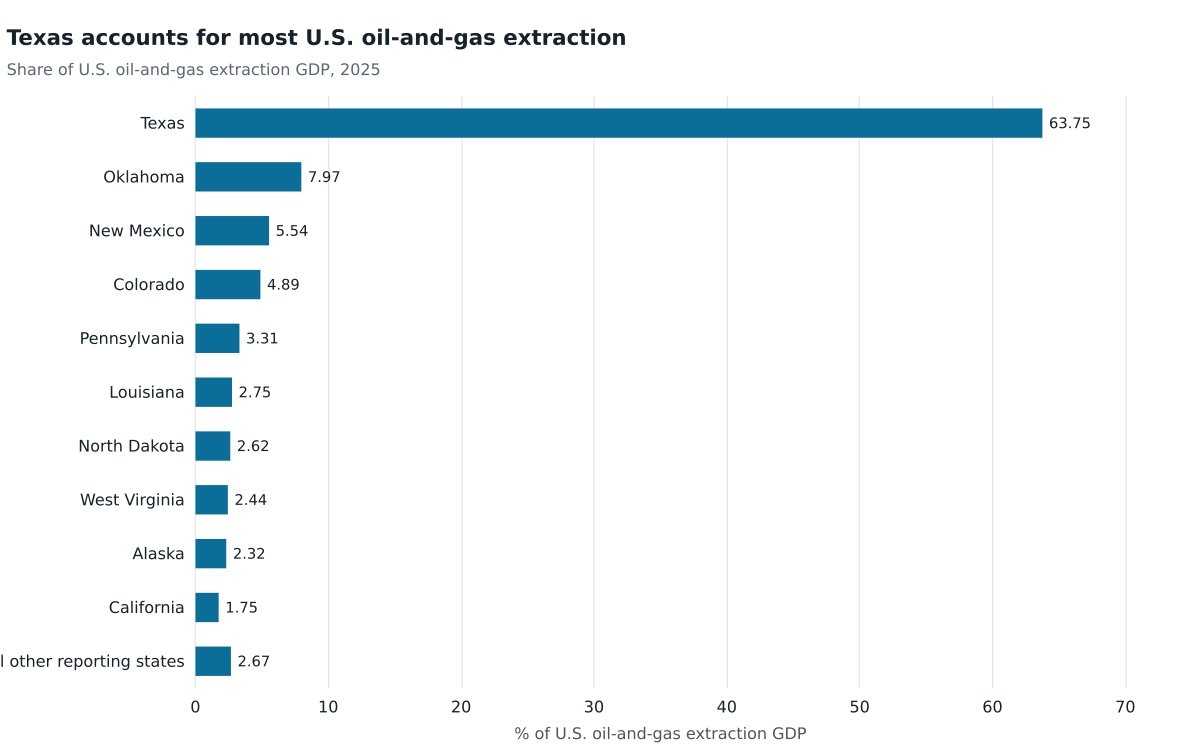
U.S. households everywhere buy motor fuel, but nearly two-thirds of oil-and-gas extraction GDP sits in Texas.
The Diesel Squeeze Is A Power-Plant Story — But Only In Some Gulf Grids
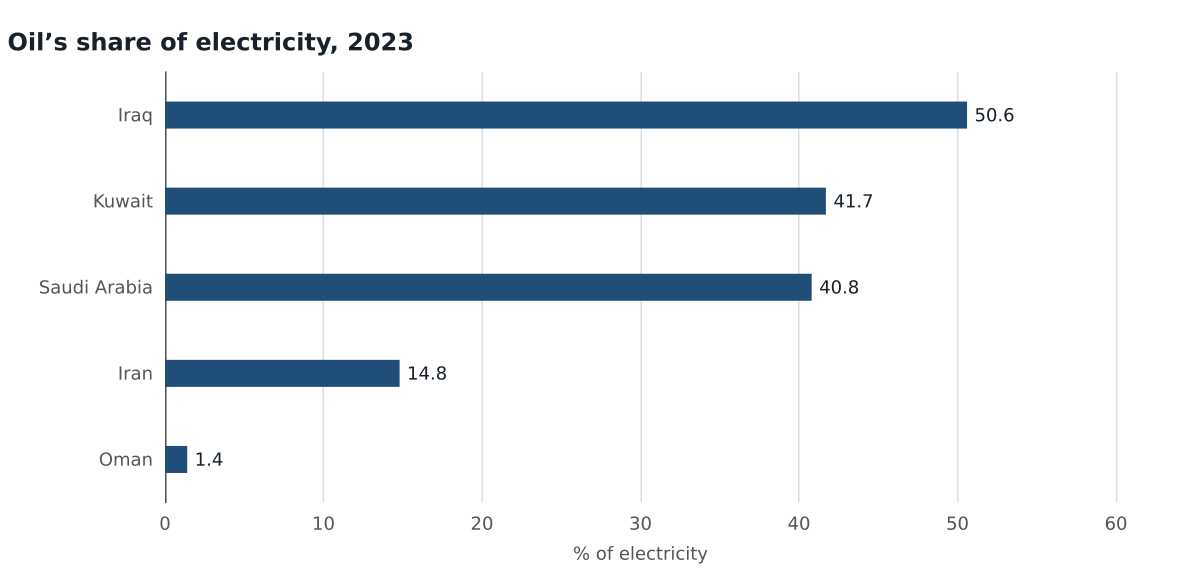
Saudi Arabia, Kuwait and Iraq still generate about two-fifths to half their electricity from oil. The UAE and Qatar do not. That split, not a generic Gulf shortage, is the structural claim o
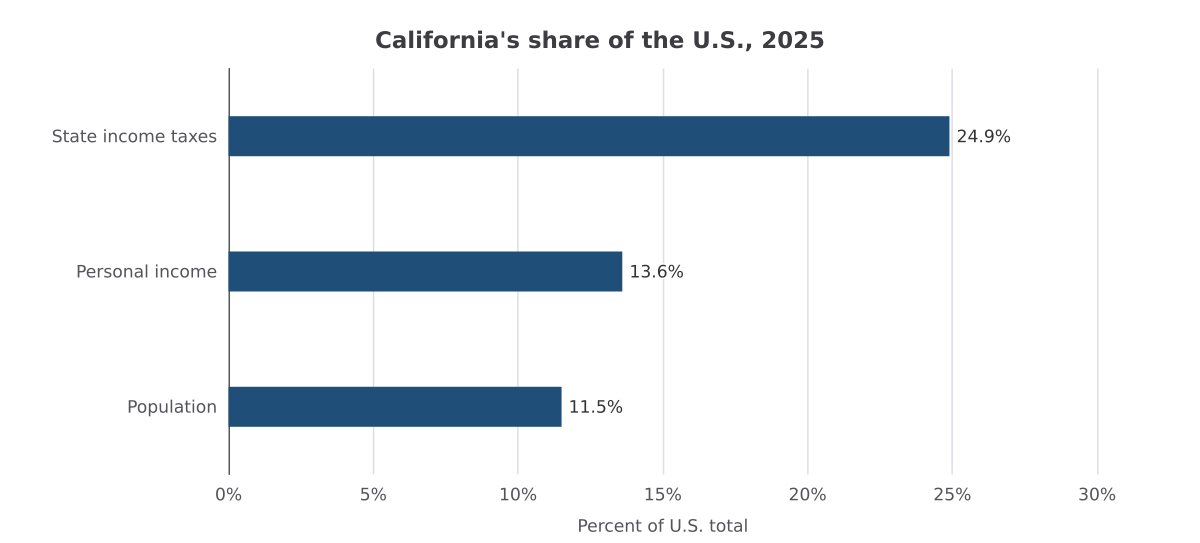
California Already Collects A Quarter Of America's State Income Taxes
California collected a quarter of U.S. state income taxes in 2025 with 11.5% of the population, then watched those receipts fall a fifth while personal income kept rising.