LunarWeave
The Diesel Squeeze Is A Power-Plant Story — But Only In Some Gulf Grids
When diesel is scarce, crude exporters are supposed to be the relief valve. That assumption is doing a lot of work this month. Washington has talked up Russian diesel cargoes and an “energy ceasefire” with Ukraine, while Brent jumped back above $106 as Houthi strikes hit Saudi airports. Separately, the South China Morning Post, citing the International Energy Agency, reported that Gulf net diesel exports in August averaged 390,000 barrels a day — barely a quarter of their pre-war pace even as crude shipments recovered.
Those are newsroom figures, not the measurements below. They do pose a concrete question the generation data can answer: if refined fuel is tight, are Gulf power systems still burning the liquids that could otherwise leave as diesel — and is that true of the Gulf as a bloc?
It is not. In 2023, the latest complete year in IRENA’s electricity statistics, Saudi Arabia, Kuwait and Iraq still generated about two-fifths to half of their electricity from oil. The United Arab Emirates and Qatar did not: IRENA has no oil-fired generation series for either, and the UAE’s 2023 non-renewable total is fully accounted for by gas plus nuclear. Those three oil-burning producers supplied 37.1% of all oil-fired electricity among the 205 countries that report the series.
Oil-fired kilowatt-hours are not a diesel tanker count. IRENA’s “oil” technology is gross generation from liquid-fired plants — crude, fuel oil, diesel and related fuels, on-grid and off-grid. It cannot be turned into barrels of exportable diesel without heat rates and a fuel mix this dataset does not provide. What it can show is where the structural claim on liquids still sits.
Three grids, not a Gulf average
Saudi Arabia generated 181.7 terawatt-hours from oil in 2023, 40.8% of its electricity. Kuwait generated 36.7 TWh, 41.7%. Iraq generated 47.9 TWh, 50.6%. Oman, also a Gulf crude exporter, generated 0.6 TWh from oil — 1.4% of its electricity. The UAE and Qatar are not on that list.
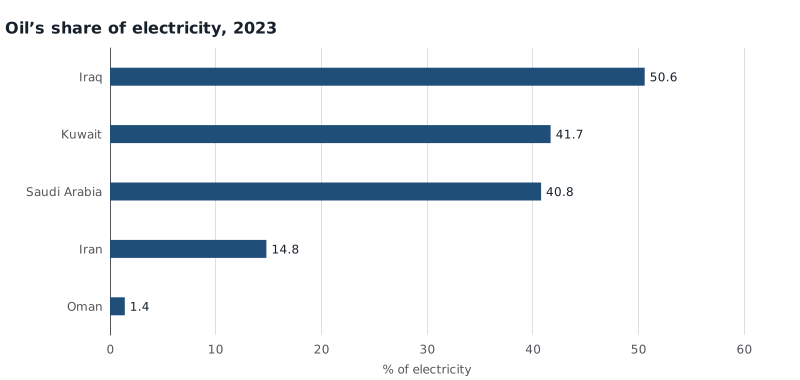
Oil-fired generation as a percentage of total electricity (renewable plus non-renewable), 2023. Iraq 50.6%, Kuwait 41.7%, Saudi Arabia 40.8%, Iran 14.8%, Oman 1.4%. The UAE and Qatar have no oil-generation series in IRENA; they are omitted, not plotted as zero. Source: IRENA Renewable Energy Statistics.
For the UAE, the omission is not a hole in the total. Gas generated 121.0 TWh in 2023 and nuclear 33.1 TWh; those two series sum exactly to the UAE’s 154.0 TWh of non-renewable generation. Renewables make up the rest. There is no residual in which oil-fired power could be hiding. Qatar is almost as clean a gas story: 96.2% of its 2023 electricity came from natural gas. IRENA still publishes no oil series there, and a 0.1 TWh sliver of non-renewable generation is unexplained — too small to treat as hidden oil, and too real to call zero.
The practical point is crude. Saudi Arabia, Kuwait and Iraq can ship oil and still burn a large fraction of their power as liquids. The UAE and Qatar, on this evidence, are not competing with diesel cargoes at the power-plant gate in the same way. Talking about “Gulf refined-fuel exports” as if every Gulf grid were Saudi Arabia’s grid flattens that split.
Iran is not a Gulf diesel exporter in the IEA sense, but it belongs on the same map: 57.1 TWh of oil-fired electricity in 2023, 14.8% of its generation — more oil-fired power than Kuwait, less as a share of a much larger, gas-dominated system.
The decline that stopped
Oil-fired power is not a frozen Gulf habit. Among countries that report the series, generation from oil fell from 998 TWh in 2015 to 718 TWh in 2023, a 28% drop. There is no official world total in this snapshot — IRENA’s World geography has no oil-generation series — so that sum is the 205 reporting countries, not a certified global inventory. It is still the right direction of travel: most systems that used to burn oil for electricity have been getting off it.
Saudi Arabia followed that path, then left it. Its oil-fired generation fell 27.5% from 225.5 TWh in 2015 to 163.4 TWh in 2018. By 2023 it was back up to 181.7 TWh, an 11.2% rise from the 2018 low. Gas still does more of the work — 57.8% of Saudi electricity in 2023 — but the liquids burn stopped shrinking just as the region’s refined-fuel balance tightened.
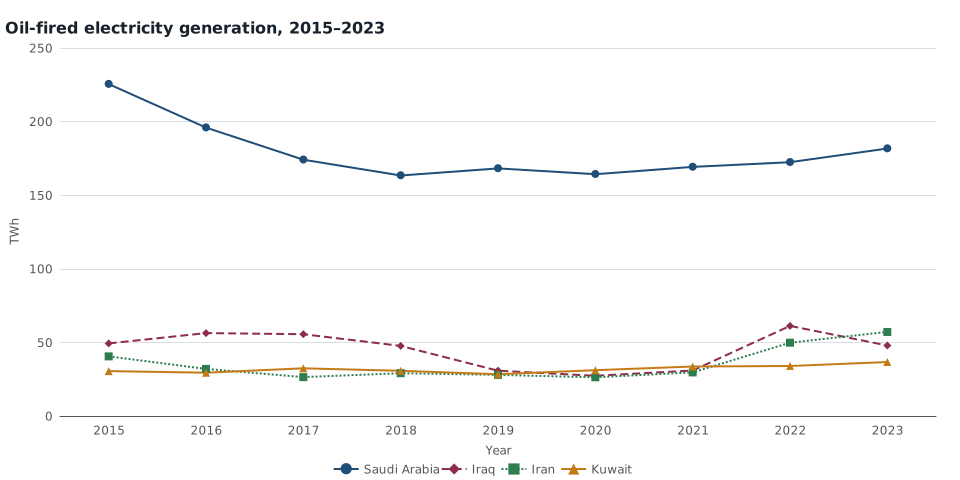
Gross electricity generation from oil-fired plants, terawatt-hours, 2015–2023. Saudi Arabia remains far larger than the others; Iraq and Iran jumped in 2022. 2024 figures are preliminary and omitted. Oil-fired kilowatt-hours are not diesel export volumes. Source: IRENA Renewable Energy Statistics.
Iraq and Iran moved the other way during the war years. Iraq’s oil-fired generation nearly doubled from 30.9 TWh in 2021 to 61.2 TWh in 2022, then settled at 47.9 TWh in 2023 — still well above the 2021 level. Iran’s rose 93% from 29.6 TWh in 2021 to 57.1 TWh in 2023. Those jumps coincide with a period of sanctions, grid stress and fuel substitution; the generation file does not say which fuel oil, diesel or crude was burned, or why. They do show that the liquids claim on two large Middle Eastern systems got bigger after 2021, not smaller.
Kuwait never left. Its oil-fired generation drifted up from 28.4 TWh in 2019 to 36.7 TWh in 2023, holding about two-fifths of the grid.
For scale: the United States generated 33.1 TWh from oil in 2023, Mexico 27.8 TWh. Each is smaller than Kuwait. Saudi Arabia alone was 25.3% of the 205-country oil-fired total. Saudi Arabia, Kuwait and Iraq together were 37.1%; add Iran and the four were 45.0%.
| Country | Oil-fired generation, 2023 (TWh) | Share of that country’s electricity |
|---|---|---|
| Saudi Arabia | 181.7 | 40.8% |
| Iran | 57.1 | 14.8% |
| Iraq | 47.9 | 50.6% |
| Kuwait | 36.7 | 41.7% |
| United States | 33.1 | — |
| Mexico | 27.8 | — |
| Oman | 0.6 | 1.4% |
| UAE | no oil series | gas 71.7%; nuclear fills the rest of non-renewables |
| Qatar | no oil series | gas 96.2% |
Shares use IRENA oil generation divided by total renewable plus total non-renewable generation. US and Mexican shares are omitted because this article did not retrieve their totals. Empty oil series are not zeros.
What this does not settle
A Russian diesel shipment, even at the volumes Moscow has floated, does not rewire these grids. Neither does an energy ceasefire that Kyiv said it had not agreed and that the physical market promptly looked through. The generation record says the largest remaining oil-fired power systems are concentrated in a handful of Middle Eastern producers, and that “the Gulf” is the wrong unit: Saudi Arabia, Kuwait and Iraq still run oil through the turbine hall; the UAE and Qatar, on IRENA’s books, do not.
That is consistent with a refined-fuel shortage that outlasts a recovery in crude loadings. It does not prove the IEA export lag is caused by power-plant burn. Refinery outages, shipping risk around Hormuz, sanctions, and domestic truck and desalination demand can all keep diesel at home. IRENA does not measure any of those. It also does not split oil-fired generation into diesel versus heavy fuel oil, so a barrel burned in a Saudi boiler is not automatically a barrel that would have arrived at a US pump.
The concentration still changes the politics. Strikes on Saudi energy sites hit the country that still generates more electricity from oil than any other reporting country. Extra diesel from a Black Sea port does not substitute for that. And a Gulf export recovery that depended on the UAE and Qatar would be a different machine from one that required Saudi Arabia and Kuwait to stop burning liquids for air-conditioning.
Sources and methods
Figures are from IRENA’s country electricity statistics (gross generation, gigawatt-hours, calendar years), converted to terawatt-hours by dividing by 1,000. Oil, gas and nuclear are separate technology series. Country totals are total renewable plus total non-renewable generation, not a third official “all electricity” series. The 205-country oil sum uses the same oil series restricted to geographies labelled as countries; it is not an IRENA world aggregate.
IRENA’s table notes state that 2024 electricity generation is preliminary and not accurate at aggregate levels. Several large oil-fired producers, including Saudi Arabia, Kuwait, Iraq and Iran, have 2024 oil-generation values identical to 2023. Headline comparisons therefore use 2023.
This is retrospective research completed 13 October 2026 with a pinned IRENA snapshot that includes later revisions than were necessarily published on 12 October 2026, the news day. Later data are not implied to have been available then. Browser layout of the charts was not separately tested beyond SVG rendering.
Research Date
The displayed date matches the related news edition. Research was completed 2026-10-13.
Related news: Daily · 2026-10-12
More Research
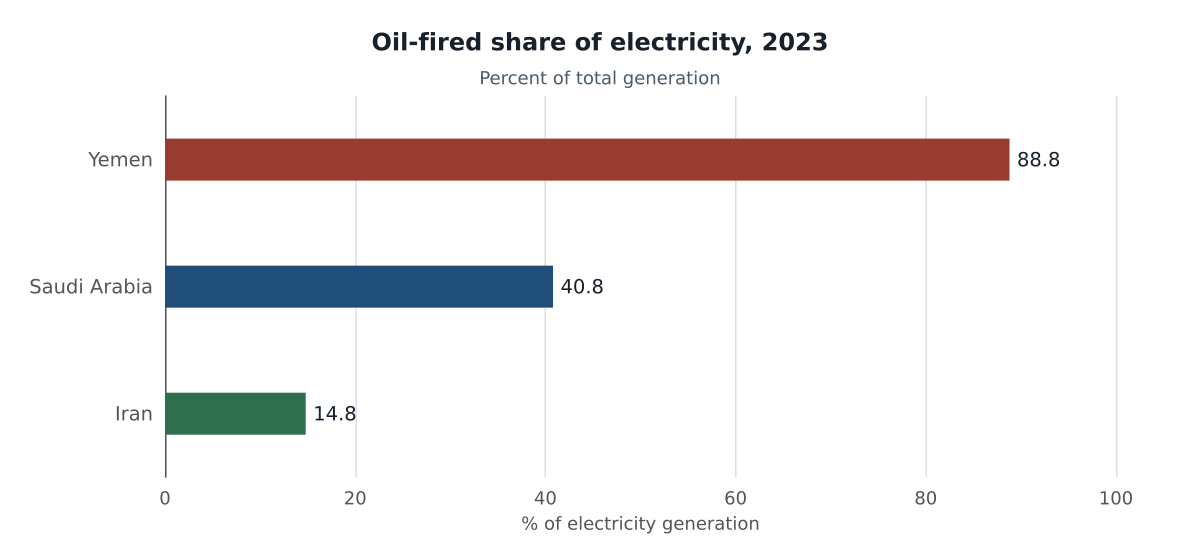
Yemen's Electricity Already Runs On Oil
IRENA generation data show oil supplied 88.8% of Yemen's electricity in 2023 after gas-fired output collapsed, versus 40.8% in Saudi Arabia and 14.8% in Iran.
California Still Pays More. Housing Takes Most Of The Difference Back.
California still out-earns Texas, even after prices. Tenant housing is 60 percent more expensive, and Texas has been adding the jobs.
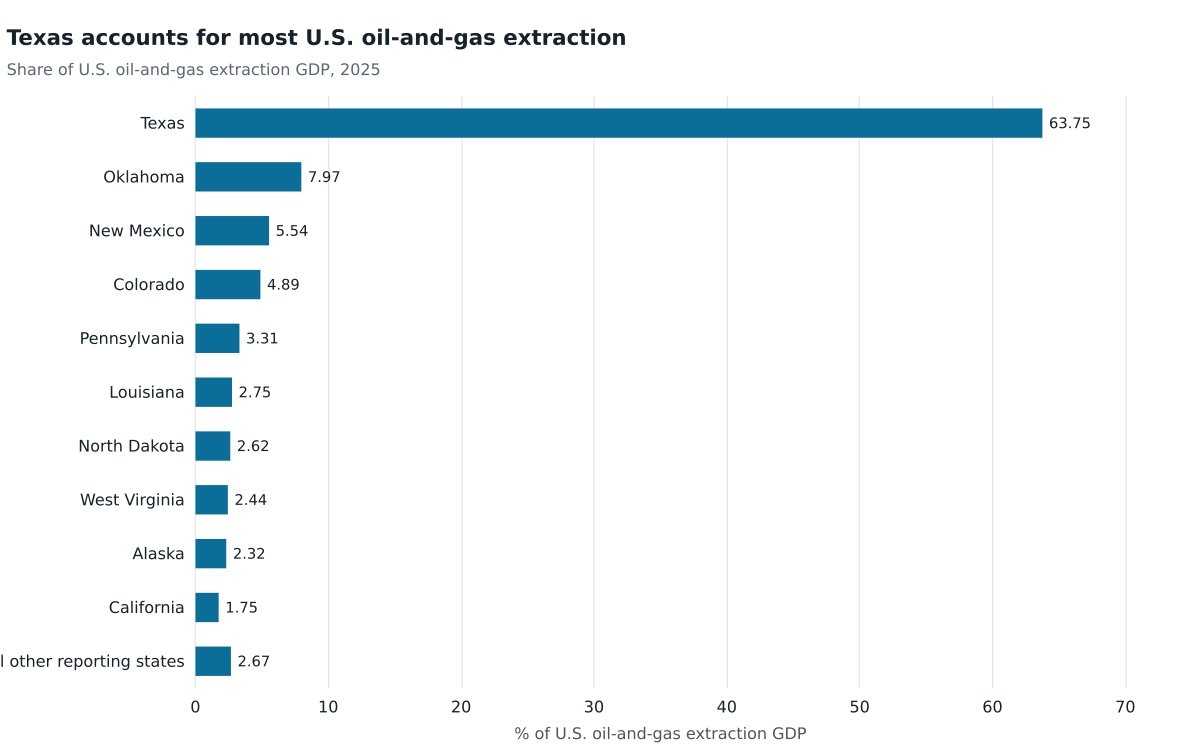
The Fuel Bill Is National. The Oil Paycheck Is Texas.
U.S. households everywhere buy motor fuel, but nearly two-thirds of oil-and-gas extraction GDP sits in Texas.