LunarWeave
California Already Collects A Quarter Of America's State Income Taxes
A ballot fight over billionaire wealth is arriving in a state whose ordinary income-tax machine is already the largest in the country — and one of the jumpiest.
Lietuvos rytas reported that California voters are being asked whether extremely wealthy residents should pay a special tax on their assets, described as the first levy of its kind in the United States. The reporting does not establish the measure's rate, legal design, or result. What the official accounts can show is the system that tax would sit beside: California already collects far more state income tax than any other state, and those receipts do not move in step with the income the Bureau of Economic Analysis records.
A large state, a much larger tax take
In 2025, California had 11.5% of the U.S. population and 13.6% of U.S. personal income. It collected 24.9% of all state-government individual income taxes in the BEA accounts — $134.0 billion of a $538.9 billion national total.
That is not just "California is big." The state's share of the income-tax total is nearly twice its share of income and more than twice its share of people.
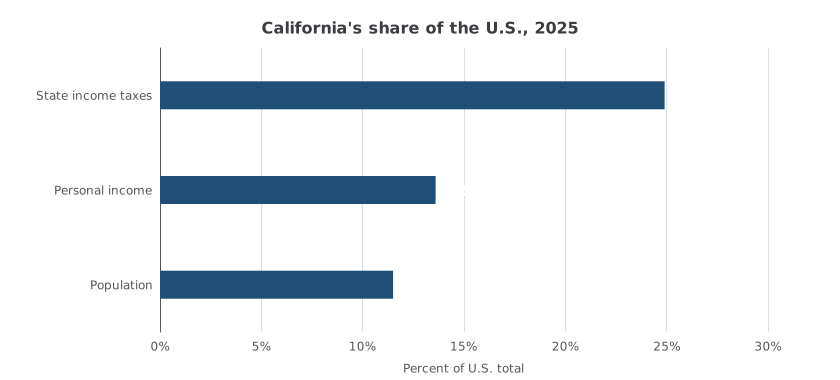
California's share of the U.S. total for population, personal income, and state government individual income taxes, 2025. Source: U.S. Bureau of Economic Analysis. The national tax total includes states that report no state individual income tax.
Part of the gap is mechanical. The BEA series is state-government income taxes paid by individuals, excluding refunds. Texas and Florida, two of the most populous states, report zero. That pulls down the U.S. total and lifts every income-taxing state's share. It does not create California's lead over other income-tax states.
New York, the next-largest collector, took in $63.7 billion in 2025 — 11.8% of the U.S. total, with 5.9% of the population and 7.0% of personal income. California collected more than twice as much. Together the two states accounted for 36.7% of all state income taxes in the country. Illinois, Massachusetts and New Jersey, the next three, collected $26.5 billion, $25.5 billion and $21.9 billion.
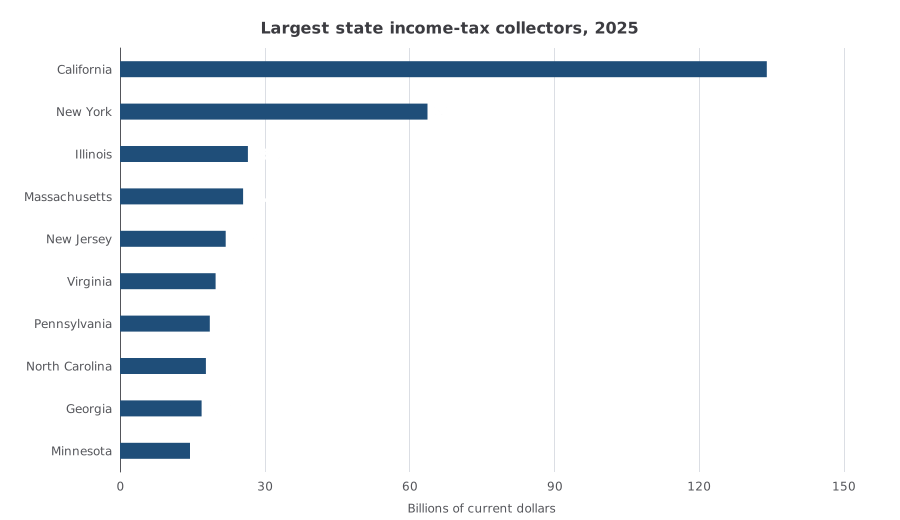
State government individual income taxes in 2025, ten largest collectors, billions of current dollars. Source: BEA SAINC50. Texas and Florida report zero on this series.
Relative to personal income, California is not a wild outlier versus New York. State income taxes were 3.74% of California personal income in 2025 and 3.48% in New York, against a U.S. figure of 2.05% that includes the zeros. The distinctive fact is scale, not a uniquely confiscatory ratio.
| Population share | Personal-income share | State income taxes | Taxes as share of personal income | |
|---|---|---|---|---|
| California | 11.5% | 13.6% | $134.0 billion (24.9%) | 3.74% |
| New York | 5.9% | 7.0% | $63.7 billion (11.8%) | 3.48% |
| United States | 100% | 100% | $538.9 billion | 2.05% |
Figures are calendar year 2025. Taxes are BEA state-government individual income taxes; personal income is the BEA state economic-profile total.
Federal taxes widen the picture only modestly. California residents accounted for 16.6% of all personal current taxes — federal, state and local combined — still above their 13.6% income share, as a progressive federal income tax would lead one to expect.
The receipts fell while income kept rising
Scale is only half the story. The same series that makes California the largest collector also shows how sharply the take can drop.
California's state income-tax receipts peaked at $134.4 billion in 2021, slipped in 2022, then fell to $108.0 billion in 2023 — a 19.7% decline from the 2021 high. Over those same two years, California personal income rose 5.5%. By 2025, tax receipts had only returned to $134.0 billion, essentially the 2021 level, while personal income was 18.5% higher than in 2021.
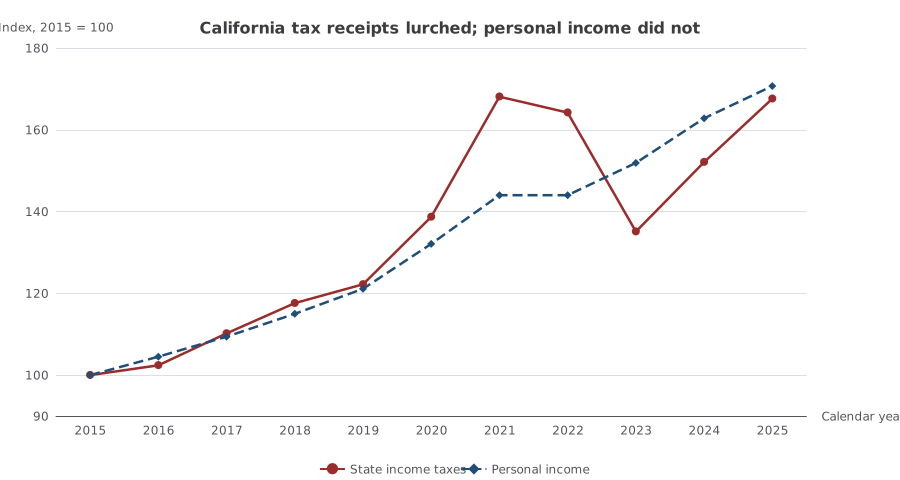
California state income taxes and personal income, indexed to 2015 = 100. Source: BEA SAINC50 and SAINC30. The two series are not the same base: personal income excludes capital gains.
This is not a California-only wobble in 2022–23. New York's receipts fell 20.5% in 2023 after a 2022 peak. The national total also dropped that year. California's own peak came earlier, in 2021, and the descent from that peak was steeper than the 2021–23 change in the U.S. total (−4.4%). From 2021 to 2023, California's share of U.S. state income taxes fell from 27.6% to 23.2% before climbing back to 24.9% in 2025.
The accounts help explain why income and tax receipts can part company. BEA personal income is a flow of wages, supplements, proprietors' income, dividends, interest, rent and transfers. It does not include capital gains. State income taxes generally do, once gains are realized. A year when residents sell appreciated stock can swell receipts without a matching jump in BEA personal income; a year when realizations dry up can cut receipts while wages and other income keep growing. The 2021–23 split is consistent with that difference. It does not isolate capital gains, rate changes, or migration, and it is not a forecast.
What the income accounts do not show about wealth
If the political argument is that California is uniquely thick with capital income, the per-person BEA figures are milder than the tax totals. In 2025, California personal income was $90,957 per person, 18% above the U.S. average of $77,028. Net earnings — pay from work, after contributions for government social insurance, plus residence adjustments — were 23% above the national average. Dividend income was only 11% above it: $6,990 per person in California against $6,293 in the United States.
Those are averages across nearly 39.4 million residents. A few hundred billionaires would not have to move the per-person dividend line much, and much of today's large fortunes sits in unrealized equity rather than in dividends. The income accounts are therefore a poor census of a wealth-tax base. They are a good census of the income-tax base California already uses.
That is the relevant backdrop. California is considering a tax on a stock of assets in a state that already depends on a large, progressive, realization-heavy income tax — and that has recently watched that tax fall by a fifth while measured personal income did not. Whether a wealth tax would stabilize receipts, chase residents out, or collect what the income tax misses is a different question. These figures cannot score the ballot measure. They can say why the fight is happening in California: the existing machine is huge, and it lurches.
Sources and methods
This article is retrospective research completed on 16 October 2026. It uses the Bureau of Economic Analysis regional annual snapshot released 30 September 2026 (calendar years through 2025), not the information set available on 15 October 2026. 2025 figures remain subject to revision.
State income taxes are SAINC50 "state governments — income taxes": income-tax payments by individuals excluding refunds, thousands of current dollars. Personal income, population and per-capita components are SAINC30. Shares use the BEA United States total, which equals the sum of states and the District of Columbia on the tax series. Texas and Florida zeros are reported values, not missing data. The District of Columbia also shows zero on the state-government income-tax line because that line is defined for state governments; that is not evidence that Washington, D.C., levies no income tax.
Browser and mobile layout were not separately tested; charts were rendered to SVG from ECharts 6.0.0.
Research Date
The displayed date matches the related news edition. Research was completed 2026-10-16.
Related news: Daily · 2026-10-15
More Research
Half The World's Solar Capacity Now Sits In China
China generated 40 percent of the world's solar electricity in 2024 and hosted half of installed solar capacity by the end of 2025, a share that has been rising since 2015.
The Fuel Bill Is National. The Oil Paycheck Is Texas.
U.S. households everywhere buy motor fuel, but nearly two-thirds of oil-and-gas extraction GDP sits in Texas.
Cuba Still Has An Oil-Fired Grid. It Has Stopped Getting Electricity Out Of It.
Cuba's October blackout hit an oil-fired grid that had already lost nearly a third of its electricity since 2018 while keeping most plants on the books.