LunarWeave
Cuba Still Has An Oil-Fired Grid. It Has Stopped Getting Electricity Out Of It.
When a fire knocked a generating unit offline in mid-October, Cuban authorities described a country that could no longer keep the lights on. Infobae, citing Unión Eléctrica, reported that the shutdown of unit 1 at the Ernesto Guevara de la Serna plant left 740 megawatts of plant available against 2,900 megawatts of projected demand — enough, in that account, to leave about three-quarters of the island without power.
A 740-megawatt remainder sounds like a small system that lost its largest machine. The annual record from the International Renewable Energy Agency shows something else. Cuba still had more than 6,800 megawatts of installed generating capacity at the end of 2024, three-quarters of it oil-fired. What had already collapsed was not the nameplate. It was the electricity those plants actually produced.
The output was already a third smaller
IRENA’s country electricity table, which counts gross generation from on-grid and off-grid plants, shows Cuban electricity output peaking in 2018 at 20,952 gigawatt-hours. In 2024 — the latest generation year in this snapshot, and flagged by IRENA as preliminary — the island generated 14,510 gigawatt-hours. That is 30.8 percent below the 2018 peak and 3.5 percent below the 2000 total. The decline is not a one-year weather blip. Generation stepped down every year from 2019 through 2024.
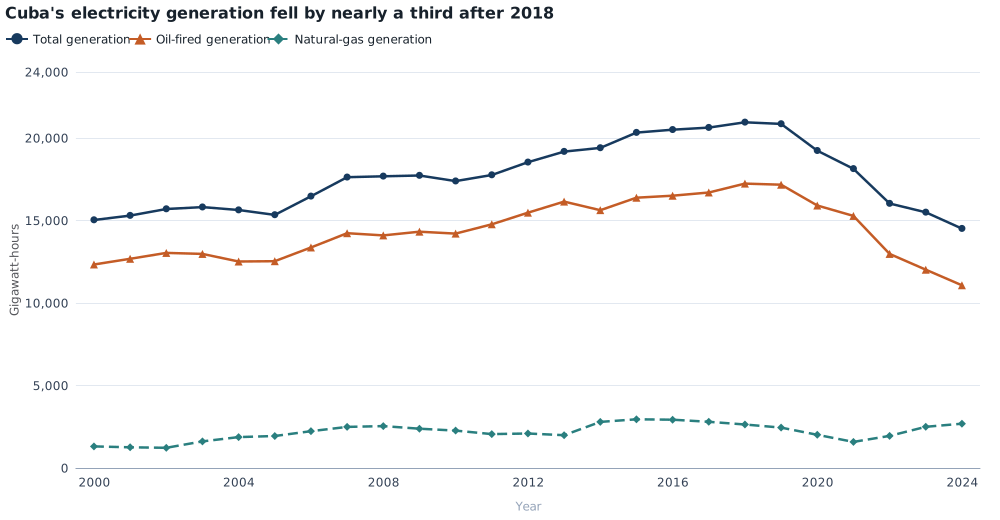
Annual gross electricity generation in Cuba, gigawatt-hours, 2000–2024. Total generation is IRENA renewable plus non-renewable output. Oil and natural gas are technology slices inside that total, not an extra sum. 2024 generation is preliminary. Source: IRENA IRENASTAT.
Almost all of the missing electricity is oil. Oil-fired plants generated 17,236 gigawatt-hours in 2018 and 11,075 gigawatt-hours in 2024, a 35.8 percent drop. Even after that collapse, oil still supplied 76.3 percent of Cuba’s 2024 electricity. Natural gas added 18.5 percent. Renewables, in IRENA’s own share series, were 3.81 percent.
That mix is the binding constraint. A system that still gets three-quarters of its kilowatt-hours from oil cannot ride out a fuel shortage, a maintenance backlog, or a single thermal outage the way a diversified grid can. The October fire did not hit a transition that had already moved on. It hit an oil system.
The plants are still there. They are barely running.
Capacity tells a different story from generation, and that gap is the part of the blackout that annual data can actually explain.
At the end of 2024 Cuba still had 5,226 megawatts of oil-fired capacity — 76.7 percent of a 6,812-megawatt fleet. If those oil units had run around the clock, they could have produced about 45,800 gigawatt-hours. They produced 11,075. Spread over 8,760 hours, that is an average oil-fired output of 1,264 megawatts, a 24.2 percent capacity factor. In 2018 the same calculation was 36.9 percent. The island did not retire its oil plants. It stopped getting power out of them.
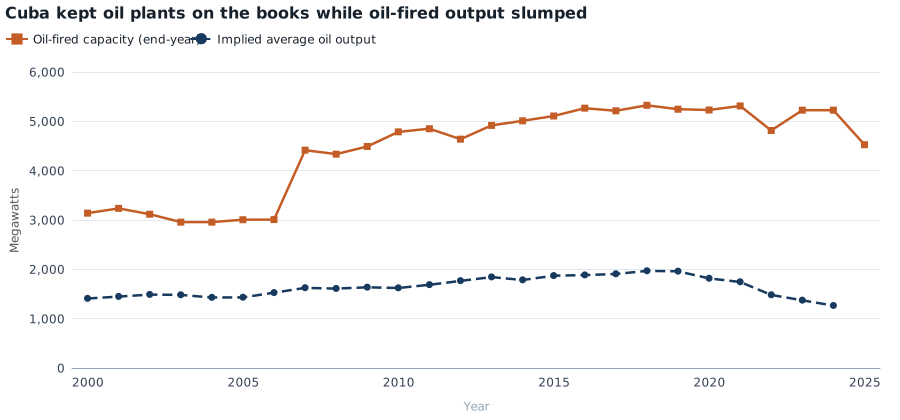
Cuba oil-fired electricity: end-year net generating capacity versus implied average output, megawatts, 2000–2025. Average output is annual oil generation divided by 8.76 gigawatt-hours per megawatt-year. 2025 generation is not in this snapshot (shown as a gap). 2024 generation is preliminary. Capacity is installed plant, not available plant. Source: IRENA IRENASTAT.
Gas plants, by contrast, still work. Cuba has recorded a flat 580 megawatts of natural-gas capacity every year since 2015. In 2024 those units generated 2,684 gigawatt-hours, a 52.8 percent capacity factor — more than double the oil fleet. Gas output had dipped to 1,580 gigawatt-hours in 2021 and then recovered. It is too small to replace oil. It is large enough to show that not every thermal plant on the island is failing in the same way.
| 2018 | 2024 | 2025 | |
|---|---|---|---|
| Total generation (GWh) | 20,952.15 | 14,509.95 | — |
| Oil generation (GWh) | 17,235.86 | 11,074.56 | — |
| Oil share of generation | 82.3% | 76.3% | — |
| Gas generation (GWh) | 2,637.20 | 2,684.10 | — |
| Renewable share of generation (IRENA) | 3.63% | 3.81% | — |
| Total capacity, end-year (MW) | 6,667.22 | 6,812.33 | 6,287.33 |
| Oil capacity, end-year (MW) | 5,325.12 | 5,226.40 | 4,526.40 |
| Implied average oil output (MW) | 1,968 | 1,264 | — |
| Oil capacity factor | 36.9% | 24.2% | — |
Generation is gross, including off-grid output and electricity used in energy industries. Capacity is end-year net generating capacity. Capacity factor uses 8,760 hours. 2024 generation is preliminary. Em dashes mark unpublished 2025 generation. Source: IRENA.
740 megawatts in a 6,800-megawatt fleet
The 740-megawatt available-capacity figure is a reported snapshot from Unión Eléctrica, not an IRENA observation. IRENA cannot confirm a 2026 unit fire, intra-day available plant, or that day’s demand. What the annual books can do is put 740 megawatts on a scale.
Cuba’s entire 2024 fleet averaged 1,656 megawatts of output from 6,812 megawatts of nameplate. The reported 740 megawatts is 10.9 percent of that 2024 nameplate and 44.7 percent of 2024’s already-reduced average output. In other words, the fire is being described as cutting available plant to less than half of what a bad recent year was already delivering, and to about a ninth of the capacity still listed as installed.
That is not proof that 5,000 megawatts of oil plant sat idle on the day of the fire. Annual capacity factors do not identify which units were broken, short of fuel, or derated. They do show that a 740-megawatt remainder is consistent with a fleet that had been running far below its paperwork for years. The acute outage arrived on top of a slow one.
IRENA’s 2025 capacity update, which predates the October 2026 fire, already records a 700-megawatt drop in oil-fired capacity, from 5,226 megawatts at end-2024 to 4,526 megawatts at end-2025. That is a round number in the annual stock, not a documented identification of the Ernesto Guevara unit, and 2025 generation has not been published here. It is further evidence that the oil fleet was shrinking on paper before this blackout — and that even the lower 2025 stock is several times the reported 740 megawatts available in October.
Renewables did not fill the hole
Cuba’s renewable share of generation was 6.87 percent in 2000 and 3.81 percent in 2024. Renewable output itself fell from 957 gigawatt-hours in 2021 to 553 gigawatt-hours in 2024. Installed renewable capacity rose, including to 1,091 megawatts by end-2025, but capacity without generation does not keep hospitals lit. Whatever the cause of the renewable drop — drought on hydro, missing bioenergy feedstock, or something else — it did not offset the oil collapse.
The IRENA record cannot say whether the oil shortfall is imported-fuel scarcity, deferred maintenance, or both. It cannot allocate 2024’s preliminary generation across months, and it cannot measure the 2026 fire. Gross generation also includes electricity that never reaches households. Those are real limits. They do not blur the central fact: Cuba entered this blackout as an oil-fired electricity system that had already lost nearly a third of its output while keeping most of the plants on the books.
A fire can take a unit offline in a night. It cannot, by itself, explain why thousands of megawatts of oil-fired capacity had been producing like a much smaller grid for six years.
Sources and methods
This is retrospective research completed on 18 October 2026, after the 17 October 2026 reporting. It uses the pinned IRENA IRENASTAT snapshot available at research time, not an as-of reconstruction of what was knowable that day. Generation covers calendar years 2000–2024; IRENA notes that 2024 electricity generation is preliminary and not accurate at aggregate levels. Capacity covers 2000–2025 as end-year net generating capacity of plant installed and connected.
Total generation is the sum of IRENA’s Total Non-Renewable and Total Renewable electricity-generation series, which match IRENA’s renewable-share series. Oil and gas figures are technology slices, not added to that total. Average megawatts equal annual gigawatt-hours divided by 8.76; leap days are ignored, and end-year capacity is not a period-average stock. Empty IRENA series for Cuban coal and the “fossil fuels” aggregate were not treated as zeros.
The 740 MW / 2,900 MW available-capacity comparison is reported by Infobae from Unión Eléctrica and is not verified in IRENA. Official statistics: IRENASTAT country electricity table.
Research Date
The displayed date matches the related news edition. Research was completed 2026-10-18.
Related news: Daily · 2026-10-17
More Research
America’s Hosting-And-Search Industry Is Already 2 Percent Of GDP. That Is Not A Map Of Data Center Alley.
BEA accounts show data processing, hosting and internet search already at 1.9 percent of U.S. GDP and about a ninth of 2025 real growth, with value added concentrated in California and Washi
Half The World's Solar Capacity Now Sits In China
China generated 40 percent of the world's solar electricity in 2024 and hosted half of installed solar capacity by the end of 2025, a share that has been rising since 2015.
America’s Auto Plants Are Producing More. Michigan’s Factories Are Not Hiring.
US motor-vehicle manufacturing output is 36 percent above 2019. Auto-state factory jobs are mixed: Michigan is down, Texas and the South are not.