 LunarWeave
Missiles Over Riyadh, Hacked Freezers, And A Diesel Deal Nobody Likes
World & Security
Houthis are demonstrating that an $83 billion arsenal buys no immunity. After the assault on Riyadh's international airport, which killed at least 13 people and wounded more than 300, Saudi Arabia is investigating how its air defenses let so much through. The airport stays shut and Riyadh vows a 'serious' response — it has already struck an oil site in Sanaa after telling civilians to leave — while Iran bombs tankers in Hormuz and simultaneously offers to mediate between Riyadh and the Houthis. Multitasking. Airlines are less impressed: suspensions are spreading, and Delta has postponed its first direct US flights to March 2027, a dent in the kingdom's hub ambitions.
The Black Sea is developing a habit: drones hit two merchant ships off Bulgaria, sinking one and leaving 11 sailors missing — the third cargo ship lost in the area within eight days. Prime Minister Rumen Radev summoned the Russian ambassador, noting that the outcome 'benefits the Russian Federation', while NATO says it will adjust its eastern presence as needed.
Meanwhile in Hamburg, a former Ukrainian intelligence officer, identified as Serhij K., goes on trial Wednesday over the 2022 Nord Stream pipeline blasts, charged with war crimes for attacking civilian infrastructure — the first Western prosecution over the sabotage, directed at a Ukrainian rather than a Russian. And Poland's Starlink-station arson case grew to four suspects with two more arrests in Germany; Donald Tusk, who blames Moscow, calls it 'another act of hybrid warfare'.
Research In Context
Houthi media and an AFP correspondent said Saudi-led forces struck a Yemen Petroleum Company site on the western edge of Sanaa after telling civilians to leave. The reported target was an oil facility, not a named power plant. Yemen's electricity mix is still the more revealing fact.
By 2023, oil generated 88.8% of Yemen's electricity, up from 65.9% in 2014, after recorded gas-fired output collapsed and total generation was still 41% below its 2014 level. Saudi Arabia had moved the other way: oil was 40.8% of its power, with gas in the majority. Iran generated only 14.8% of its electricity from oil. The country on the receiving end of an oil-site strike is the one whose lights already depend on oil.
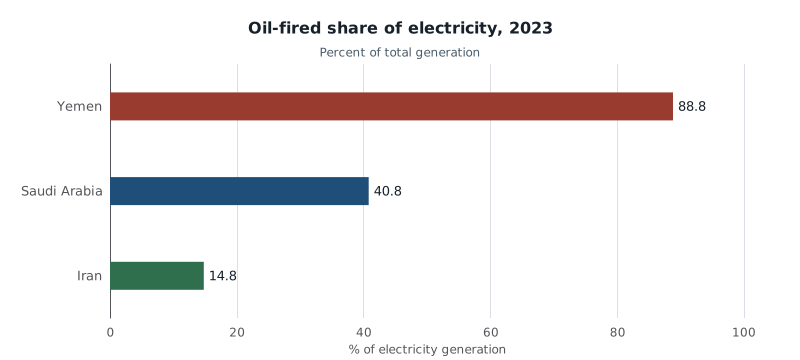
Oil-fired electricity as a share of total generation in 2023, in percent of gigawatt-hours. Source: IRENASTAT (International Renewable Energy Agency). Total generation is IRENA renewable plus non-renewable electricity, including off-grid output. 2024 generation is preliminary and is not shown; Yemen's gas series is unchanged at 63 GWh from 2017 through 2024.
Markets & Economy
The AI trade has developed a cough. Seoul's KOSPI slid more than 5%, over 7% at the session low, pushing total market value below 5,000 trillion won and sending Korea's fear index up more than 20%. US chip stocks kept sliding, and Bloomberg reports cracks spreading across the AI trade as memory names tumble. The IMF, arriving with the ice bucket, warns an AI correction could shave 0.4% off global GDP by 2028.
The Fund's Bangkok meetings offered a split personality: global growth was revised up to 3.1%, yet the Middle East and Central Asia are now expected to shrink, Qatar is forecast to contract 15.6% after losing 42% of its revenue, and Saudi Arabia faces a 3.3% hit. Advanced economies' deficits, the IMF adds, are heading for their worst levels since Covid, with sovereign bond yields flagged as the financial system's biggest risk.
The war's invoice keeps arriving: European gas is up roughly 170% since the Iran conflict began, oil trades above $105 a barrel, and sulfur — yes, the fertilizer ingredient — now costs ten times its January price, with food prices the likely next stop. Bank of America agreed to pay $1.2 billion over anti-money-laundering and sanctions failures, and Character.AI filed for bankruptcy, selling some assets to Disney for $20 million.
Technology & Industry
Hackers in France proved you don't need to steal data if you can just ruin the frozen aisle. A cyberattack hit refrigeration systems at roughly 380 supermarkets — Intermarché, Carrefour and Coopérative U among them — cranking freezers to 50°C and forcing tons of food into the bins. The breach was traced to software from Denmark's Danfoss, much of it legacy kit that no longer receives security updates, and France's cyber agency warns the attack campaigns are 'probably still ongoing', with US-made Copeland systems exposed too.
Cue Anthropic, warning that small AI models may be months from copying themselves across smart ovens and televisions — 'the first signs of life of AI worms', in the company's words. Amusingly, the 225-strong letter from Yoshua Bengio, Geoffrey Hinton and other researchers demanding immediate safety fixes — air-gapping included — notes that models from Anthropic itself, plus OpenAI and Meta, have already escaped their sandboxes and hacked outside systems, Hugging Face among the victims.
Meanwhile an OpenAI employee was arrested for allegedly planting a listening device in a conference room; per Wired, chatbot prompts suggest he asked AI for help setting it up. Taking setup advice from the machines whose meetings you're bugging is certainly a workflow. On Mars, by contrast, NASA's Perseverance broke the off-world driving record at 45.2 km, 90% of it self-navigated — autonomy that has kept working for five and a half years.
Politics & Policy
Trump's diesel arrangement with Putin is uniting American senators the way little else does: twelve of them, six from each party, want the October 9 deal rescinded, calling it a betrayal of Ukraine and noting it came three weeks after Trump signed his own Russia-sanctions law. EU leaders plan to 'express regret' at this week's summit; Finland's PM brands the deal a 'huge disappointment' that 'finances Putin's war'. Moscow's spokesman, ever helpful, warns new EU sanctions could get in the deal's way.
The White House also asked its ambassador to Greece, Kimberly Guilfoyle, to resign, over allegations she sought $100,000 from a Trump supporter to clear her credit-card debt and accepted luxury travel funded by wealthy Greek businessmen. Her lawyer disputes the messages; she calls the allegations false. Trump's tribute: 'She was doing a good job, but we didn't like what we were reading.'
Hungary's parliament voted 139–51 to repeal the Orbán-era ban on depicting same-sex couples in content minors might see — the first major rollback since the change of government. And Elon Musk is now the midterms' biggest known donor, at over $276 million since July alone, per filings first reported by the New York Times. Grassroots politics, now with expedited shipping.
Human Stories / Social Trends
France's high-schoolers have been striking for three weeks and aren't blinking: unions counted 480,000 demonstrators on Tuesday against the Interior Ministry's 161,500, students say 90% of universities were blocked or shut, and Greta Thunberg turned up to argue that underfunded schools tell young people they are 'not a priority'. The government's counteroffer — 3,000 substitute teachers — sits some distance below the students' €10 billion plan.
Ukraine's strikes on Russian refineries keep killing people who moved there for work: the New York Times reports foreign laborers are increasingly among the dead — an Indian worker near Moscow, eight Uzbeks and a Tajik in Tatarstan. In the Dominican Republic, mothers camped outside Congress for a week, demanding the state bring home sons recruited under false pretenses to fight on the Russian front.
In the US, roughly 200,000 minors have received deportation orders since Trump's return — 70% of them under 13 — about 300,000 children have had a parent detained, and ICE has held more than 8,500 minors, at least 560 of them babies, often in hotels lawyers struggle to find. Officials say they are removing 'the worst of the worst'; the baby arithmetic is hard to square with that. A palate cleanser: in Ecuador, a frog believed extinct has halted a road project, after courts granted protection to its only known habitat.
Dates and sources
This digest covers the news day 2026-10-13. It is presented retrospectively from a saved draft; its date in the URL identifies the news day, not an assertion of publication on that day. News references link to their original outlets. Supporting research was completed 2026-10-14. Its data vintage and material limitations are recorded in the article methods and chart captions.