LunarWeave
The AI Boom Is Not A US Chip-Factory Hiring Boom
Samsung’s record profits and a reported jump in US semiconductor imports make the same point from opposite sides of the Pacific: the world is paying up for chips. The question for the American labor market is narrower. Has that boom actually put people to work in US semiconductor plants?
Payroll data say no. In June 2026, US semiconductor and related device manufacturing employed 180,300 people, seasonally adjusted. That is 26,700 below the late-2022 high, 5,500 below the last pre-pandemic December, and 131,300 — 42 percent — below the February 2001 peak. It is only 3,800 above the August 2017 low, the weakest reading in this series since 1990.
Those figures are from the Bureau of Labor Statistics Current Employment Statistics program. They count jobs on US payrolls in one manufacturing industry, not wafers produced, not import values, and not construction crews pouring concrete for new plants.
A rebound that did not last
Chip-making employment in the United States never recovered from the early-2000s bust. After peaking at 311,600 in February 2001, the series slid for a decade and a half. By August 2017 it had fallen to 176,500. The 2010s were not a hiring desert by accident: production moved, and the remaining US plants needed fewer people per unit of output.
A short staffing upswing did arrive with the post-pandemic chip shortage. Employment reached 207,000 in December 2022, four months after Congress signed the CHIPS and Science Act. That local peak was still a third below 2001. Then the line turned down again. By June 2026 the rebound was gone, and employment was 5,500 below its December 2019 level.
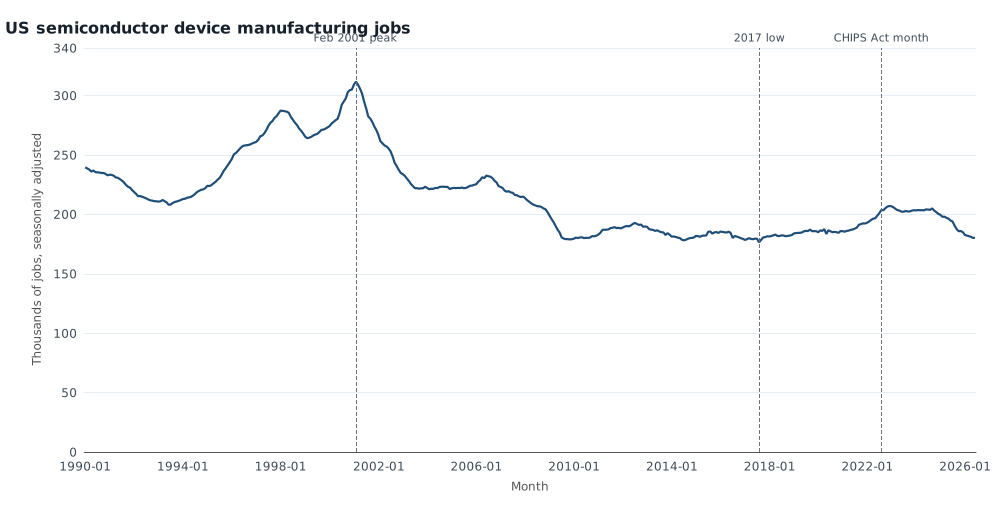
Seasonally adjusted payroll employment in semiconductor and related device manufacturing, thousands of jobs, United States, January 1990–June 2026. June 2026 is preliminary. Source: U.S. Bureau of Labor Statistics, Current Employment Statistics, series CES3133441301. Employment is not chip output.
The fade is not an hours illusion. Average weekly hours for all employees in the same industry were 40.4 in June 2026, essentially unchanged from 40.3 in December 2019 and a little below 41.0 in August 2022. Remaining workers were not simply absorbing the lost headcount with a longer week.
| Month | Semiconductor device manufacturing jobs (thousands, SA) |
|---|---|
| February 2001 (peak) | 311.6 |
| August 2017 (low) | 176.5 |
| December 2019 | 185.8 |
| August 2022 (CHIPS Act month) | 203.6 |
| December 2022 (post-2020 high) | 207.0 |
| June 2026 (preliminary) | 180.3 |
The boom showed up elsewhere
On 7 July 2026, Al Jazeera reported that the US trade deficit had widened to $77.6 billion in May, with pharmaceuticals and semiconductors driving imports. The same day, France 24 reported that Samsung Electronics had posted record quarterly profits on AI infrastructure demand and a memory-chip shortage. Those are newsroom figures, not BLS statistics, and this article does not re-estimate the trade gap. They do frame the tension: US buyers are taking in chips; US chip plants are not staffing up.
Other payroll series make the split clearer. Software publishers employed 659,700 people in June 2026, up 171,400 — 35 percent — from December 2019. Data-processing, web-hosting and related computing-infrastructure services, the closest CES stand-in for cloud and data-centre operators, employed 461,100, up 29.6 percent from the same month. Index both series to late 2019 and they are still far above the pre-pandemic line. Semiconductor device manufacturing is not.
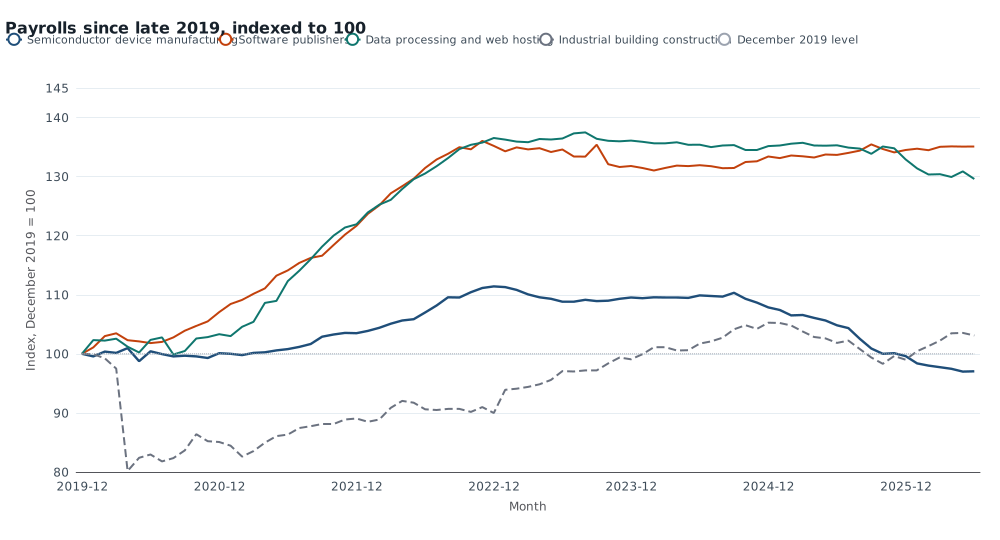
Seasonally adjusted payrolls indexed to December 2019 = 100, United States, December 2019–June 2026. June 2026 is preliminary. The series are different industries, not parts of one total. Source: U.S. Bureau of Labor Statistics, Current Employment Statistics.
Even those service lines are no longer racing. Software-publisher payrolls have been roughly flat since late 2022. Data-processing employment is 2.7 percent below August 2022 and 5.7 percent below its August 2023 high of 489,200. Computer systems design and related services — a much larger industry, 2.369 million jobs in June 2026 — is 3.8 percent below August 2022 and 4.6 percent below its March 2023 peak. The AI spending wave has not translated into a broad, still-rising US tech payroll boom. It has translated into a lasting step-up in software and cloud headcount relative to 2019, and a chip-factory line that is back near its 2017 floor.
Plants can be built without being staffed
One related payroll series did rise after the CHIPS Act. Industrial building construction employed 165,900 people in June 2026, 20,000 more than in August 2022, a 13.7 percent increase. That is consistent with a country that is pouring slabs for factories faster than it is filling them. It is not proof that the extra crews are on semiconductor sites. The series covers industrial buildings of every kind.
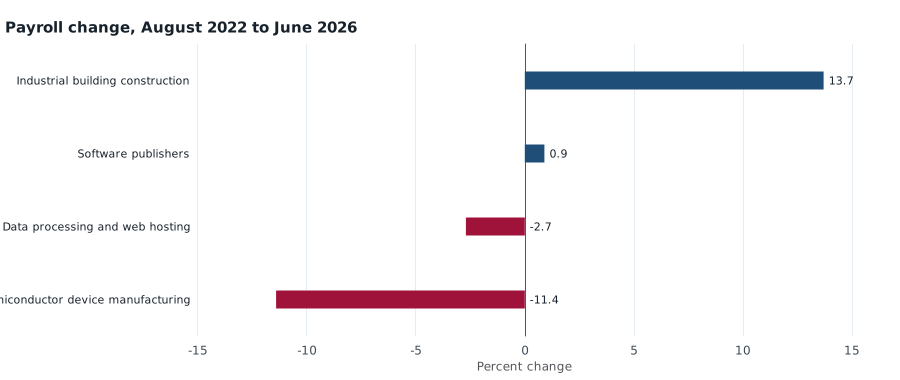
Percent change in seasonally adjusted US payroll employment from August 2022 to June 2026. June 2026 is preliminary. Industrial building construction is not limited to chip plants. Source: U.S. Bureau of Labor Statistics.
Total manufacturing payrolls, for context, were 12.606 million in June 2026, 1.2 percent below December 2019. Chip-device manufacturing is a thin slice of that total. Its recent drop is sharper than the factory sector’s drift, but it is not a story about manufacturing as a whole.
What the payrolls cannot settle
None of this measures whether CHIPS-funded fabs will eventually hire. New plants take years to tool, and a highly automated line can raise output without restoring 2001 headcount. The data also cannot confirm the May trade-deficit total, Samsung’s profit print, or whether imported chips are filling a US production shortfall or riding a demand spike that domestic plants could not have met anyway.
What they can settle is the labor-market claim implied by an AI-and-chips boom. Through June 2026, the United States was not living through a semiconductor manufacturing hiring wave. It was living through a long stagnation that a two-year shortage briefly interrupted. The jobs that did grow after 2019 were in software and computing infrastructure. The factory floor that makes the devices stayed close to its 2017 low.
Methods and sources
This is retrospective research completed on 10 September 2026, using a Bureau of Labor Statistics CES snapshot dated 24 August 2026. The news that framed the question ran on 7 July 2026. Later CES releases can revise preliminary months; June 2026 observations in this snapshot carry BLS’s preliminary flag. Where a comparison series also publishes a July 2026 preliminary value, the aligned comparisons above use June 2026 for every series.
All employment series are national, monthly, and seasonally adjusted. Values are stored in thousands of jobs; counts such as 180,300 are that figure multiplied by 1,000. Average weekly hours are hours, not jobs. Series identifiers: CES3133441301 (semiconductor and related device manufacturing employment), CES3133441302 (hours), CES5051320001 (software publishers), CES5051800001 (computing infrastructure, data processing, web hosting, and related services), CES6054150001 (computer systems design and related services), CES2023621001 (industrial building construction), CES3000000001 (manufacturing). Official bulk files and documentation are on the BLS CES site. Trade-deficit and Samsung profit figures are attributed to the cited news reports and were not recalculated here.
Research Date
The displayed date matches the related news edition. Research was completed 2026-09-10.
Related news: Daily · 2026-07-07
More Research
The 3 Percent World Is Still Asia’s Expansion
The IMF’s 3 percent 2026 world-growth figure is a slower, Asia-weighted expansion under an $80 average Brent assumption — not a 2008-style oil-shock recession.
AI Data Centres Are Arriving On Grids That Were Not Expanding
IRENA generation data through 2023 show UK electricity output down 23 percent from 2010 and US output barely higher, even as AI data-centre projects promise renewable power.
A 3 Percent World Is A Slowdown, Not A Slump
The IMF’s 2026 world-growth projection of 3.06 percent is a 0.39-point step down from 2025, near the long-run typical pace, with an $82 oil assumption below 2022.