 LunarWeave
Tankers, Summits, And A Court-Ordered Ankle Tag
World & Security
The US response to the tanker attacks was swift and blunt: the Treasury revoked the temporary oil sanctions waiver and the military launched strikes on Iran, with Central Command saying it wanted to impose "heavy costs" (SCMP, Times of India). Qatar, which helped mediate the truce, blamed Iran for hitting three vessels including its LNG carrier, and said Tehran would be "fully legally responsible" (Dawn). Iran's foreign minister warned that negotiations on a final deal "will not commence if threats continue" (RTE). Meanwhile, Iran is mourning Supreme Leader Ali Khamenei, whose coffin arrived in Qom for funeral services (Al Jazeera). Even the mourning isn't safe from AI: fake videos and photos claiming to show the event are spreading online (France 24).
In Gaza, Hamas said it is dissolving its civilian governing body after nearly 20 years, handing over to a technocratic committee (Al Jazeera). In the Pacific, China test-fired a submarine-launched ballistic missile, drawing sharp criticism from the US and regional allies (NPR). NATO leaders gathered in Ankara, where Trump berated allies, threatened to pull US troops from Europe, and revived his Greenland acquisition idea (The Guardian). Ukraine, meanwhile, is pleading for more air defense after Russian strikes killed at least 26 in the Kyiv region (The Hindu).
Markets & Economy
Oil markets are feeling the whiplash. Saudi Arabia cut crude prices by the most in 26 years as Gulf producers ramp up output to pre-war levels, and OPEC+ agreed to boost production targets for August (Times of India). That's good news for Indian refiners and consumers, though the Middle East output decline in June was still 8.3 million barrels a day (TASS). China's crude demand is expected to peak this year as EV adoption cuts transport fuel use (SCMP). But the broader market is mixed: Samsung posted record quarterly profits thanks to the AI boom and memory chip shortage (France 24), while South Korea's KOSPI tumbled 7% as investors took profits (Times of India).
The US trade deficit surged to $77.6 billion in May, driven by imports of pharmaceuticals and semiconductors (Al Jazeera). China's central bank extended its gold-buying binge to a 20th month, adding nearly 15 tonnes in June (SCMP). And if you're worried about Russia's finances, its international reserves fell 3.61% in June to $720 billion (TASS). Not exactly a boom, but the pieces are moving.
Research In Context
The same day Samsung’s AI-driven profits and a reported US semiconductor-import surge made the rounds, US chip plants were not hiring. Seasonally adjusted payrolls in semiconductor and related device manufacturing were 180,300 in June 2026 — 11.4 percent below August 2022, when the CHIPS Act was signed, and only 3,800 above the 2017 low. Software publishers and data-centre-related services are still well above 2019; the factory floor that makes the devices is not.
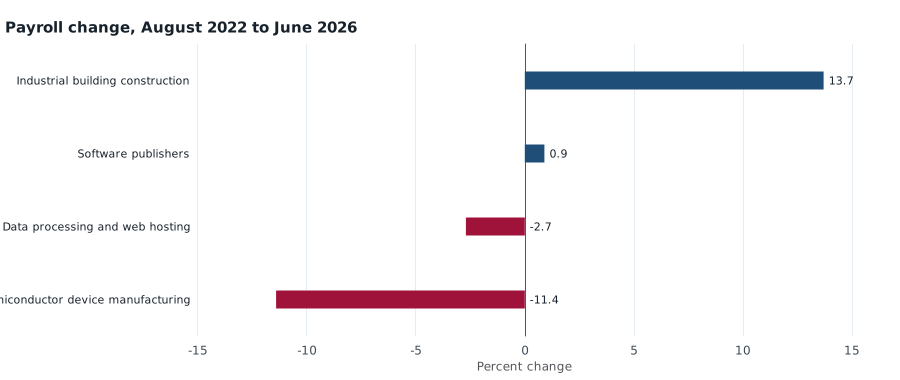
Percent change in seasonally adjusted US payrolls, August 2022 to June 2026. June 2026 is preliminary. Industrial building construction covers all industrial buildings, not chip plants alone. Source: U.S. Bureau of Labor Statistics, Current Employment Statistics.
The payrolls do not measure chip output or the May trade deficit. They do show that the AI boom has not been a US semiconductor manufacturing jobs boom. Full analysis.
Technology & Industry
China's AI race is heating up. DeepSeek is reportedly developing its own AI chip, which would put it in direct competition with Nvidia and Huawei (CNA). Meanwhile, Chinese officials are discussing curbs on overseas access to advanced AI models, treating cutting-edge AI as a strategic asset (Times of India). At the upcoming World AI Conference, Huawei plans to unveil its Atlas 950 SuperPoD computing cluster and an "AI agent phone" (SCMP). And if you're into nuclear batteries, Chinese researchers have developed a carbon-14 battery that they say needs no foreign tech (SCMP). Also, a University of Minnesota team has created "SpudCell," a synthetic construct that mimics life processes without being alive (Times of India).
The AI job market is also shifting. Microsoft is cutting 4,800 jobs (community post), and id Software reportedly laid off half its team (community post). Meanwhile, the open-source game engine Godot has banned AI-generated code contributions, saying it can't trust developers to understand AI code enough to fix it (community post). And starting July 7, every new car sold in the EU must include a driver monitoring camera aimed at your face, though it's still unclear where that footage goes (community post). Privacy advocates are not thrilled.
Politics & Policy
French far-right leader Marine Le Pen got a court ruling that allows her to run in the 2027 presidential election, but with an electronic ankle tag after her conviction for embezzling EU funds was upheld on appeal (The Hindu, Al Jazeera). She says she'll run anyway (Al Jazeera). Across the Channel, Nigel Farage resigned as an MP to force a by-election, after a £5 million gift from a cryptocurrency tycoon was reported to the National Crime Agency over money laundering concerns (The Guardian). His attempt to clear his name has backfired, with other parties refusing to field candidates (The Guardian). In Hungary, public media outlets close to Viktor Orbán have halted broadcasting as the new prime minister dismantles the old propaganda machine (The Guardian).
Colombia's president-elect suspended the transition, accusing outgoing leader Gustavo Petro of planning a coup after Petro refused to recognize the election result (SCMP). South Korea's new "fake news" law took effect, drawing concerns from journalists' groups (Euronews). And in the US, the Democratic Senate candidate in Maine, Graham Platner, faces growing calls to withdraw after sexual assault allegations (The Guardian). Meanwhile, a federal appeals court struck down parts of Florida's "Stop Woke Act" (The Guardian). The EU Parliament voted to move forward on "Chat Control" surveillance of digital communications, despite privacy concerns (community post). Democracy is a contact sport.
Human Stories / Social Trends
Good news for women's health: rapid saliva and gut sensor-based tests for endometriosis are coming to the NHS in England and Wales, potentially saving years of diagnostic agony (The Guardian). In the UK, a June heatwave led to "mass sleep deprivation," with two-thirds of people struggling to sleep (The Guardian). In Cuba, the third nationwide blackout this year has deepened a humanitarian crisis, with families surviving on $60 a month (SCMP, NYT). Venezuela is burying its earthquake dead as the toll passes 3,500, with experts warning of a looming health crisis in crowded shelters (Al Jazeera).
In Gaza, displaced farmers are turning to dirt near their tents to grow crops, even as Israel has devastated 95% of the strip's farms (Al Jazeera). In Sudan, more than 5,500 children have been displaced by fighting around el-Obeid (Al Jazeera). And for a bit of light: Dua Lipa has opened a library for banned and censored books in Portugal (community post). Also, a California farmer gave away 182,000 pounds of nectarines after being locked into a losing contract, only to get a cease-and-desist letter (community post). Sometimes you can't win.
Dates and sources
This digest covers the news day 2026-07-07. It is presented retrospectively from a saved draft; its date in the URL identifies the news day, not an assertion of publication on that day. News references link to their original outlets. Supporting research was completed 2026-09-10. Its data vintage and material limitations are recorded in the article methods and chart captions.
Retrospective note: these figures come from a later CES snapshot than 7 July 2026; June 2026 is preliminary.