 LunarWeave
Ceasefires That Aren't, Summits That Are, And Everything Overheating
World & Security
The U.S.-Iran truce fell apart in the Strait of Hormuz. After Iranian attacks on three commercial vessels transiting the strait, the U.S. military said it hit more than 80 targets, including more than 60 small boats of the Revolutionary Guards, plus air defenses and drone sites. Iran answered by targeting U.S. military sites in Bahrain and Kuwait, and President Trump declared the ceasefire “over” from the NATO summit, adding he didn’t want to deal with Tehran anymore. NATO chief Mark Rutte called the new U.S. strikes “absolutely necessary” — helpful clarity, if you like your diplomacy pre-chewed.
Ukraine got more promises and more incoming fire. Russian strikes overnight killed at least two, with another round reported as at least seven killed as NATO leaders met in Turkey and three killed across Ukraine with Kyiv hit for a second night. Trump told Zelensky the U.S. will give Ukraine a licence to manufacture Patriot systems, pitched as the only tool in Kyiv’s arsenal that can shoot down Russian ballistic missiles, though even supporters admit it could take several years to set up manufacturing. NATO, meanwhile, pledged €70 billion in military assistance to Ukraine for 2026. On the drone front, Russia is installing powerful jammers to disrupt Starlink, which Ukraine uses to fly cheap “mid-strike” drones dozens of kilometres behind front lines.
Elsewhere the temperature is military, not just meteorological. China launched a ballistic missile from a nuclear-powered submarine, its first known such test since 1982, then got a U.S. scolding for giving only hours’ notice. Beijing also radioed cargo ships passing Taiwan during coast guard patrols off Taiwan’s east. In Iraq, Khamenei’s coffin moved through Najaf to the shrine of Imam Ali as hundreds of thousands attended commemorations in Najaf and Karbala. And Gaza and Sudan grind on: Israeli air strikes in Gaza killed eight, including two children, while El-Obeid has been under “siege-like conditions” for 18 months and drone strikes on civilian vehicles killed at least 20 in Sudan.
Markets & Economy
Oil traders got whiplash and stocks got the bill. Brent rose above $76 for the first time in two weeks, then jumped more than 5% to crest $80 and rose by 5% to more than $78, its sharpest rise in nearly two months after the Hormuz attacks and revoked Iran oil waiver left more than 60 million barrels stranded at sea. The U.S. response was textbook risk-off: the Dow fell 1.09%, or 500 points, the S&P saw a small loss while Nasdaq rose slightly, with the FTSE down 1% and Nikkei down 2.1%. In India, Sensex and Nifty tanked 2% after Trump called the interim Iran agreement “over”, and travel stocks plunged as United fell 3% while energy stocks gained. Nothing calms markets like a ceasefire obituary.
The IMF tried to look through the smoke and squinted. It now expects the global economy to expand by just 3% in 2026, down from 3.5% last year and 3.1% forecast in April, blaming the Iran energy shock partly offset by AI investment, while global trade is forecast at 3.5% in 2026 and 4.3% in 2027 and global inflation is seen pausing its decline at 4.7%. Britain got a backhanded compliment: GDP growth of 1% this year, up 0.2 points, third-fastest in the G7, though the update was finalised before the latest flare-up. China’s investors read the room differently, pulling a record $2.91 billion from domestic gold ETFs in June to chase equities. And German autos issued the day’s grimmest memo: Volkswagen preparing to propose up to 100,000 job losses unless “bold decisions” answer China. At least memory pays: Samsung posted record quarterly operating profit of 89.4 trillion won, passing Nvidia.
Research In Context
After tanker attacks in the Strait of Hormuz and a fresh round of U.S.–Iran strikes, Brent jumped more than 5 percent and crested $80. The IMF’s same-day line — world growth of just 3 percent in 2026 — sounded like an energy-shock recession.
In a later WEO vintage it is not. PPP-weighted world growth is 3.1 percent (2.6 percent at market rates) under an $80 annual-average Brent assumption: about $12 above 2025 and $19 below 2022. China and India still account for close to half of that headline. Trade volume, not GDP, takes the larger hit.
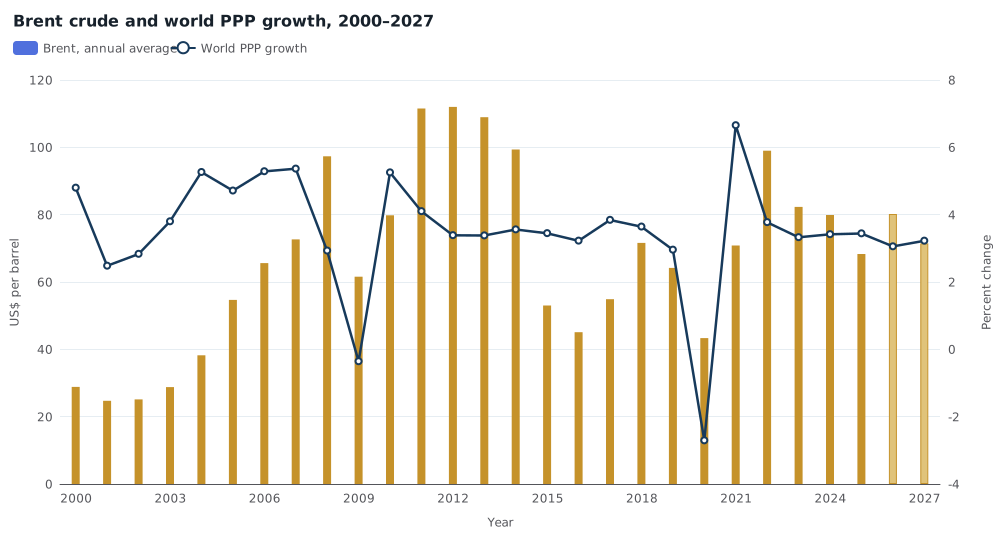
IMF annual-average Brent, U.S. dollars per barrel (bars, left), and world real GDP growth, PPP-weighted percent change (line, right), 2000–2027. Paler bars from 2026 are projections in an August 2026 WEO snapshot — retrospective relative to 8 July 2026, not as-of that day. Source: IMF World Economic Outlook, POILBRE and NGDP_RPCH. A one-day $80 print is not an $80 year.
Technology & Industry
AI geopolitics is now just geopolitics with servers. Beijing’s vulnerability database warned Claude Code contains a “security backdoor” that could transmit locations and identifiers without consent, covering versions 2.1.91 to 2.1.196 and urging uninstall or upgrade. Anthropic’s reply, in essence: users in China weren’t supposed to be using it anyway. Washington is tightening its own leash, with OpenAI to launch GPT-5.6 on Thursday after a U.S. government-requested delay over misuse fears, following extra testing under a frontier-AI review framework. China’s answer is self-reliance as performance art: Xi called for an innovation overhaul and talent push while awarding top science prizes to battery pioneer Chen Liquan and radar expert Ben De, as DeepSeek develops its own inference chips to cut Nvidia dependence.
Big Tech had a week of expensive oopsies. Apple lost its challenge to EU rules designating its App Store and iOS as gatekeepers, which can fine up to 10% of global turnover — Brussels’ polite way of saying play nice. Apple also signed a five-year, $30 billion-plus deal with Broadcom for more than 15 billion U.S.-made chips. Microsoft’s Xbox is cutting about 3,200 jobs, collapsing 14 management layers to five, while shifting prompts to in-house models to cut OpenAI and Anthropic costs. Neighbors are unimpressed: Microsoft’s $7.3 billion Wisconsin AI data centre was sued over nonstop generator and HVAC noise, and a Meta contractor in Wyoming flushed bacteria-contaminated water into public sewers, triggering tighter wastewater rules. Add a nearly five-hour Telstra outage that halted trains, traffic lights and Eftpos payments and a Tesla filmed asleep at 100 km/h with kids aboard after sunglasses fooled eye-tracking, and the future feels beta-tested on us.
Politics & Policy
The NATO summit in Ankara was unity with heckling. Trump demanded the U.S. cut trade ties with Spain, calling Madrid a “terrible partner” over defense spending and Iran support, then threatened to halt all trade with Spain — Madrid calmly insisted there is “no tension” and the relationship remains “positive”. He also renewed his demand for U.S. control of Greenland as vital for global security, prompting Denmark’s prime minister to answer “we will defend the kingdom of Denmark”. Leaders still restated collective-defense commitments and support for Ukraine and left with more than $50 billion in procurement deals, while informally agreeing not to mention the World Cup to avoid irritating Trump. Alliance management via babysitting.
On Syria, Trump formally began removing Damascus from the state sponsors of terrorism list, notifying Congress, leaving only Iran, North Korea and Cuba on the blacklist and meeting Ahmed al-Sharaa on the sidelines. In France, Marine Le Pen announced she will run in 2027 after an appeals court shortened her office ban even as it upheld her EU-funds embezzlement conviction, then kicked off her campaign to cheers and boos — mentorship drama with Jordan Bardella included. In Hungary, public broadcasts went to a black screen apology as Peter Magyar began dismantling Orbán’s media machine.
Britain’s sleaze watch is working overtime. Farage’s £5m gift from crypto tycoon Christopher Harborne was reported to the National Crime Agency over possible laundering, with more Reform-linked loans and donations worth millions also flagged; the Bank of England governor says he is “able to spot” lobbying after Farage pressure over crypto policy. Across the Atlantic, Trump said he would ask the Supreme Court to rehear his birthright-citizenship loss, while the Justice Department sent letters to all 50 states threatening criminal charges if noncitizens vote — which state officials called bizarre. Democracy: now with extra paperwork.
Human Stories / Social Trends
Heat is rewriting summer routines. Spain handed out 1,400 heat-monitoring wristbands in Barcelona that beep before heatstroke hits, while Madrid roof crews start at 7am and “have to stop at 1pm come what may” past 38C. In Bordeaux, the thermometer hit 40C and new eco-flats turned into ovens — sustainability, minus the livability patch. Unions want workplace temperature limits and heat-break rights, citing about 230 heat-linked workplace deaths a year, and UK waters are in an “extreme” marine heatwave threatening “mass mortality” for species. China got the violent version: 17 killed, over 130,000 evacuated, a burst reservoir dam in Guangxi, 40 rivers overflowing, plus 800 to 900 snakes escaped after a breeding farm washed away and a landslide in Gansu killed five with 12 missing.
Justice stories ranged from belated to bizarre. A Berlin court sentenced a 41-year-old palliative-care doctor to life for murdering 15 patients — 12 women and three men — during home visits from 2021-2024, with dozens more killings still under investigation. Utah revoked the licence of Provo Canyon School, where Hilton said the facility “failed the children,” citing neglect and unnecessary restraints. British Columbia said it is preparing a lawsuit against OpenAI for failing to report violent ChatGPT activity by the Tumbler Ridge shooter, banned in June 2025 months before the 18-year-old killed eight. And in Arizona, a toddler declared dead after a pool incident was actually alive for hours in the hospital “cold room,” with officers seeing signs of life multiple times.
Everyday risks got less everyday. Australian researchers found 90% of tested craft sand samples released airborne asbestos when played with, contradicting “low risk” assurances. In Texas, Lorenzo Salgado Araujo was fatally shot by an immigration agent on his way to work, with his family learning of it from news reports and demanding an independent probe. In Gaza, mothers describe a third wartime summer where children carry adult burdens, deprived of play and art. And Britain is arguing with itself: two in five Britons think Muslims cannot integrate, while 85% of Muslims favour integration — a perception gap you could drive a double-decker through.
Dates and sources
This digest covers the news day 2026-07-08. It is presented retrospectively from a saved draft; its date in the URL identifies the news day, not an assertion of publication on that day. News references link to their original outlets. Supporting research was completed 2026-09-10. Its data vintage and material limitations are recorded in the article methods and chart captions.