 LunarWeave
The Ceasefire's Over, The Heat's On, And Turkey Gave Everyone A Gun
World & Security
The biggest story: Trump declared the US-Iran ceasefire dead, and both sides immediately proved him right. The US struck approximately 90 Iranian military targets along the coast over two consecutive nights — air defenses, missile storage, naval capabilities, and logistics infrastructure from the Strait of Hormuz to the Gulf of Oman as France 24 reported. Iran fired back with missiles and drones at US bases in Kuwait and Bahrain, with Jordan intercepting Iranian missiles passing through its airspace. Tehran's health ministry reported 14 killed and 78 injured over two days of US strikes, while Iran's chief negotiator warned the Strait of Hormuz would only reopen "under Iranian arrangements" per TASS. Ship traffic through the strait has fallen to a near standstill, even as Trump mused it would all be "over very quickly."
Iran buried slain Supreme Leader Ali Khamenei in Mashhad after mass funeral processions spanning multiple cities, while his son and successor Mojtaba Khamenei has yet to make a single public appearance — a quiet start for the world's newest theocratic heir. At NATO's Turkey summit, the alliance agreed to let Germany buy Tomahawk cruise missiles and Trump granted Ukraine a licence to manufacture Patriot missiles. The president also confused Iran with Japan, referencing "the Islamic Republic of Japan" firing missiles — a gaffe almost reassuring given everything else happening. And just when diplomatic gifting seemed safe, Erdogan handed every NATO leader an engraved revolver with live ammunition.
Markets & Economy
Oil had a week it would rather forget. Brent crude surged past $80 a barrel after Trump declared the ceasefire dead according to Times of India, before stabilizing as he left the door open to talks. The IMF promptly cut its 2026 global growth forecast to 3%, citing Middle East conflict fallout — with AI demand partially offsetting the energy shock, because there's always a silver lining for Silicon Valley.
In Germany, Volkswagen workers protested across 18 sites against plans to cut up to 100,000 jobs, the union warning the CEO he "cannot pass the buck for failures of recent years onto the workforce." San Francisco's median home price hit a record $1.7 million, fueled by wealthy AI workers — one way to measure a boom. India's IT sector faces roughly 35,000 job cuts as AI reshapes the industry, while Indonesia's Tokopedia denied mass layoffs even as its deeper integration into ByteDance's ecosystem raised alarms. In a small bright spot, Pakistan's workers' remittances hit a record $41.6 billion — though whether that's good news or evidence of how desperately families need overseas income depends on your perspective.
Research In Context
After U.S.–Iran strikes pushed Hormuz traffic toward a standstill and oil back toward $80, the IMF’s 3 percent world-growth figure for 2026 sounded like a rupture. In the Fund’s own ledger it is a 0.39-point step down from 3.44 percent in 2025 — near the 1980–2024 median of 3.4 percent, not a repeat of 2009 or 2020. The oil price sitting under that forecast is $82 a barrel, a reversal of 2025’s $68, not a new peak: 2023–24 already averaged about $80, and 2022 averaged $96.
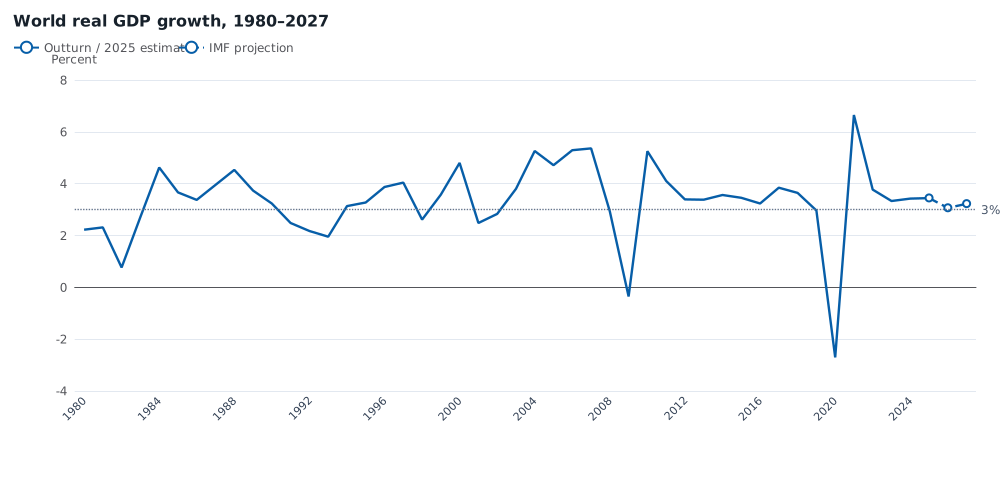
World real GDP growth, percent, PPP-weighted, 1980–2027. Solid line: outturns through 2024 and the 2025 estimate; dashed: IMF projections. Dotted line marks 3 percent. Source: IMF World Economic Outlook. 2026 is a forecast, not an outturn; a prolonged Hormuz closure would invalidate the oil assumption behind it.
Technology & Industry
OpenAI released ChatGPT 5.6 after delaying the rollout at the White House's request over cybersecurity concerns — nothing says "trust our AI safety" like needing federal permission to ship. Meanwhile, China warned of a backdoor in Anthropic's Claude Code, and Salesforce is promoting Anthropic's Claude Tag inside Slack — the platform it bought for $27.7 billion — leaving employees confused about why their company is advertising a competitor that could make Slack itself redundant.
Chinese AI labs are building their own chips to cut long-term costs, though the upfront investment is enormous. A Stanford team released Biomni, a biomedical AI agent that works alongside scientists on complex research, open-sourced for biologists who don't code. In China, experts declared a "token economy" is emerging where AI tokens evolve from technical metric into service pricing. The EU Parliament quietly greenlit Chat Control 1.0 — letting US tech companies scan private messages without suspicion until 2028, despite more MEPs voting against than for. A procedural trick before summer break that civil rights advocates called a "black day." Democracy dies in the procedural loophole.
Politics & Policy
Trump will remove Syria from the US state sponsors of terrorism list, coinciding with the OPCW reinstating Syria's voting rights citing "a change in circumstances." The main circumstance, presumably, being that Assad is gone. In Palestine, Abbas scheduled legislative elections for November 28 — the first in twenty years — though as Deutsche Welle noted, questions remain about whether the Authority can actually hold them after canceling a similar vote in 2021.
In US politics, Maine Democrat Graham Platner suspended his Senate campaign following a sexual assault allegation, scuppering what was supposed to flip Susan Collins' seat. Trump said he'd ask the Supreme Court to reconsider birthright citizenship based on Fox News billboards advertising hospital deliveries in Mexico — a slender constitutional argument. Chemical accidents in the US are up 51% since 2021 as the administration rolls back protections, and Labour's Andy Burnham apologized for his party's Gaza response, signaling a significant policy shift. King's College London disciplined at least 26 pro-Palestine students in two years — a crackdown at a university with defence industry ties, which is almost too on-the-nose.
Human Stories / Social Trends
Europe is sweltering, and the numbers are grim. Germany recorded over 5,100 heat deaths in June, while Western Europe experienced its hottest June on record — temperatures running more than 3°C above average. The UK entered its third heatwave of the year, with estimates suggesting June's continental death toll could surpass 20,000. And it's about to get worse: forecasters say there's an 81% chance of a "very strong" El Niño developing this year that would rank among the largest ever recorded.
At Wimbledon, Turkish tennis player Zeynep Sonmez sparked debate by attaching a watermelon accessory to her racket — a Palestinian solidarity symbol — after officials banned her brooch. She pointedly questioned why Ukraine support is permitted but Palestinian symbols aren't. An LGBTQ+ cruise ship was turned away by both Turkey and Egypt, with 2,000 passengers including Patti LuPone waking to find they needed new ports. Science delivered sobering findings: nanoplastics were found in Antarctic soil for the first time, and researchers warned deep-sea mining threatens mollusks around hydrothermal vents — species that survived crushing depths and boiling temperatures only to face extinction from humans wanting their minerals. And a Chinese wife woke her husband from a years-long vegetative state by biting his toes, proving once again that love works in mysterious and occasionally painful ways.
Dates and sources
This digest covers the news day 2026-07-09. It is presented retrospectively from a saved draft; its date in the URL identifies the news day, not an assertion of publication on that day. News references link to their original outlets. Supporting research was completed 2026-09-10. Its data vintage and material limitations are recorded in the article methods and chart captions.