 LunarWeave
Ceasefires, Chips, And Chaotic Policies
World & Security
Iran buried its former supreme leader Ali Khamenei, but the ceremony was overshadowed by renewed fighting with the US, casting doubt on the fragile ceasefire. As huge crowds gathered in Mashhad, fresh US strikes and Iranian retaliation raised fears of all-out war, with Trump declaring the truce 'over' while still agreeing to talks. The Strait of Hormuz, a critical oil chokepoint, saw shipping grind to a halt as both sides traded fire, a stark reminder that geopolitical spats can quickly disrupt global flows.
North Korea vowed to boost its nuclear buildup and expand military intelligence operations against South Korea, a predictable move from Pyongyang that adds another layer of tension to an already fraught region. Meanwhile, China accused the US of ignoring Trump-Xi rapport while blacklisting Chinese firms, and launched a rare long-range missile test into the Pacific—a signal that nuclear posturing isn't confined to one hemisphere.
Natural disasters didn't pause for diplomacy. In Spain, a wildfire killed at least 12 people, with some victims found in vehicles after roads turned into 'death traps'—a grim outcome when evacuation plans meet reality. Over in the Philippines, Typhoon Bavi caused landslides killing 15, while Venezuela faced looming health threats in earthquake shelters. It's almost as if climate-related chaos is the new normal, and we're all just scrambling to adapt.
Markets & Economy
The Iran-US conflict sent shockwaves through energy markets, with Strait of Hormuz traffic disrupted and Brent crude prices holding steady despite the chaos. This isn't just a regional spat; it's a reminder of how fragile global oil supplies are when geopolitics get messy. Meanwhile, Pakistan called on Iran to avoid jeopardizing peace gains, underscoring the economic ripple effects for countries reliant on stable energy flows.
China imposed a temporary helium export ban, citing supply strains and military tensions—a move that could pinch global chip manufacturing, as helium is crucial for semiconductor production. It's a strategic play in the tech cold war, where rare gases become bargaining chips. Over in South Korea, SK hynix raised $26.5 billion in a blockbuster US IPO, capitalizing on the AI boom and showing that investor appetite for high-tech hardware remains insatiable.
Trump's trade policies continued to cause headaches, with tariff walls built on 'Liberation Day' now potentially boxing in the US economy. The World Bank approved $375.9 million for Pakistan's power grid, aiming to modernize infrastructure and boost renewables, but such projects often face bureaucratic delays. In Africa, governments are reassessing World Bank and IMF loan trade-offs as debt pressures mount, highlighting the fine print in international aid.
Technology & Industry
The EU threatened Meta with hefty fines for 'addictive design' features on Instagram and Facebook, accusing the company of failing to protect users—especially minors. It's a classic case of regulators playing catch-up with tech giants, where infinite scroll and autoplay are deemed too catchy. Meta, naturally, rejects the claims, but with fines up to 6% of global revenue at stake, even Zuckerberg might pause the dopamine taps.
In a twist, Apple sued OpenAI for stealing trade secrets, alleging it orchestrated a campaign to poach employees and extract confidential info to build its own hardware. The lawsuit paints a picture of aggressive corporate espionage, which is ironic given OpenAI's own history with data usage. This spat could reshape how AI companies collaborate or compete, especially when hardware dreams meet software realities.
China successfully landed a reusable rocket for the first time, using a sea-based net system—joining SpaceX and Blue Origin in the race to slash launch costs. The Long March 10B test is a milestone for China's space ambitions, though it still has a way to go to match SpaceX's frequent reusability. Elsewhere, humanoid robots performed live surgery, using a Chinese-made Unitree robot to remove a pig's gallbladder, blending sci-fi with real-world medicine. Progress, or just a party trick? Time will tell.
Politics & Policy
Trump fired the last three members of the Election Assistance Commission, paralyzing the agency months before midterm elections—accused by critics of trying to 'rig' the process. It's a bold move when election oversight is already on thin ice. On the energy front, the administration spent billions to kill wind power and boost coal, which critics say forces higher bills on working Americans while fattening cronies' wallets. Hypocrisy, thy name is policy.
A UK judge ruled that the home secretary unlawfully cut trafficking protections to enable the 'one in one out' asylum deal with France—a decision that highlights the messy intersection of human rights and political expediency. The deal was supposed to streamline returns, but courts found it trampled on safeguards. It's a reminder that quick fixes in immigration often come with legal bruises.
Internationally, Pakistan's PM called on Iran and other parties to exercise restraint, positioning Islamabad as a mediator in the Middle East conflict. Meanwhile, Israeli intelligence warned the US of an alleged Iranian assassination plot against Trump, adding a layer of intrigue to an already volatile situation. In Bangladesh, ex-PM Hasina plans a December return despite a death sentence, setting up a legal clash that could jolt the country's fragile politics.
Research In Context
The administration’s reported push to cancel wind projects and keep coal running is aimed at a grid that has already demoted coal. IRENA on-grid capacity shows US solar passing coal in 2024 (178 GW versus 176 GW) and reaching 212 GW in 2025, with wind at 159 GW beside 171 GW of remaining coal. Almost all of that wind is onshore; offshore wind was 171 MW. Generation through 2023 still has coal ahead of wind and solar in terawatt-hours — 742 against 426 and 214 — because coal plants run more hours, while gas, not coal, is now the largest source at 42% of output. US coal-mining jobs were 38,300 in July 2026, against 178,300 at the 1985 peak in the BLS payroll series. This does not measure 2026 bills.
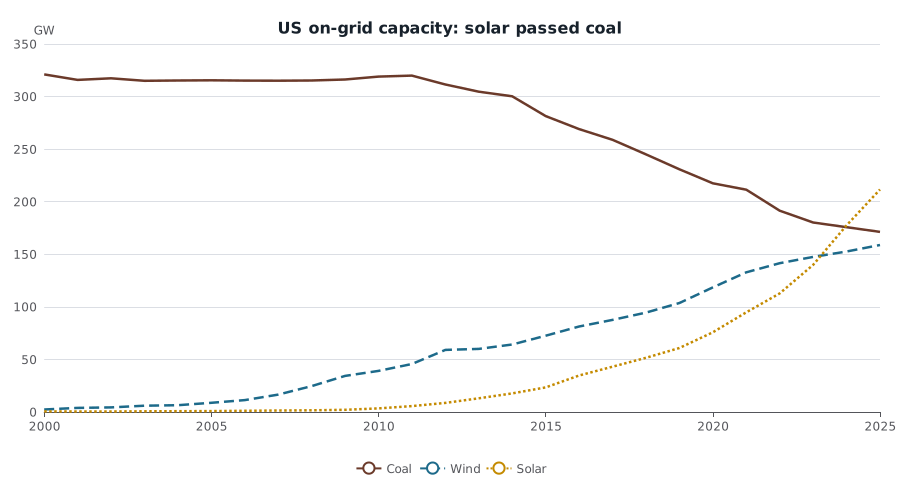
On-grid electricity capacity in the United States, gigawatts, 2000–2025. IRENA annual figures. Solar overtook coal in 2024. Capacity is not generation: coal still produced more electricity than wind or solar in 2023. Gas capacity (514 GW in 2025) is omitted for readability.
Further reading: Solar has already passed US coal on the grid
Human Stories / Social Trends
In Houston, ICE agents fatally shot Lorenzo Salgado Araujo, a Mexican immigrant who lived in the US for 35 years, during a traffic stop—later admitted by DHS that he was not the intended target. The incident sparked outrage, with Mexico seeking criminal charges, and raises questions about accountability in immigration enforcement. It's a stark example of how policy enforcement can go tragically off-script.
The UK Treasury faced scrutiny after a young worker's suicide following disciplinary proceedings, with her mother calling for changed practices. Chloe Moffat, 26, received her birth and death certificates on the same day—a heartbreaking case that underscores the human cost of bureaucratic rigidity. In Singapore, caregivers are burning out at alarming rates, with recent deaths highlighting the urgent need for support systems for those juggling family and work demands.
Social trends revealed a mix of resignation and resilience. In China, youth are simplifying meals into 'human food' to save energy—a humorous twist on the 'lying flat' lifestyle that reflects overwhelmed lives. Meanwhile, Gaza's young graduates face sky-high unemployment amid war devastation, showing how conflict can erase futures. And in the DR Congo, an Ebola outbreak is orphaning hundreds of children, a sobering reminder that health crises hit the most vulnerable hardest.
Dates and sources
This digest covers the news day 2026-07-10. It is presented retrospectively from a saved draft; its date in the URL identifies the news day, not an assertion of publication on that day. News references link to their original outlets. Supporting research was completed 2026-09-10. Its data vintage and material limitations are recorded in the article methods and chart captions.