 LunarWeave
Missiles Over Kyiv, A Long Goodbye In Tehran, And AI’s Electric Bill
World & Security
Russia opened the week with a missile-and-drone barrage on Kyiv on the eve of the NATO summit in Ankara — a second major assault on the capital in under a week that The Guardian said killed at least 11 and wounded dozens. Volodymyr Zelensky demanded ‘strong decisions’ from the summit, while NATO’s Mark Rutte framed the meeting around contracts worth tens of billions to ‘deter and defend’. Expect brave statements about unity; the invoices arrive separately.
The same Monday, China launched a ballistic missile from a nuclear submarine into the Pacific, calling it routine annual training with advance notice to relevant countries. Japan said it had strongly urged China to reconsider, and Australia’s foreign minister called the test ‘destabilising to the region’. It was an awkward companion piece to the ‘Ocean of Peace’ mutual-defence pact Australia signed with Fiji, which makes Fiji one of Canberra’s few formal treaty allies.
Canada also made defence news, selecting Germany’s TKMS and Norway for 12 submarines in what Prime Minister Mark Carney called the largest procurement in Canadian history. Analysts read the choice as deepening NATO ties while reducing reliance on Washington. No word yet on whether the subs come with maple-scented air fresheners.
Markets & Economy
Oil did the thing oil does on geopolitical news: not much. OPEC+ agreed to raise output targets by 188,000 barrels a day from August, and Brent drifted down to $71.78 as traders watched US-Iran relations and recovering Gulf exports. The increase is ‘largely on paper’, one analyst said — Gulf output is still recovering from the war and the UAE has already left the cartel, so this was less a production decision than a strongly worded memo.
The energy aftershocks of the Iran war are still shaping budgets. Bloomberg Economics, via a TASS summary, expects a period of elevated interest rates as inflation risks from the Hormuz closure linger, while India plans to double US LPG purchases to cut Gulf dependence and build a 30-day reserve. The world’s oil routes are not fully back to normal — but countries are adjusting their shopping lists anyway.
In media money, ITV agreed to sell its media and entertainment arm to Sky for £1.6bn. That is consolidation in its favourite form: fewer, bigger bets, with no indication that British viewers were consulted.
Technology & Industry
Microsoft is cutting 4,800 jobs — roughly 2% of its workforce — and Xbox takes the deepest blow: 3,200 gaming jobs through fiscal 2027, 1,600 of them immediately. Xbox’s boss calls the business ‘not healthy’; four studios are leaving, with Double Fine and Compulsion returning to independence and Ninja Theory and Undead Labs heading to new owners. Microsoft says the eliminated roles are not being replaced by AI — they are merely being replaced by a spreadsheet.
The wider AI boom keeps colliding with physics. A Guardian investigation says the £8.2bn Lanarkshire datacentre project billed as powered entirely by on-site renewables has no prospect of meeting that promise, and Scotland is now weighing an SNP-backed freeze on new datacentres. Meanwhile, Henrico County, Virginia, welcomed 37 data centres and is now watching school power bills climb by about 25%. The cloud, it turns out, is not in the sky.
China is also building the next layer of compute: Biren Technology is raising HK$7bn to make more GPUs and take on Nvidia at home, while Tianwen-2 has photographed its asteroid target and found it smaller than expected, making the sample grab trickier. The chips, at least, should know where they are going.
Research In Context
The Lanarkshire campus was sold as an AI factory running on on-site renewables; Scotland is now weighing a freeze on new data centres. The generation record is less flattering than the brochures. In 2023 the United Kingdom produced 293.4 terawatt-hours of electricity, 23 percent less than in 2010. Renewables reached 46 percent of that smaller pie — they replaced coal, gas and nuclear, they did not enlarge the system. US output was only 1.7 percent above 2010.
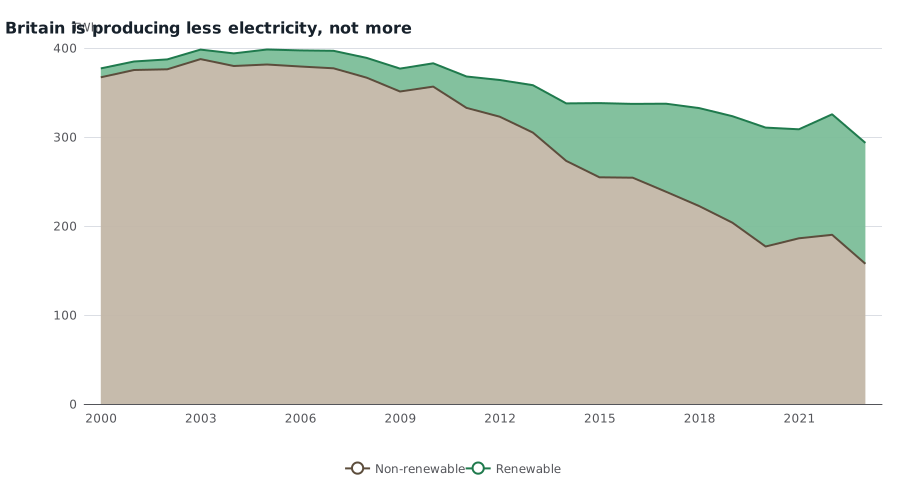
UK electricity generation, TWh, 2000–2023. Stacked areas are IRENA renewable and non-renewable generation; the top edge is their sum. Pumped storage is excluded. These are UK-wide generation figures, not Scottish consumption and not data-centre load. Source: IRENASTAT, latest year 2023.
That is the backdrop for a project that still needs a large, constant block of power. Read the full analysis.
Politics & Policy
In the Middle East, Hamas announced it was dissolving the body that has governed Gaza for nearly 20 years, clearing the way for a technocratic committee created under the US-brokered ceasefire structure. A Hamas official said the move removes pretexts for the occupation; France 24 notes the change is unlikely to mean much in daily life, with disarmament and Israeli withdrawal still very much on the stuck table.
Iran began a six-day farewell for Ali Khamenei, with mass processions in Tehran and public calls for revenge. The Guardian notes the scale of the march — however engineered — is an extraordinary turnaround for a country gripped by protests seven months ago. The new supreme leader, Mojtaba Khamenei, has yet to appear in public, and his father’s burial was delayed for months, breaking Islamic custom. Some Tehran residents reportedly left town rather than join the crowds.
Turkey, hosting the NATO summit, has been sending its own signal: more than 200 people arrested in raids, demonstrations banned and a gay-friendly cruise ship turned away. The Guardian quotes Human Rights Watch accusing Ankara of ‘ruthless intolerance of freedom of speech and assembly’. And in Washington, Trump suggested leading AI firms would make a public ‘contribution’ to the country — vague enough to make tax lawyers and AI lobbyists equally nervous.
Human Stories / Social Trends
Australian research found extreme heat doubles young people’s risk of mental-health hospital admission, based on 720,000 admissions in New South Wales, with heat-related admissions projected to rise 6–7.7% by the end of the century. The climate bill just got personal.
Social posts sharing The Guardian’s story describe Gaza’s musicians reopening the national conservatory in displacement tents, with a teacher saying music is no longer entertainment but ‘an important tool for psychological relief’. Students are improvising with salvaged instruments and homemade flutes — a small refusal to let the war take the soundtrack too.
And in China, university graduates who cannot find work are enrolling in vocational schools in what is colloquially known as ‘returning to the furnace’. The schools offer hope, but the reality often falls short of the promise. A degree no longer guarantees the dream; the next qualification is not guaranteed to be better.
Dates and sources
This digest covers the news day 2026-07-06. It is presented retrospectively from a saved draft; its date in the URL identifies the news day, not an assertion of publication on that day. News references link to their original outlets. Supporting research was completed 2026-09-10. Its data vintage and material limitations are recorded in the article methods and chart captions.