LunarWeave
Britain’s Economy Grew. Britons Are Barely Richer.
When Andy Burnham was confirmed as Labour leader on 17 July 2026, clearing the way for him to become prime minister, the job description arrived already written. The New York Times called it a moment of political upheaval and “economic stagnation,” and noted that he would be Britain’s seventh prime minister in a decade. France 24 listed a tepid economy and high government borrowing costs among the items waiting on the desk.
Those phrases are not invented. They are also not quite the right diagnosis. The United Kingdom’s economy is larger than it was before the pandemic. What has barely moved is income per person.
That distinction matters for a government that has promised to “give hope back,” as Burnham put it after being elected unopposed. A collapsed economy and a larger economy with stalled living standards imply different constraints — and different room to spend.
Larger, not richer
In the International Monetary Fund’s World Economic Outlook, UK constant-price GDP in 2025 was 5.4 percent above 2019. That is not Germany’s stall: German output was only 0.3 percent larger over the same span. It is also not an American expansion. US real GDP was 15.1 percent above 2019.
The living-standards measure tells a colder story. UK real GDP per capita at purchasing-power parity was just 1.1 percent higher in 2025 than in 2019. In 2024 it was 0.08 percent above 2019 — five years in which the average person, on this measure, went nowhere. The 2025 estimate still sits a hair below the 2022 rebound. Britain has not made a new high in real income per person since then.
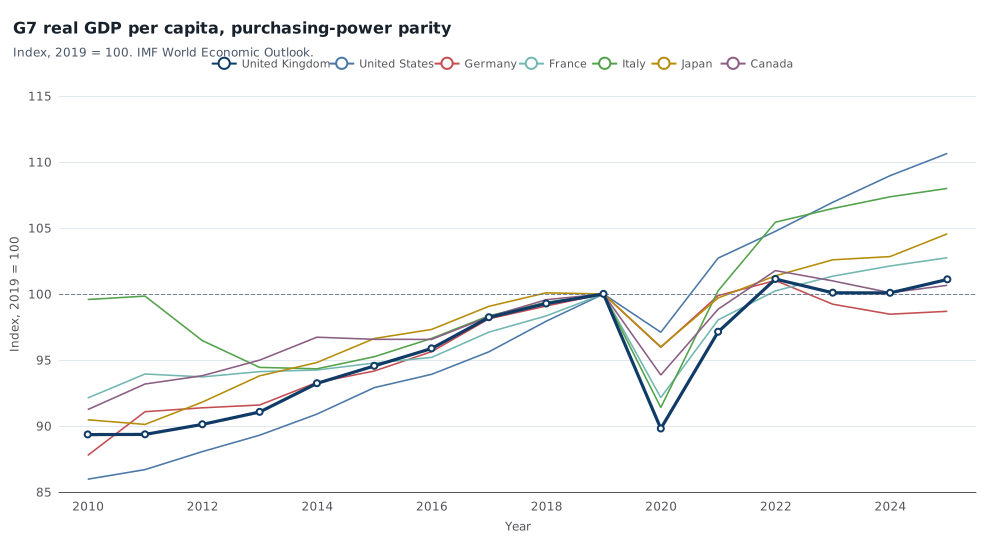
Index of real GDP per capita at purchasing-power parity, 2019 = 100. Annual IMF World Economic Outlook estimates for G7 countries, 2010–2025. The United Kingdom is the thicker navy line. 2026 projections are omitted. PPP per-capita GDP is not the same as constant-price national GDP.
Constant-price GDP is a volume of output in national currency; the per-capita series is a PPP living-standards measure. They can diverge because of population, relative prices, or both. The extra output since 2019 has not shown up as a meaningful rise in real income per person.
Not the worst in the G7 — and nowhere near the best
Britain is in a slow cluster, not in a class of its own. From 2019 to 2025, only Canada (0.66 percent) and Germany (a 1.3 percent fall) had weaker per-person gains among the G7. The United States was 10.7 percent above 2019. Italy, whose total output grew only a little faster than Britain’s, still recorded an 8.0 percent rise in real GDP per person.
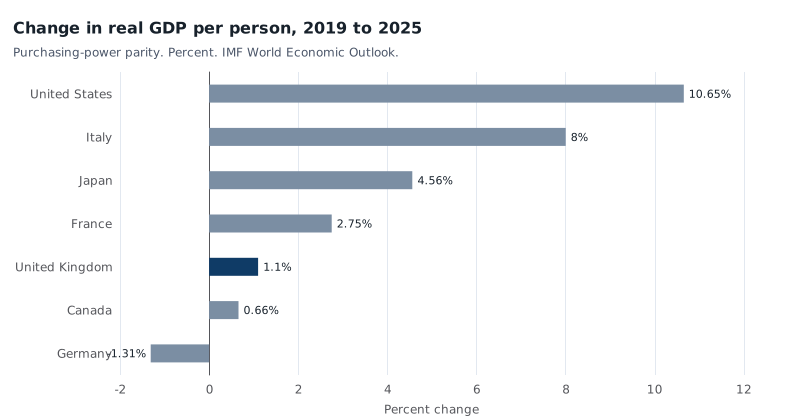
Percent change in real GDP per capita at purchasing-power parity, 2019–2025. IMF World Economic Outlook. The United Kingdom is highlighted. Germany is the only G7 country below zero. 2025 figures are the latest estimate year in this vintage.
Stretch the window through the decade of premiership churn and the ranking barely improves. From 2015 to 2025, UK real GDP rose 14.2 percent, but real GDP per person rose 6.9 percent — better than Germany and Canada, and well under half the US gain of 19.1 percent. Turnover is a political fact of that decade. It is not, on this evidence, a sufficient explanation: peers with fewer prime ministers also crawled.
The recent growth rates match the “tepid” label more cleanly than the word “stagnation” does for the whole economy. UK real GDP grew 0.3 percent in 2023, 1.1 percent in 2024 and 1.3 percent in 2025. The Fund’s 2026 projection in this vintage is 0.8 percent. Average consumer-price inflation, after 7.3 percent in 2023, was still 3.4 percent in 2025. Unemployment rose from 4.3 percent in 2024 to 4.9 percent in 2025; the 2026 projection is 5.6 percent.
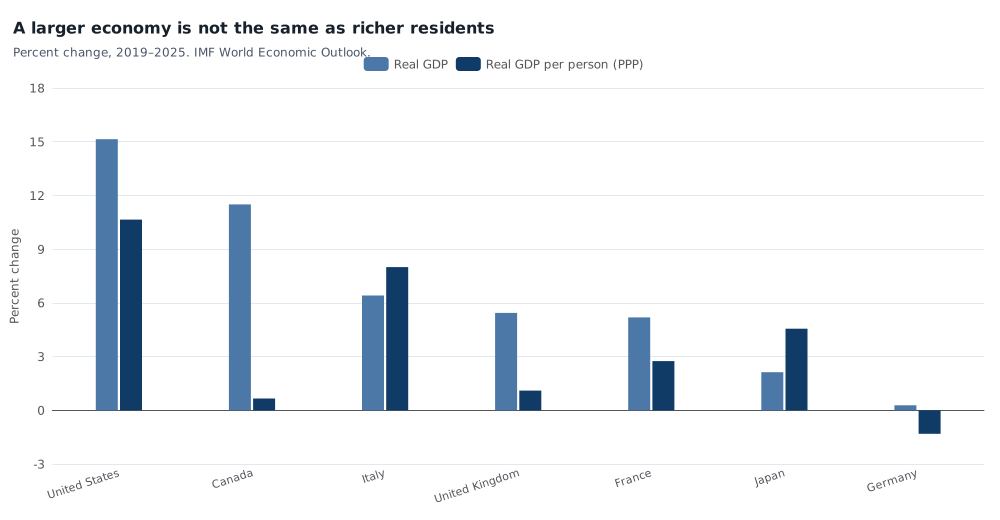
Percent change, 2019–2025, in constant-price GDP (national currency) versus real GDP per capita at PPP. IMF World Economic Outlook. The two measures are not a population residual: they use different price bases.
The fiscal box is tight. It is not unique.
High borrowing costs are harder to read from this dataset than living standards, because the Outlook does not publish gilt yields. What it does publish is the budget arithmetic.
UK general government net lending was −5.4 percent of GDP in 2025, more than twice the 2.4 percent deficit of 2019. Gross public debt was 102.3 percent of GDP, up from 84.9 percent. The gap between the overall balance and the primary balance — a derived interest bill, not a market yield — was 2.6 percent of GDP in 2025, against 1.4 percent in 2019. It spiked to 3.6 percent in 2022, the year inflation-linked debt costs jumped.
That is a heavier interest load than Britain carried before the pandemic. It is not the G7’s heaviest. In 2025 the United States ran a wider deficit (6.8 percent of GDP) and a larger implied interest bill (3.7 percent); Italy’s implied interest was 3.6 percent. France’s deficit, at 5.1 percent, sat in the same neighbourhood as Britain’s.
| Country | Real GDP, 2019–25 | Real GDP per person (PPP), 2019–25 | Budget balance, 2025 | Gross debt, 2025 |
|---|---|---|---|---|
| United States | 15.1% | 10.7% | −6.8% of GDP | 123.9% of GDP |
| Canada | 11.5% | 0.66% | −1.8% | 113.5% |
| Italy | 6.4% | 8.0% | −3.1% | 137.1% |
| United Kingdom | 5.4% | 1.1% | −5.4% | 102.3% |
| France | 5.2% | 2.8% | −5.1% | 116.0% |
| Japan | 2.1% | 4.6% | −1.0% | 206.5% |
| Germany | 0.3% | −1.3% | −2.7% | 62.9% |
IMF World Economic Outlook. GDP is constant national-currency volume; per-person GDP is at purchasing-power parity. Budget figures are general government. 2025 is the latest estimate year in this vintage, not a settled outturn.
A 5 percent-of-GDP deficit with debt already above 100 percent of GDP is a constraint. It is not proof that gilt yields are uniquely punitive. It does mean that large new spending or tax cuts have to be financed in a country still borrowing at a wartime-looking rate of GDP, years after the pandemic.
What the inbox actually contains
The useful reading of the July 2026 coverage is therefore narrower than “stagnation.” Britain did not fail to recover output. It failed to turn that recovery into a lasting rise in real income per person, and it is still running a wide deficit while paying more of national income in debt interest than it did in 2019.
That combination — a slow living-standards machine and limited fiscal spare capacity — is the box Burnham inherits. Canada has more growth with almost no per-person gain; France has a similar deficit. It is not the American mix, where both output and income per person moved. These series cannot test small boats, housing or party management.
Seven prime ministers in a decade is a political fact. The economic fact sitting underneath it is quieter: the country is a little bigger, households are not much better off, and the budget is still in the red.
Sources and methods
This is retrospective research, written on 10 September 2026 about events of 17 July 2026. Figures come from a pinned IMF World Economic Outlook snapshot assembled on 24 August 2026, which can include later estimates than were published on the news day. The Outlook mixes outturns, estimates and projections; 2010–2025 are treated here as the latest historical or estimate years in that vintage, and 2026 figures are identified as projections. The IMF, not the data portals, is the statistical source.
Primary balances use IMF code GGXONLB_NGDP (general government primary net lending/borrowing). A local label calls that series a structural balance; the code, not the label, is used. Implied interest is the gap between the primary and overall balances. It is not a market yield. Empty external-debt-service series for the United Kingdom were not treated as zero. PPP per-capita GDP and constant-price GDP are not combined into a population estimate. Charts were rendered from these calculations and have not been separately checked in a browser. Linked MacroVedia pages do not pre-select the United Kingdom.
Research Date
The displayed date matches the related news edition. Research was completed 2026-09-10.
Related news: Daily · 2026-07-17
More Research
Pakistan Is Resetting Fuel Prices After Already Closing Its Current-Account Gap
IMF current-account figures show Pakistan had already closed its 2022 external gap when it moved to daily fuel-price resets; Egypt had not.
Five Percent China Is The New Slope — And The IMF Does Not See A Rebound
IMF annual accounts already treat China’s 5 percent growth as the baseline, with no rebound through 2031, even though China remains about a fifth of world PPP output.
The Electrician Shortage Is A Tug-Of-War, Not An Empty Bench
U.S. electrician and HVAC contractor payrolls are at records. $40 an hour is no longer a premium; house work is losing people to better-paid nonresidential jobs.