LunarWeave
Pakistan Is Resetting Fuel Prices After Already Closing Its Current-Account Gap
When the Strait of Hormuz is being fought over, a government that imports oil can look as if it is about to run out of foreign exchange. Pakistan’s decision to reset retail fuel prices every day — after already shortening the review from a fortnight to a week when the US–Iran war began — reads that way. The Hindu reported the change as Dawn described fighting over the waterway that carries about a fifth of the world’s oil, with prices up more than four percent in a day.
The IMF World Economic Outlook numbers say something less dramatic. Pakistan has already closed the current-account hole that opened in 2022. Egypt, whose informal recyclers are selling plastic into a Gulf polyethylene shortage, has not. The United Arab Emirates still runs a surplus large enough that cutting Hormuz dependence to “zero” is a logistics problem, not an external-solvency one.
A repair, not a rerun of 2022
In 2022, with the IMF’s average petroleum spot price at $96.36 a barrel, Pakistan’s current-account balance as a share of GDP was in deficit by 4.7 percent, or $17.5 billion. By 2025 that balance had swung to a 0.5 percent of GDP surplus, about $1.9 billion — a 5.1 percentage-point, $19.4 billion turnaround. The IMF’s 2026 forecast still has Pakistan only 0.4 percent of GDP in deficit. (On that MacroVedia page, choose Pakistan in the chart selector; 2026 is a forecast.)
That is not what a fresh balance-of-payments emergency looks like on paper. Average consumer-price inflation hit 29.2 percent in 2023 and 23.4 percent in 2024, then 4.5 percent in 2025. The Fund’s 2026 inflation forecast is 7.2 percent — higher, but not a return to the 2023 peak. Real GDP is projected to grow 3.6 percent in 2026 after 3.1 percent in 2025.
Daily fuel-price resets can still be a way to stop that repair from unwinding. They are not, by themselves, evidence that the 2022 current-account crisis has returned.
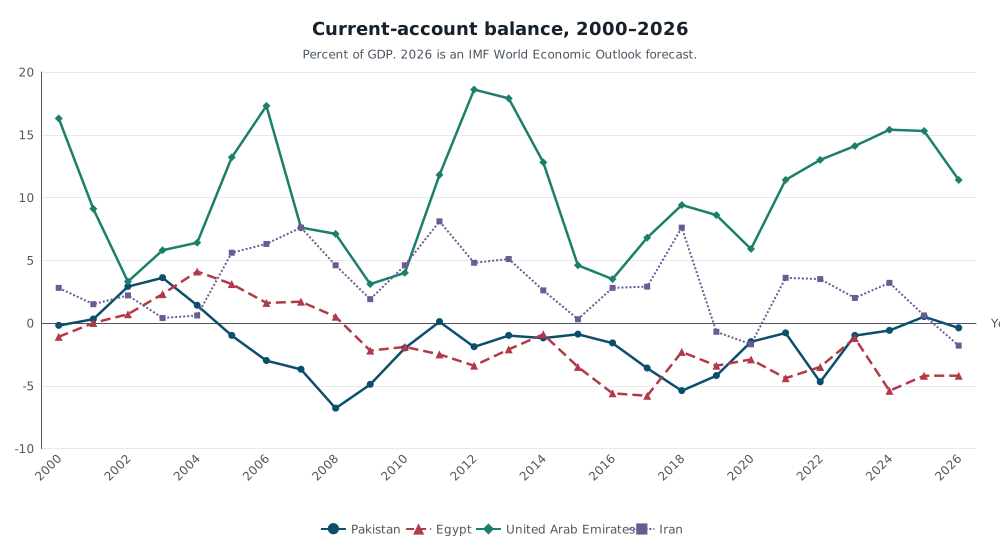
Current-account balance as a percent of GDP, 2000–2026. Source: IMF World Economic Outlook, series BCA_NGDPD. 2026 is an IMF forecast in a snapshot packaged 24 August 2026; 2025 may still be an estimate. The current account includes goods, services, income and transfers, not oil trade alone.
Oil is not a sufficient statistic
If the current account were just an oil bill, Pakistan’s worst external years would be the highest oil years. They are not.
In 2008, with the average petroleum spot price at $96.77 a barrel, the deficit was 6.8 percent of GDP — worse than 2022 at almost the same price. In 2011, with oil at $104.07, Pakistan ran a 0.1 percent surplus. In 2018, oil averaged only $68.53 and the deficit was still 5.4 percent of GDP. The current account records goods, services, primary income and transfers. Remittances, import compression, an IMF programme and a weaker currency can move it as much as a barrel price. The series does not isolate the oil-import bill.
The Fund’s 2026 average petroleum spot assumption is $82.22 a barrel, above 2025’s $67.74 but below 2022. Those are annual averages. They cannot speak to a four-percent one-day jump when tankers and mines are in the news, and they are not a claim that 2026 will be a cheap-oil year.
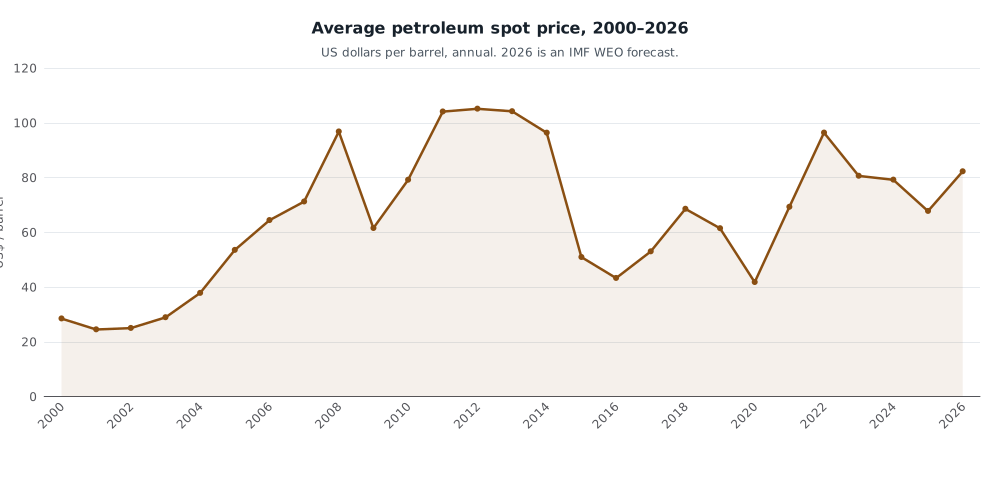
IMF average petroleum spot price, US dollars per barrel, annual, 2000–2026. Source: IMF World Economic Outlook, series POILAPSP (world geography G001). 2026 is a forecast.
Egypt is still in the hole
The same war that prompted Islamabad’s daily price list is a supply shock for Egyptian factories that rely on Gulf polyethylene. Reporting from Cairo’s Garbage City said about 85 percent of Middle East polyethylene exports pass Hormuz, Egypt imports around 40 percent of its raw plastic, and local recyclers saw demand triple after the strait clogged.
That boom is happening inside a still-stressed external position. Egypt’s current-account deficit was 4.2 percent of GDP in 2025, after 5.4 percent in 2024, and the IMF still has it at 4.2 percent in 2026. Average inflation was 33.3 percent in 2024 and 20.4 percent in 2025; the 2026 forecast is 13.2 percent. General government gross debt was 86.8 percent of GDP in 2025, against Pakistan’s 72.8 percent. The Fund’s 2026 forecast for Egypt’s general-government net lending widens to a 12.1 percent of GDP deficit from 6.6 percent in 2025.
Jordan, where Iranian fire killed US troops, is in a similar external bind: a 5.6 percent of GDP current-account deficit in 2025, 6.2 percent projected in 2026, and government debt of 82.8 percent of GDP. India’s deficit is milder, 0.9 percent in 2025.
The war is not hitting one interchangeable “oil-importing emerging market.” It is hitting countries that already look different on the IMF’s books.
| Economy | 2022 | 2025 | 2026 forecast |
|---|---|---|---|
| Pakistan | −4.7 | 0.5 | −0.4 |
| Egypt | −3.5 | −4.2 | −4.2 |
| Jordan | −7.5 | −5.6 | −6.2 |
| India | −2.1 | −0.9 | −2.0 |
| Iran | 3.5 | 0.6 | −1.8 |
| United Arab Emirates | 13.0 | 15.3 | 11.4 |
| Kuwait | 34.4 | 23.3 | 26.0 |
Current-account balance, percent of GDP. Source: IMF World Economic Outlook, series BCA_NGDPD. 2026 is a forecast; 2025 may still be an estimate.
Gulf surpluses, and one that is slipping
Kuwait, which accused Iran of hitting civilian power and water sites, ran a 23.3 percent of GDP current-account surplus in 2025. The UAE’s surplus was 15.3 percent of GDP, or $87.2 billion — larger as a share of GDP than in 2022, when oil was more expensive. The IMF still projects an 11.4 percent surplus in 2026.
That is why Abu Dhabi’s talk of cutting Hormuz dependence to zero is not a current-account survival plan. Jebel Ali and Khalifa, which handle most of the UAE’s reported $1 trillion in annual non-oil trade, sit inside the strait. The surplus says the country can absorb an oil-price swing; it does not move the ports.
Iran is the exporter that does not have that cushion. Its current account was only 0.6 percent of GDP in 2025 and is projected at a 1.8 percent deficit in 2026, alongside a 6.1 percent contraction in real GDP and 68.9 percent inflation in the Fund’s forecast. That is a different starting point from Kuwait, not a typical petrostate buffer.
What the numbers cannot say
None of this measures barrels through Hormuz, the rupee cost of a litre of petrol, or whether daily price resets will stick. A current-account surplus can be import compression rather than a healthy export machine; Pakistan’s 2025 surplus is small. The 2026 figures are forecasts, and a later IMF vintage cannot establish what was knowable in mid-July. They do establish a narrower point: if the question is whether Pakistan is again in a 2022-style external hole, the recorded balance says no — and that Egypt and Jordan are the importers in this war still running large gaps.
Sources and methods
This is retrospective research completed 10 September 2026 on news from 18 July 2026. Figures come from the IMF World Economic Outlook in a snapshot packaged 24 August 2026 (raw run 10 August 2026). That later vintage was not available on the news day and should not be read as an “as of 18 July” reconstruction. Series are annual (stored as 1 January dates). 2026–2031 are IMF projections in this snapshot; 2025 is the latest IMF figure and may still be an estimate. Current-account ratios are series BCA_NGDPD (percent of GDP); dollar current-account levels are BCA (Pakistan’s dollar series ends in 2025). Inflation is average consumer prices (PCPIPCH); real growth is NGDP_RPCH; government debt is GGXWDG_NGDP; net lending is GGXCNL_NGDP. Oil prices are POILAPSP on world geography G001. Official documentation: IMF World Economic Outlook. Browser and mobile layout were not separately tested beyond SVG rendering.
Research Date
The displayed date matches the related news edition. Research was completed 2026-09-10.
Related news: Daily · 2026-07-18
More Research
The Electrician Shortage Is A Tug-Of-War, Not An Empty Bench
U.S. electrician and HVAC contractor payrolls are at records. $40 an hour is no longer a premium; house work is losing people to better-paid nonresidential jobs.
Britain’s Economy Grew. Britons Are Barely Richer.
IMF figures show the UK economy is larger than in 2019, but real GDP per person has barely risen — the constraint Andy Burnham inherits.
Britain Is No Richer Per Person Than It Was In 2019
IMF data show UK real GDP per capita was unchanged from 2019 to 2024, unlike the United States, while consumer prices were about a quarter higher.