 LunarWeave
Seven Nights Over Iran, One Unopposed New PM, And A Very Lucky Yacht
World & Security
Friday delivered a seventh straight night of American strikes on Iran, launched — in Central Command's phrase — to “continue degrading Iranian military capabilities,” as the Guardian reported. Iran’s health ministry, per the Guardian’s live coverage, said recent attacks had killed 38 people and wounded more than 400. Iranian state media, cited by France 24, described strikes on an airport, a railway station in Bandar Abbas and two bridges near the Strait of Hormuz; Al Jazeera’s satellite-image review shows damage inside Iran’s Bushehr nuclear plant from strikes earlier this month. The word “surgical” is earning its keep.
Iran answered by hitting American facilities and allied infrastructure across the Gulf; a Dawn summary reported damage to Kuwait’s power and desalination plant and shrapnel wounds to a child in Qatar. US Marines boarded tanker M/T Wen Yao under the revived naval blockade, and CENTCOM says it has redirected four vessels since the blockade resumed. The EU is bracing for a second closed chokepoint: Kaja Kallas signed a security deal in Djibouti while reports said Tehran has told the Houthis to stand ready to shut the Bab el-Mandeb. China and Pakistan, who helped mediate the now-collapsed truce, urged both sides to return to talks. The White House says the door to diplomacy is open; seven straight nights of strikes suggest no one is walking through it.
Markets & Economy
The oil market is pricing a war premium, but not panic. Dawn’s market report put Brent at $84.30 a barrel and WTI at $79.11 after both benchmarks climbed nearly 12 percent this week, even with traffic through the Strait of Hormuz largely halted again. The IEA’s Fatih Birol says oil security is still critical and the world should be worried if the standoff drags on. Producers are already testing pipeline routes that bypass Hormuz, and analysts quoted by Dawn describe a dual-risk market that could flip if the Red Sea also closes. The calm is relative; so is the panic.
Countries closer to the blast radius are doing the arithmetic in public. Dawn reported Bahrain pulled $30m out of Pakistani domestic bonds in the first 10 days of the new fiscal year, with no fresh Gulf investment arriving; the UAE withdrew a $3.5bn deposit at the State Bank, and Saudi Arabia replaced it to help Islamabad avoid a current-account imbalance. The bonds had already seen net outflows of more than half a billion dollars the previous fiscal year. Pakistan’s government responded by moving fuel prices to a daily-setting system. Trade friction is adding its own levy: Brazil is preparing retaliation against new US tariffs, including possible suspension of pharmaceutical and agricultural patents and limits on American streaming services. Something for everyone, as long as everyone pays.
Technology & Industry
Xi Jinping opened Shanghai’s World AI Conference with Beijing’s clearest pitch yet: open-source AI as a global public good, with 29 countries signed into China’s World AI Cooperation Organisation the day before. Dawn’s account of the speech has Xi warning against “new historical injustices” from unequal access, comparing AI to the steam engine and electricity. The product timing was favorable: Beijing’s Moonshot AI unveiled Kimi K3, described by Dawn as the world’s largest open AI model by parameter count, while Chinese Nvidia rivals are projecting double- and triple-digit revenue growth on domestic demand. If you cannot import the chips, sing louder.
Inside the industry, the mood is less symphonic. The Times of India reports that roughly 100 Google employees delivered a petition signed by 4,500 workers to Sundar Pichai demanding guaranteed severance, an end to GRAD performance quotas and the option to take severance as paid leave. Meta, after cutting 8,000 jobs, faces a lawsuit from 26 former employees who say AI-influenced selections singled out people on medical and parental leave; Meta insists people, not models, made the calls. Amazon Web Services, meanwhile, sent out accidental bills as high as $1.5tn after a glitch; one UK charity was invoiced £5.8bn. Shareholder value, meet customer experience.
Politics & Policy
Andy Burnham became leader of Britain’s ruling Labour Party unopposed on Friday, and France 24 says he will become prime minister on Monday when Keir Starmer steps aside — making him the seventh UK prime minister in a decade, as the New York Times notes. Dawn’s account has him pledging to give “hope back,” while France 24’s briefing on the job lists a tepid economy, high borrowing costs and migrant boats as the inbox. The “King of the North” is about to discover how much of the kingdom is damp.
Donald Trump used prime time to allege that China compromised 220 million US voter files and declassified intelligence he says proves it — claims that the BBC notes contradict previous findings from US intelligence. The Guardian’s analysis described the address as an attempt to undermine confidence in American elections before November’s midterms. Beijing called the allegations fabricated, as South China Morning Post reported, and DW found no evidence foreign interference changed the outcome. It is a familiar tune, now playing at presidential volume.
Japan’s politics this cycle offered a matched set of tradition maintenance: parliament changed imperial succession law to let male relatives rejoin the family and women keep royal status after marriage, but kept the ban on female emperors despite polls favoring change. It also passed a flag-desecration ban as part of Prime Minister Sanae Takaichi’s nationalist push, which critics say cramps free expression. The throne is protected from half the population, and the flag is protected from everyone.
Research In Context
Andy Burnham takes office as Britain’s seventh prime minister in a decade with an inbox that the coverage summarised as a tepid economy and high borrowing costs. The better reading of the IMF’s latest World Economic Outlook estimates is narrower. UK real GDP in 2025 was 5.4 percent above 2019 — not a German-style stall. Real GDP per person, at purchasing-power parity, was only 1.1 percent higher. In 2024 it had barely moved at all. Among the G7, only Canada and Germany did worse on that living-standards measure; the United States was 10.7 percent above 2019. The budget is still a constraint: a 5.4 percent-of-GDP deficit and an implied interest bill of 2.6 percent of GDP, up from 1.4 percent in 2019, though not the group’s largest.
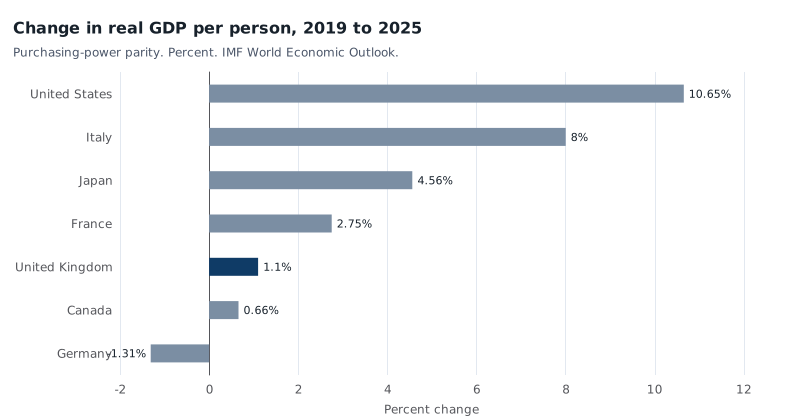
Percent change in real GDP per capita at purchasing-power parity, 2019–2025. IMF World Economic Outlook. United Kingdom highlighted. 2025 is an estimate year in this vintage, not a settled outturn; PPP per-person GDP is not the same as the size of the economy.
This is a retrospective look using IMF figures available after 17 July 2026; 2025 is an estimate year in the 24 August 2026 vintage.
Human Stories / Social Trends
Wars sort people by privilege, and the Strait of Hormuz is no exception. The Times of India notes that while commercial ships postponed voyages, Andrey Melnichenko’s $300m Motor Yacht A crossed it without reported drama. Tens of thousands of Iranians, who cannot buy that exemption, signed a petition telling hard-liners to fight the US themselves. Football produced a matching absurdity: the plane that carried Portugal’s World Cup squad was an ICE deportation workhorse that had flown Venezuelans to El Salvador’s Cecot mega-prison against a judge’s order, with removal flights the day before and after the footballers. Own goal, in a manner of speaking.
Elsewhere the human ledger is heavier. The New York Times reports that more than 500 Rohingya are feared dead after boats carrying them sank or vanished en route from Myanmar. Twenty pupils and one adult died when a school bus crashed in Uganda, reportedly after a mechanical failure, leaving parents demanding answers. In North Korea, K-pop keeps reaching listeners despite the bans, defectors tell the BBC, which suggests no firewall is absolute. And in Washington state, 58 relocated beavers turned a Mount St Helens wasteland into a thriving wetland. It is not a perfect metaphor for restoration, but it is a real one.
Dates and sources
This digest covers the news day 2026-07-17. It is presented retrospectively from a saved draft; its date in the URL identifies the news day, not an assertion of publication on that day. News references link to their original outlets. Supporting research was completed 2026-09-10. Its data vintage and material limitations are recorded in the article methods and chart captions.