 LunarWeave
Hormuz Is Back On The Clock, And Nobody Set An Alarm
World & Security
Pakistan’s June mediation produced a preliminary peace deal, yet the U.S.–Iran fight was back for a sixth day by 16 July. U.S. strikes reached northern Iran as Iran announced drone-and-missile attacks on U.S. bases in Bahrain, Kuwait and Jordan. In the Strait of Hormuz, U.S. forces disabled an unladen tanker heading for Kharg Island after it ignored warnings, and Pakistan pleaded for a return to the June talks. The waterway is closed, the red lines are everywhere, and 'ceasefire' is filing for divorce.
Vice-President JD Vance opened another front, with Al Jazeera reporting his accusation that people inside the Israeli government tried to sway U.S. public opinion against Iran diplomacy and prolong the war. In Tehran, Deutsche Welle says leaders are stepping up “revenge propaganda” after Khamenei’s death to rally supporters at home. And after a strike near a children’s cancer hospital, Iran accused the United States of a “cowardly war crime”; a community post circulating an Al Jazeera report said all 211 patients had to be moved, some on oxygen and ventilators. Even if the intended target was something else, the evacuation was not abstract.
Markets & Economy
Oil did the easy math: crude rose for a fourth day and stayed above $85 as ships and strikes made the Strait of Hormuz hard to ignore. Harder is the warning from former World Bank vice-president Ian Goldin, who said concentrated U.S. equities left portfolios exposed to a painful valuation correction and urged global diversification. In other words, hedge the thing that still looks expensive.
Washington’s trade reset is targeting Brazil first. The USTR will impose 25% tariffs on most Brazilian imports from 22 July, the first action after the Supreme Court gutted the earlier tariff regime, with coffee, beef and rare earths spared. Brazil dismissed the move as unjustified and vowed reciprocal WTO action. At home, the consumer is blinking: grocery unit sales fell 1.8% in June, meaning price rises no longer keep total sales growing. Nor is China humming: a widely shared report put second-quarter growth at 4.3%, the slowest since 2022. Tariffs go up just as shoppers decide they are buying less—economists call that a stress test; everyone else calls it Tuesday.
Research In Context
Reports described China’s economy growing at its slowest pace in years even as artificial-intelligence and electric-vehicle plants hummed. The IMF’s annual accounts already treat that slower speed as the baseline, not a one-quarter scare.
Real GDP growth averaged 7.7 percent a year in 2010–19. It was 5.0 percent in 2024, and the Fund’s 2025 estimate is 4.96 percent. Projections then keep easing, to 4.4 percent in 2026 and 3.3 percent by 2031 — still faster than the United States, and still from an economy that is about a fifth of world PPP output. Consumer prices in those same accounts were essentially flat, at 0.05 percent inflation in 2025, so the AI and EV boom is not showing up as a broad overheating.
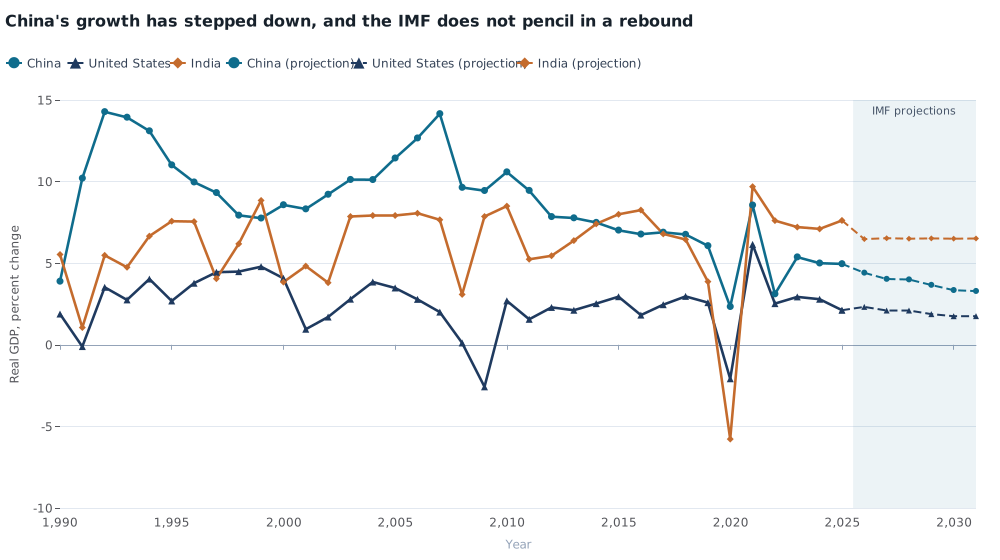
Annual real GDP growth, percent. Solid lines through the 2025 IMF estimate; dashed lines are projections. China, United States and India. Source: IMF World Economic Outlook, pinned August 2026 snapshot. Retrospective research: these figures were not an as-of reading of 16 July 2026. Annual figures are not quarterly prints; 2026–31 are forecasts, not outturns.
The 5 percent slope, and why it still moves the world economy, is in the accompanying research.
Technology & Industry
China’s AI industry now has an official policy on romance: out. Beijing banned chatbots from fostering emotional reliance; Alibaba and ByteDance are disabling companion features, and platforms must monitor conversations for distress. The same week, Moonshot AI released Kimi K3, billed as the largest open-source model yet and a rival to top U.S. systems. Chinese AI in a nutshell: no chatbot girlfriends, but open weights for everyone.
The capital side is all-in. TSMC pledged another $100bn to its Arizona plants, bringing total U.S. investment to $265bn, even as Beijing denounces the latest U.S. chip-export curbs as a threat to global supply chains. Elsewhere in hardware, MIT and EPFL showed a 300-gram robot that flies, dives and launches again on flapping wings—a first full cycle without propellers. SpaceX went the other way: Starship aborted its 13th test just before liftoff after its engines shut down. And everyone rushing to deploy autonomous AI agents should note security experts’ warning that the same autonomy creates fresh vulnerabilities. Puffin-like ambition, rocket-like schedules.
Politics & Policy
U.S. immigration policy is now timed with a stopwatch. DHS final rules cap student and exchange visas at four years, journalists at 240 days and journalists from China at 90. A judge has already pushed back on one related move: he blocked the visa and deportation policy targeting foreign trust-and-safety researchers, finding it likely violates the First Amendment. Human Rights Watch’s director describes the broader programme as an “all-out assault on human rights,” with the Fort Bliss ICE centre a “human rights catastrophe”. The stopwatch, apparently, has no mercy setting.
Kyiv is having its own policy whiplash. The dismissal of popular defence minister Mykhailo Fedorov drew mass protests, and Zelensky publicly called for unity amid an emerging split in the military’s top ranks. Across the Atlantic, the White House put a longtime teleprompter operator on leave over alleged Kalshi bets on Trump speeches worth $100,000; the press secretary called it a disgrace. Speaking of prediction markets, Kalshi is now offering wagers on drug-trial results and FDA regulatory decisions. At least those markets cannot see the teleprompter.
Human Stories / Social Trends
Some grief finally gets paperwork. For one family in Kashmir, a judge issued a death certificate for Abdul Rashid Wani, missing in military custody since 1997, ruling that an army major murdered him and disposed of his body. It is a closed file with an open wound. And the losses that never get official recognition are even harder: UN agencies fear more than 500 Rohingya may have died after two boats capsized off Myanmar.
Elsewhere, reinvention takes smaller, stranger forms. A gay-themed Mediterranean cruise was turned away from Turkey and then Egypt, after years of making the same stops without trouble. Italy now offers young relatives of mafia bosses a new city, school and identity if they want out. And one UK housing association runs a hoarding support group where people describe living without heating or hot water rather than risk eviction by letting repair workers in. The state can arrange a new life; sometimes a working radiator would be a better start.
Dates and sources
This digest covers the news day 2026-07-16. It is presented retrospectively from a saved draft; its date in the URL identifies the news day, not an assertion of publication on that day. News references link to their original outlets. Supporting research was completed 2026-09-10. Its data vintage and material limitations are recorded in the article methods and chart captions.