LunarWeave
Missile Plants Hired. The Shipyards Barely Moved.
When asset managers treat defense as a growth sector, the pitch is industrial: more hulls, more missiles, more factories. In June 2025 BlackRock launched a European defense ETF, and Phenomenal World reported that asset managers’ holdings in the global arms industry had nearly tripled over a decade. The live military problem, though, is maritime. After Houthi strikes on Saudi oil sites, Politics Today, citing Kpler, described Bab el-Mandeb traffic collapsing to 11 commodity vessels in a single day.
If chokepoints are the constraint, the industrial test is whether the United States has rebuilt the workforce that welds ships. Payroll records from the U.S. Bureau of Labor Statistics say it has not. Shipyard employment has barely left a 30-year holding pattern. The factory category that did hire is the one that mixes guided missiles with space vehicles.
A shipyard workforce that never remobilized
In June 2026, ship building and repairing employed 107,800 people on a seasonally adjusted basis (preliminary). That is 4,900 more jobs than in June 2015, a 4.8 percent increase across the decade in which defense became an investment theme. From February 2022, the month Russia launched its full-scale invasion of Ukraine, the gain is 7,000 jobs, or 6.9 percent.
Those are small moves against the industry’s own history. The same series peaked at 127,400 jobs in February 1991, at the end of the Cold War buildup, then fell to 86,200 in September 2000. It has since lived in a narrow band around 100,000. June 2026 is still 19,600 jobs below that 1991 peak and 9,800 below January 1990. The 2010s average was 98,700; the average since February 2022 is 105,800. That is a modest recovery, not a mobilization.
Shipbuilding is 0.86 percent of U.S. manufacturing employment. All manufacturing itself is only 2.4 percent larger than in mid-2015. The yards did a little better than the factory sector as a whole. They did not behave like an industry being asked to contest the Red Sea.
Where the hiring actually went
The contrast is guided-missile, space-vehicle, and related parts manufacturing. That category employed 69,700 people in June 2015 and 115,900 in June 2026, a gain of 46,200 jobs, or 66 percent. From February 2022 the increase is 21,300 jobs, or 22.5 percent. In every month since July 2022 it has employed more people than ship building and repairing. In mid-2015 the shipyards were larger by 33,200 jobs; by June 2026 the missile-and-space category was larger by 8,100.
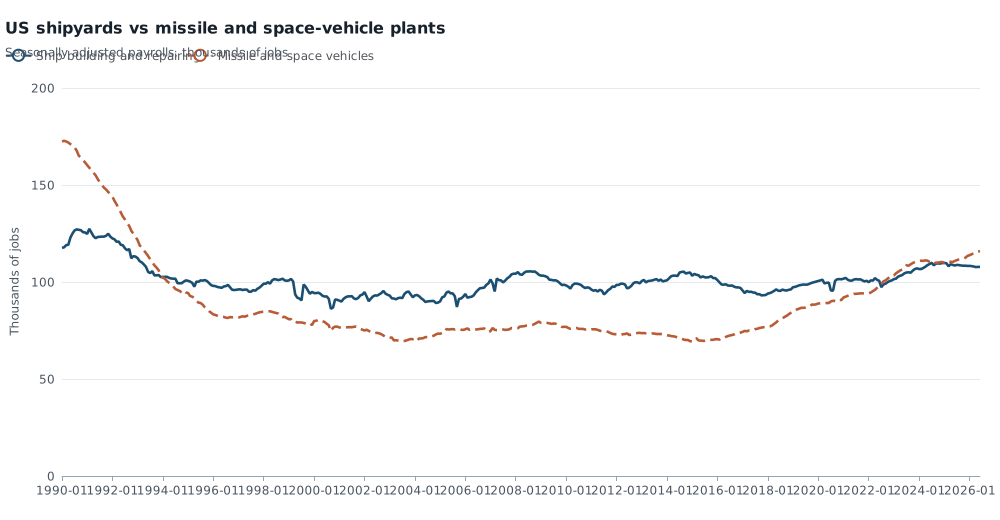
Seasonally adjusted U.S. payrolls, thousands of jobs, January 1990–June 2026 (June 2026 preliminary). Solid line: ship building and repairing. Dashed line: guided-missile, space-vehicle, and related parts manufacturing. The dashed series mixes military missiles with commercial space-vehicle work. Source: U.S. Bureau of Labor Statistics, Current Employment Statistics.
This is not a return to the late Cold War. Missile-and-space employment averaged 108,200 in the 1990s and 172,400 in January 1990. Today’s 115,900 jobs match the 1990s average and remain far below the 1990 peak. What changed is the direction after 2015: this category expanded; the yards did not.
The BLS label is a hard limit on what that expansion means. The series covers guided missiles, space vehicles, propulsion units, and auxiliary parts together. It cannot separate a Tomahawk line from a Falcon line, or Pentagon work from NASA and commercial launch. Some of the 46,200 added jobs are the space industry. The data show a boom in that combined factory workforce, not a count of missiles.
Aerospace recovered. Ordnance mostly already had.
Aerospace products and parts, the parent industry, employed 591,600 people in June 2026, up 103,200, or 21 percent, from June 2015. That parent includes both the missile-and-space plants and aircraft manufacturing, which itself rose 14 percent over the same span, to 265,100, after a Covid-era dip to 218,300 in February 2022. Of the 103,200 aerospace jobs added since mid-2015, 46,200 were in the missile-and-space category. The rest is aircraft and other aerospace parts, including commercial work at firms such as Boeing. Aerospace as a whole is still well below 849,300 jobs in January 1990.
Small arms, ammunition, and other ordnance is a different industry, and a different cycle. It grew 37 percent from June 2015 to June 2026, from 40,800 jobs to 55,900, but only 4.3 percent after February 2022. Most of that hiring happened before the Ukraine war, and the series includes civilian firearms. It is not a clean military-ammunition gauge. Search, detection, and navigation-instrument plants, often lumped into “defense electronics,” added almost nothing: 130,100 jobs in June 2026 versus 124,000 in mid-2015, and less than half their 286,700 jobs of January 1990.
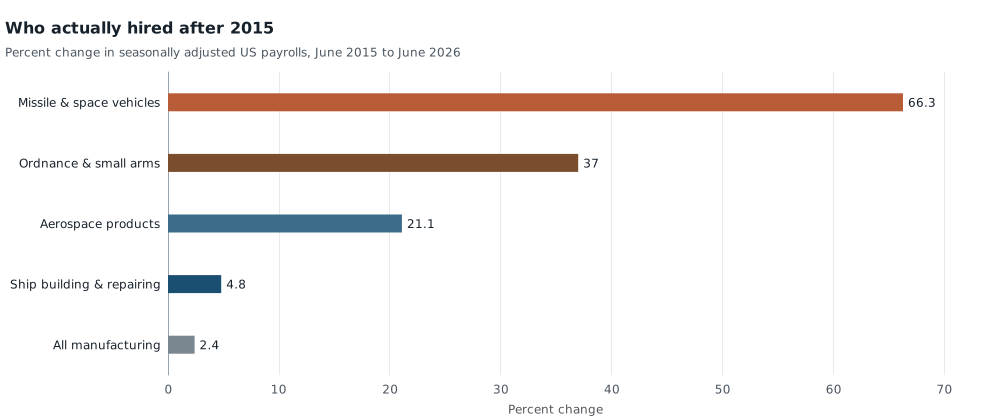
Percent change in seasonally adjusted U.S. payrolls, June 2015 to June 2026 (June 2026 preliminary). Aerospace includes the missile-and-space category, so those two bars are not additive. Source: BLS Current Employment Statistics.
| Industry (U.S., seasonally adjusted) | June 2015 | Feb. 2022 | June 2026* | Change since June 2015 |
|---|---|---|---|---|
| Ship building and repairing | 102,900 | 100,800 | 107,800 | +4.8% |
| Missile and space vehicles (inside aerospace) | 69,700 | 94,600 | 115,900 | +66.3% |
| Aircraft manufacturing (inside aerospace) | 232,200 | 218,300 | 265,100 | +14.2% |
| Aerospace products and parts (parent) | 488,400 | 487,100 | 591,600 | +21.1% |
| Small arms, ammunition, and other ordnance | 40,800 | 53,600 | 55,900 | +37.0% |
| All manufacturing | 12,307,000 | — | 12,606,000 | +2.4% |
*June 2026 figures are preliminary. Missile/space and aircraft are subsets of aerospace; do not add them to the parent. Values are BLS thousands converted to headcount.
What payrolls cannot say
Jobs are not ships, and they are not magazines of ammunition. Output per worker, overtime, imported components, and yards that repair rather than build can all move capability without moving headcount. U.S. large shipyards are heavily Navy-oriented, but the BLS series still includes commercial repair. None of this measures European rearmament, which is what the BlackRock ETF is designed to hold. It does not measure whether the U.S. Navy has enough hulls; it measures whether the domestic factory workforce that would have to produce them has grown.
On that narrower question the record is clear. Capital markets rediscovered defense. Missile-and-space plants hired. The shipyards that would have to keep sea lanes open added a few thousand jobs and remain smaller than they were in 1990.
Sources and methods
Payrolls are monthly, seasonally adjusted, national Current Employment Statistics all-employees series from the U.S. Bureau of Labor Statistics: ship building and repairing (CES3133661101), guided missile and space-vehicle manufacturing (CES3133641901), aerospace products and parts (CES3133640001), aircraft manufacturing (CES3133641101), small arms, ammunition, and other ordnance (CES3133299401), search and navigation instruments (CES3133451101), and manufacturing (CES3000000001). Official series documentation is in the CES bulk-file notes. June 2026 observations are preliminary.
This article is retrospective. It was researched on 10 September 2026, using a BLS snapshot dated 24 August 2026, and attached to a 27 July 2026 news roundup reconstructed from publication dates rather than an original same-day capture. Later revisions can change preliminary months. The snapshot is not a claim about what was knowable on 27 July 2026.
Research Date
The displayed date matches the related news edition. Research was completed 2026-09-10.
Related news: Daily · 2026-07-27
More Research
Nuclear Power Barely Grew For 25 Years. It Still Outproduces Solar.
World on-grid solar capacity overtook nuclear in 2018 and is now nearly six times larger, but nuclear still generated more electricity than solar in 2023. Almost all net nuclear growth since
Africa’s First Battery Factory Is Plugging Into A Coal Grid
Africa’s first EV battery gigafactory is planned for Morocco, but IRENA data show coal still supplied two-thirds of Moroccan electricity in 2023.
The Oil Shock Is Not A U.S. Oil-Jobs Boom
U.S. oilfield payrolls remain about 40 percent below their 2014 peak; the 2026 price spike is not a hiring boom.