LunarWeave
Africa’s First Battery Factory Is Plugging Into A Coal Grid
The African Development Bank has approved a $110 million loan for what it describes as Africa’s first electric-vehicle battery gigafactory: an integrated lithium-iron-phosphate plant in Morocco’s Rabat-Salé-Kénitra free zone, to be built by Gotion Power. The pitch is industrial and green at once — a factory on a continent that still imports most of its batteries, in a country that has spent a decade advertising solar and wind.
The power Morocco actually generates tells a harder story. In 2023, the latest year IRENA has published generation figures in this snapshot, coal and peat produced two-thirds of Moroccan electricity. Renewables produced 18.5 percent. That is better than a fossil desert. It is not a clean grid.
The plants look greener than the electrons
Morocco has built a lot of renewable capacity. IRENA’s renewable share of electricity capacity was 36.9 percent in 2023 and 39.6 percent in 2025. On-grid renewable capacity rose from 3,494 megawatts in 2020 to 4,823 megawatts in 2025, while on-grid coal capacity held at 4,116 megawatts.
Capacity is not output. Wind and solar run at lower capacity factors than coal plants, so they contribute less energy than their nameplate share. Hydro, which used to fill some of that gap, has faded. The result is a persistent split: Morocco can say that about two-fifths of its power fleet is renewable, while less than one-fifth of the electricity it generates comes from those plants.
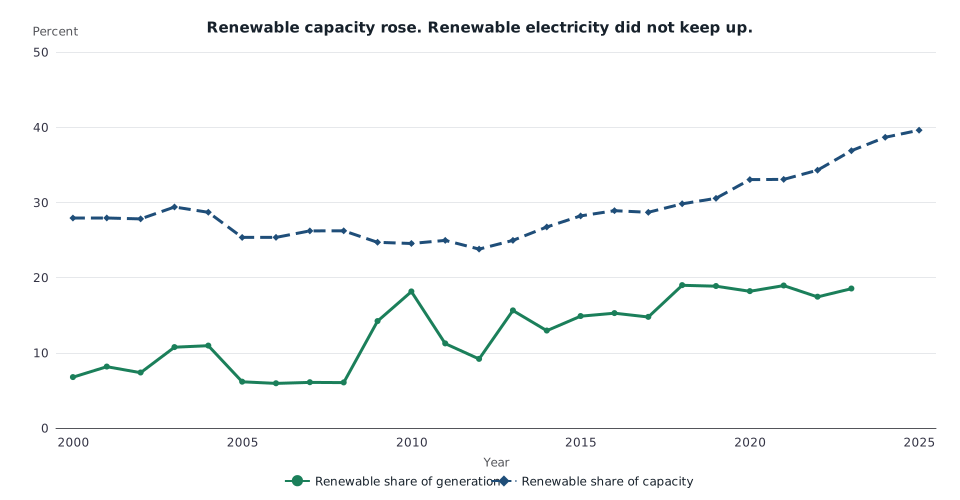
IRENA renewable-energy share of electricity capacity (dashed line, through 2025) versus share of generation (solid line, through 2023) in Morocco, percent. Generation after 2023 is not in this snapshot. Wind and solar typically produce less energy than their capacity share; that is a physical difference, not proof the extra plants are idle.
The generation share has barely moved since 2018, when it was already 19 percent. In 2000 it was 6.8 percent, so there was a transition — and then it stalled at a level still below the world average.
Two-thirds of the power is still coal
In 2023 Morocco generated 40,995 gigawatt-hours of electricity. Coal and peat accounted for 27,149 GWh, or 66.2 percent. Natural gas contributed 10.4 percent and oil 4.5 percent. Onshore wind was the only renewable source in double digits, at 16.0 percent. Solar photovoltaics supplied 1.6 percent; hydropower 0.9 percent.
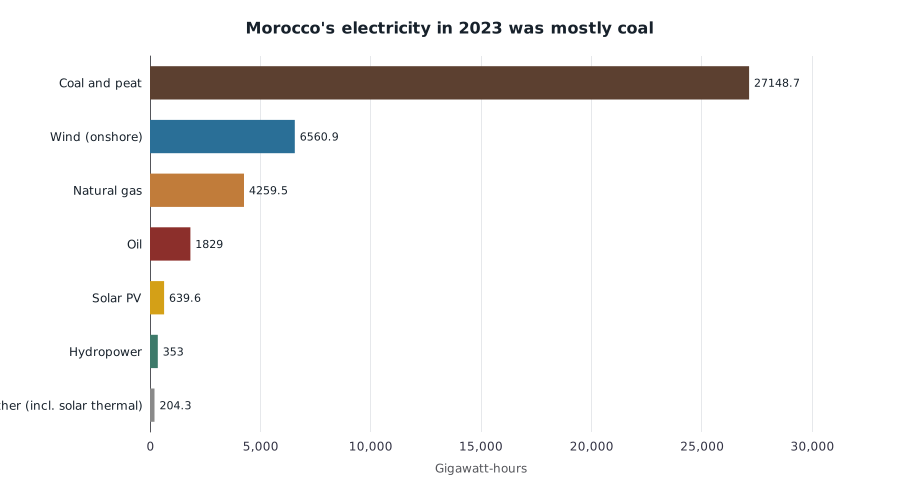
Electricity generation in Morocco in 2023, gigawatt-hours by fuel, from IRENA country statistics. A 204 GWh residual — including IRENA’s 1.5 GWh solar-thermal print that year — is grouped as other. Percentages use generation totals, not capacity.
Wind now does almost all of the renewable work: 86 percent of renewable kilowatt-hours in 2023. That is a real build-out. Onshore wind generation rose from 3,856 GWh in 2018 to 6,561 GWh in 2023. It was not enough to change the mix, because coal rose too, from 21,261 GWh to 27,149 GWh over the same years, and hydropower collapsed from 1,693 GWh to 353 GWh.
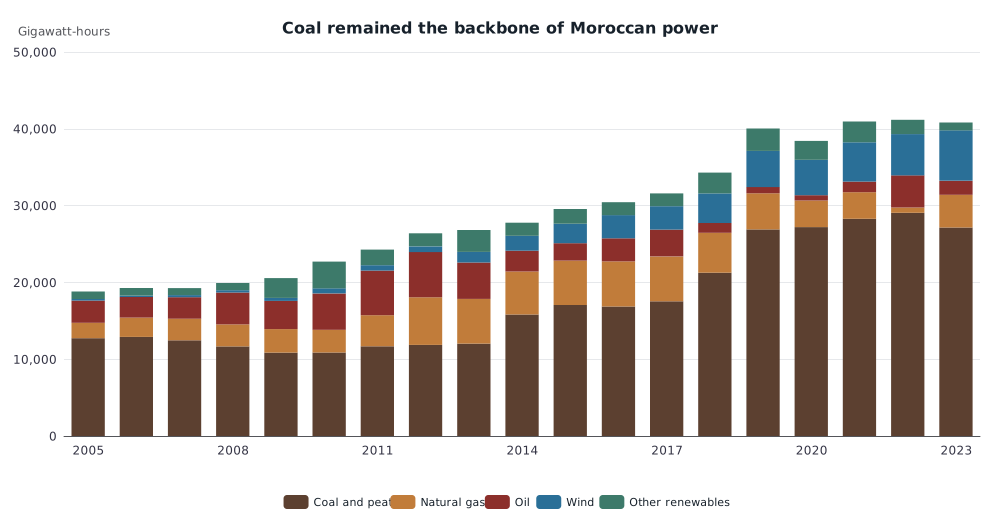
Annual electricity generation in Morocco, 2005–2023, gigawatt-hours. Other renewables combine hydro, solar PV, solar thermal and a small residual. IRENA records 1.5 GWh of solar thermal in 2023 after 864 GWh in 2022; that drop is large enough to treat as a possible reporting or outage break, not a completed exit from concentrated solar. Repeating 2022’s solar-thermal output would still have left coal at about 65 percent of generation.
A battery factory does not have to take the grid-average mix. It can sign a power-purchase agreement, sit behind a dedicated line, or run when the wind is blowing. None of that is visible in national annual totals. What the totals do show is the system the plant is joining: a coal-majority grid with a growing wind fleet and very little solar electricity so far.
Greener than its Maghreb neighbours. Dirtier than the world.
Morocco is not the laggard of North Africa. In 2023 renewables supplied 11.8 percent of electricity in Egypt, 6.2 percent in Tunisia and 1.0 percent in Algeria. South Africa, the other large industrial power on the continent, generated 8.3 percent from renewables; coal still produced 83.5 percent of South African electricity that year. Morocco’s coal share is lower than South Africa’s, and its renewable share is higher than those peers.
It is not high enough to match the “green gigafactory” framing. The world average renewable share of generation in 2023 was 29.9 percent. Spain, the large grid next door and a natural export market for Moroccan industry, was at 50.3 percent. Kenya generated 89.1 percent from renewables — mostly hydro and geothermal, a different resource endowment, not a template for a battery plant.
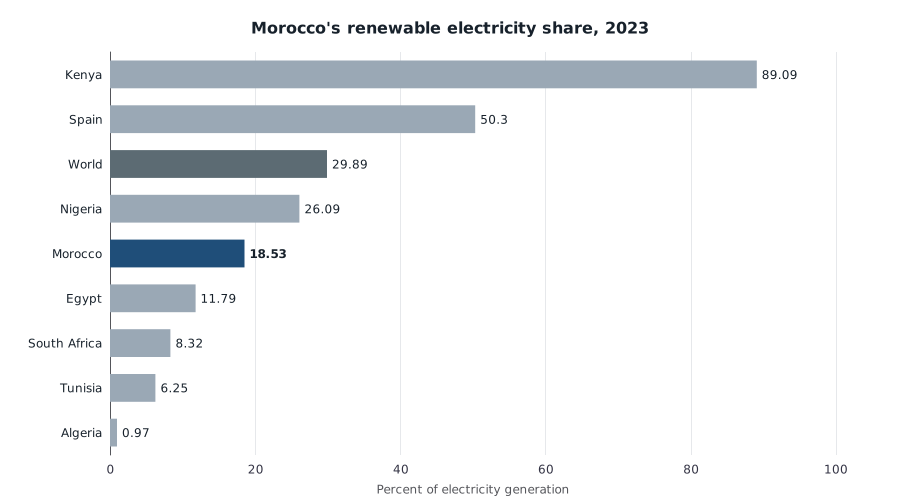
Renewable share of electricity generation in 2023, percent, IRENA. Morocco is highlighted. Kenya’s high share is hydro- and geothermal-heavy and is not a like-for-like industrial comparison.
The implication for Africa’s first gigafactory is narrow but material. Locating an LFP plant in Morocco can make sense for phosphates, ports, EU market access and political stability without the average kilowatt-hour being clean. If the factory draws grid power as Morocco generated it in 2023, most of that power was coal. If the project’s climate claim depends on a renewable-majority system, that system is not here yet: capacity has moved; generation has not.
Sources and methods
This is retrospective research completed on 10 September 2026, using pinned catalogue snapshots available then, not an as-of reconstruction of what was known on 26 July 2026. The digest date is 26 July 2026.
Electricity figures are from the International Renewable Energy Agency’s IRENASTAT country generation, capacity and renewable-share tables in the pinned snapshot (created 24 August 2026). Generation and official generation shares run through 2023; official capacity shares and on-grid capacity run through 2025. Shares of generation are IRENA’s published renewable-energy share series, which match a constructed renewable / (renewable + non-renewable) total to two decimal places in 2023. On-grid renewable and non-renewable capacity are cited as megawatts only; they are not used to reconstruct the official capacity-share series, which differs from a simple on-grid ratio.
Coal, gas, oil, onshore wind, hydro and solar PV are IRENA “all-grid” generation series in gigawatt-hours. Empty extracts — including nuclear generation for Morocco, and coal generation for Egypt, Algeria, Tunisia, Kenya and Nigeria — are treated as missing, not zero. A small residual of renewable and non-renewable generation is not allocated to a named fuel.
The $110 million African Development Bank loan and Gotion plant location are taken from contemporaneous reporting in the 26 July 2026 news packet, which quotes the bank’s statement. That is reported news, not a figure audited here. National annual electricity totals cannot show how a single factory will be powered.
Research Date
The displayed date matches the related news edition. Research was completed 2026-09-10.
Related news: Daily · 2026-07-26
More Research
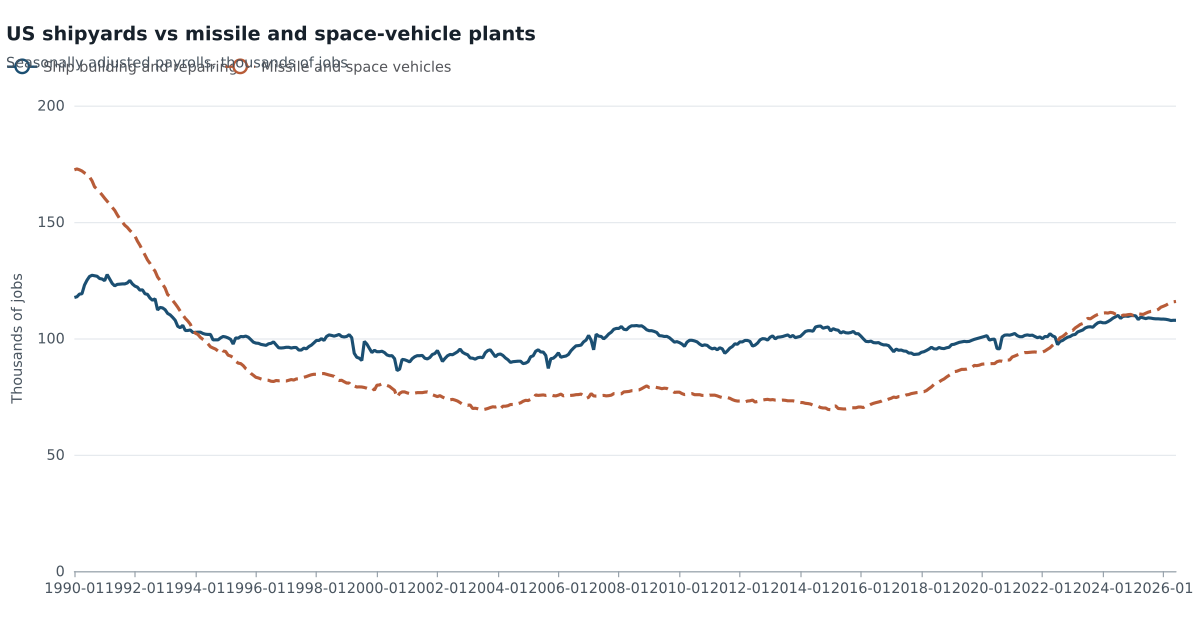
Missile Plants Hired. The Shipyards Barely Moved.
US shipyard payrolls have barely grown since 2015, even as missile-and-space plants hired. A look at BLS factory jobs behind the defense-stock boom.
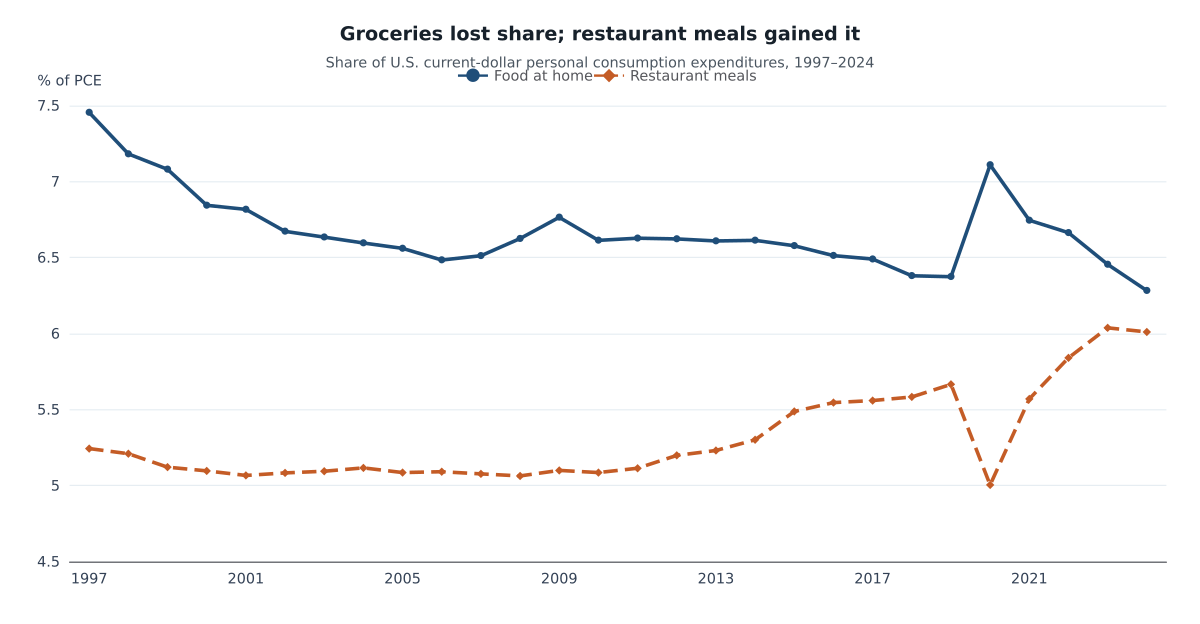
Groceries Cost More. They Still Take A Smaller Slice Of Spending.
BEA spending accounts through 2024 show food at home taking a smaller slice of U.S. consumption after the post-2019 grocery-price jump, with a much larger gap between states than between yea
Nuclear Power Barely Grew For 25 Years. It Still Outproduces Solar.
World on-grid solar capacity overtook nuclear in 2018 and is now nearly six times larger, but nuclear still generated more electricity than solar in 2023. Almost all net nuclear growth since