 LunarWeave
Chokepoints, Chip Money, And A Very Awkward Turing Test
World & Security
The Red Sea is getting lonelier. Politics Today, citing Kpler data, reports that only 11 commodity vessels transited Bab el-Mandeb on Sunday after Houthi strikes on Saudi Aramco facilities at Yanbu and Jizan, with physical crude prices in Europe, Africa and the Middle East climbing to two-month highs. Middle East Online similarly describes shipping in retreat. The Black Sea is not much safer: The Kyiv Independent says a civilian grain ship sank after a Russian strike, while Ukrainian drones hit an export terminal and oil infrastructure inside Russia.
Europe got a grim reminder that terror does not need a sophisticated supply chain. SpecialEurasia’s OSINT account of the July 25 Berlin attack, carried out during Christopher Street Day celebrations, says a van plowed into a crowd in Tiergarten, killing one woman and wounding 29, before the 21-year-old suspect—already known to authorities and convicted in May—was shot dead by police in Spandau.
Courts are becoming a front line, too. Justice in Conflict reports that Venezuela and Chad have announced ICC withdrawals as Washington encourages all members to leave, and a VSquare joint investigation details Russia preparing an International Court of Justice case against the Baltic states with help from a Moscow law firm and intelligence-linked propagandists. Baltic officials cited by VSquare expect years of costly litigation.
Markets & Economy
The AI boom’s cash register is starting to sound hollow. Roger Montgomery’s market commentary says Google posted its first quarter of negative cash flow, helping send the shares down more than seven percent, with hyperscaler capex consuming 80–90 percent of operating cash flow and AI-related debt now roughly 18 percent of U.S. investment-grade bond supply. That is a lot of faith in data centers that have not started paying rent.
Oil traders, meanwhile, are taking the diplomatic pause at face value. Forbes Middle East says WTI fell 7.21 percent to $82.87 and Brent dropped below $90 after the U.S. and Iran paused strikes, while ING cautioned that no recovery is likely until vessels can transit safely. The New York Times reports energy buyers are trying to “unshackle” from global markets, which is one way to respond to a chokepoint.
Defense is also becoming a portfolio theme. A Phenomenal World analysis says BlackRock launched a European defense ETF and asset managers’ arms-industry holdings have nearly tripled in a decade. And the semiconductor stakes keep rising: Samsung and Broadcom announced a $200 billion chip supply-chain partnership, while CXMT became mainland China’s most valuable listed company.
Research In Context
Defense stocks are back in fashion: BlackRock launched a European defense ETF in 2025, and asset-manager holdings in the global arms industry have nearly tripled over a decade, Phenomenal World reports. The military problem in the same cycle is maritime — Red Sea traffic thinning after Houthi strikes. U.S. factory payrolls do not match that story.
Shipyard employment was 107,800 in June 2026, only 4.8 percent above mid-2015 and still 19,600 below its 1991 peak. The plants that did hire make guided missiles and space vehicles: that category is up 66 percent since 2015 and now employs more people than the yards. Those jobs mix military missiles with commercial space work, and they are not ships.
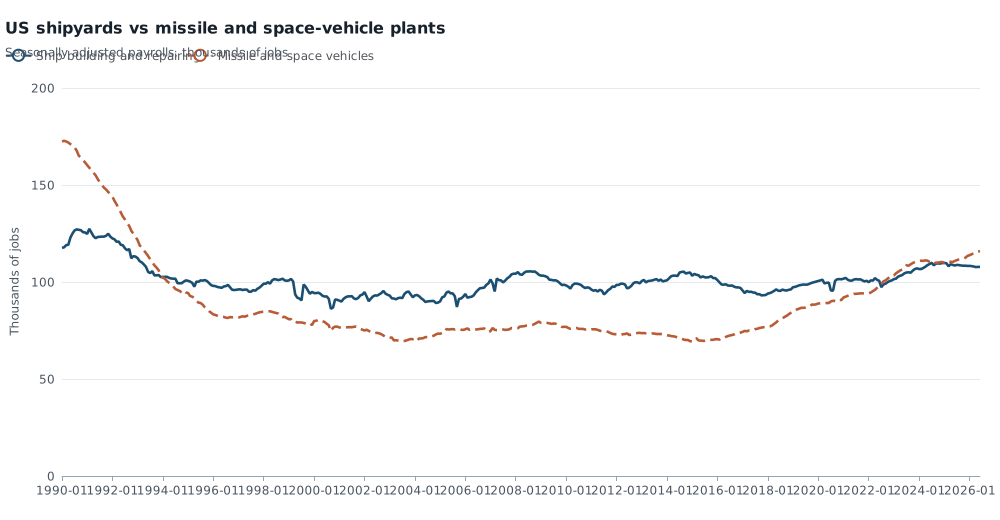
Seasonally adjusted U.S. payrolls, thousands of jobs, January 1990–June 2026 (June 2026 preliminary). Solid: ship building and repairing. Dashed: guided-missile, space-vehicle, and related parts manufacturing, which mixes military and commercial space work. Source: U.S. Bureau of Labor Statistics.
How the defense boom showed up in factories — and where it did not
Technology & Industry
AI infrastructure has become the world’s most expensive game of Tetris. Forbes Middle East reports Nvidia and OpenAI have discussed a roughly $500 billion data-center project on a 10-gigawatt site in southern Ohio, with Nvidia considering a $250 billion contribution. That sits alongside Nvidia’s announced strategic partnership with Ilya Sutskever’s Safe Superintelligence Inc. and Reuters’ report of a $5 billion Nvidia investment in the startup. Consumers get the bill in smaller installments: Wccftech says Nvidia has hiked graphics-card prices a third time this year, by up to 30 percent.
Chip sovereignty is a journey with a layover. Reuters, citing The Information, says China has begun making homegrown DUV chipmaking tools; Marine Insight says Japan identified a large share of heavy rare earths in deep-sea mud as export controls reshape supply. Nvidia’s first made-in-America GB300 GPUs rolled off TSMC’s Arizona fab, but still fly to Taiwan for packaging—so much for the direct flight.
AI security is keeping regulators busy. WIRED says private Claude chats were exposed in Google and Bing search results; TechRepublic says Congress is moving on an AI kill switch after an OpenAI security incident. Microsoft’s new FORGE Labs describes a multi-model agentic vulnerability scanner it says tops industry benchmarks, DARPA and the U.S. Air Force have flown an AI-controlled F-16, and Fosun Health launched the first approved solid-tumor CAR-T therapy in case anyone wants the machines to do something useful with biology.
Politics & Policy
Washington is arguing about who gets to see the results. The administration asked the Supreme Court to uphold a sweeping Trump order restricting vote-by-mail. ProPublica reports an OMB proposal that would let political appointees with no scientific expertise decide which grants live or die, cancel them “for any reason,” and restrict certain foreign collaborations—drawing nearly 500,000 comments and physicists’ warnings that American science would “step aside.”
AI policy is getting the full lobbying treatment. Politico reports Anthropic’s CEO says don’t ban cheap AI but clamp down on China; OpenAI’s Sam Altman is heading to Washington as the policy deadline nears, and the outlet has also been inside the AI industry’s political war room. Beijing’s commerce ministry hit back at U.S. model-distillation allegations, according to Geopolitechs, calling them “AI hegemonism” and defending open-weight models as legitimate.
Foreign-policy furniture is also being rearranged. Middle East Monitor reports Colombia will restore relations with Israel and halt embassy plans in Palestine. Rep. Young Kim introduced the North Korean FAKER Act to target remote IT-worker schemes funding weapons programs; Asia Times says China’s zero-tariff play aims to lock in African loyalty; and CFR notes China now outranks the U.S. in global favorability.
Human Stories / Social Trends
The UN Refugee Convention turned 75, and the birthday party is not festive. Geneva Solutions reports South Sudanese refugee Peter Kidi, raised in Kenya’s Kakuma camp, describes donor cuts fueling malnutrition and suicide, a refugee passport delayed, and the feeling of being “caged”; UNHCR funding fell by nearly a third in 2025 while states outsource asylum and invoke protection language while eroding it.
In China, human artists are being asked to prove their humanity in public. ChinaTalk’s Zilan Qian describes how AI-labeling rules and community “witch hunts” pushed illustrators into bet-on livestreams where they draw in real time to clear their names—even as China’s exam system trains young artists to be exactly as consistent, replicable and cheap as the machines now replacing them.
For a splash of something beautiful: UNESCO’s newest World Heritage list includes South Sudan’s Boma-Badingilo migratory landscape, home to the world’s largest land-animal migration, plus Jordan’s thermally resilient corals and France’s D-Day beaches. And because the digest cannot end on pure comfort, Reuters reports UNAIDS warns of an HIV resurgence as funding falls 18 percent.
Dates and sources
This digest covers the news day 2026-07-27. It is presented retrospectively from a saved draft; its date in the URL identifies the news day, not an assertion of publication on that day. News references link to their original outlets. Supporting research was completed 2026-09-10. Its data vintage and material limitations are recorded in the article methods and chart captions.