LunarWeave
Pakistan’s Prices More Than Doubled. Then Inflation Came Back.
In late July, hundreds of people marched in Karachi against empty plates and fuel bills they could no longer meet. AFP reported that Pakistan’s statistics office had just put June consumer prices 11.1 percent above a year earlier, after a government survey showed inflation jumping to about 10 percent in the first months of the Middle East war from 5.5 percent in the July–February stretch. One sign at the protest put the politics in a sentence: “We beg on the streets, you beg at the IMF.”
Eleven percent sounds like a crisis if the comparison is a rich-country target of 2 percent. It is the wrong comparison. Pakistan has already lived through a much larger shock. In the International Monetary Fund’s annual-average consumer-price inflation series, 2023 and 2024 were the two highest inflation years since at least 2000. Average prices rose 29.2 percent in 2023 and another 23.4 percent in 2024. Those are not rounding errors on a bad month. They are the years that reset the cost of living.
What looked like an ending in 2025 was only a pause. Average inflation cooled to 4.5 percent, and year-end inflation fell to 3.2 percent. In the same IMF snapshot, 2026 is not a return to that calm. The Fund projects average inflation of 7.2 percent and year-end inflation of 11.5 percent — a path that sits next to the June 11.1 percent print reported from Islamabad. Annual figures cannot prove that the war caused the rebound. They do show that the rebound is a second wave on top of a price level that never came back down.
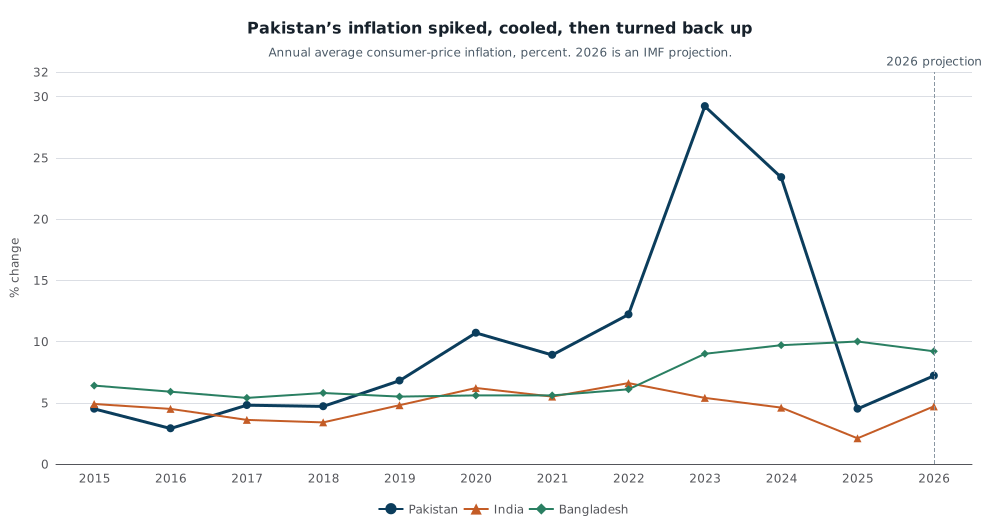
Annual-average consumer-price inflation, percent, 2015–2026. 2026 is an IMF projection in this snapshot, not a completed year. Source: IMF World Economic Outlook, average consumer prices (PCPIPCH). Choose Pakistan, India or Bangladesh on the MacroVedia inflation page.
A doubled basket, not a one-year spike
Inflation is a rate. Households live with a level. The IMF’s consumer-price index makes that distinction brutal. Rebased so 2019 equals 100, Pakistan’s index reached 225 in 2025. The same average basket of goods and services cost 125 percent more than it had six years earlier — more than twice as much.
Falling inflation in 2025 only slowed the climb. It did not restore 2019 prices, or even 2021 prices. From 2021 to 2025 the index still rose 87 percent. Anyone whose rupee income did not rise in line with that path lost purchasing power even while the official inflation rate was coming down.
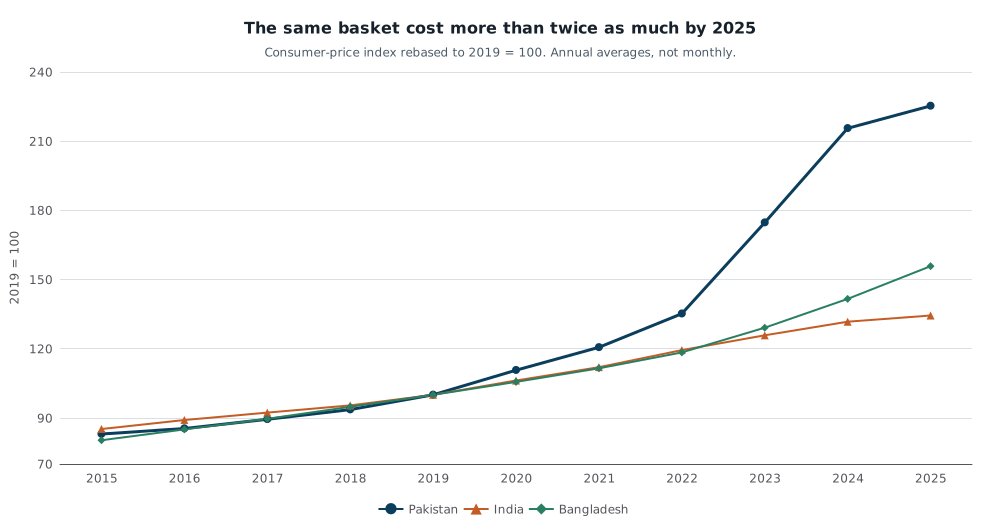
Consumer-price index rebased to 2019 = 100, annual averages, 2015–2025. Source: IMF World Economic Outlook, PCPI, rebased by the authors. The 2025 cooling is visible as a flatter slope, not a reversal.
Neighbors did not go through the same reset. Over 2019–2025, India’s consumer-price index rose 34 percent and Bangladesh’s 56 percent. Bangladesh has had a different, stickier problem: average inflation near 9–10 percent in 2023–2025, without Pakistan’s 29 percent spike, and without Pakistan’s 2025 collapse toward 4 percent. India, in the same IMF accounts, averaged 5.4 percent in 2023 and 2.1 percent in 2025.
Sri Lanka is the regional warning, not the template. Its average inflation hit 45.2 percent in 2022 and 17.4 percent in 2023, then 1.2 percent in 2024, after which this snapshot has no later Sri Lankan CPI. Pakistan’s 2023–24 burst was milder than Sri Lanka’s peak and longer than India’s. It was also unfinished: the Fund’s 2026 projection has the rate rising again.
| 2022 | 2023 | 2024 | 2025 | 2026 proj. | |
|---|---|---|---|---|---|
| Pakistan | 12.2 | 29.2 | 23.4 | 4.5 | 7.2 |
| India | 6.6 | 5.4 | 4.6 | 2.1 | 4.7 |
| Bangladesh | 6.1 | 9.0 | 9.7 | 10.0 | 9.2 |
| Sri Lanka | 45.2 | 17.4 | 1.2 | — | — |
Annual-average consumer-price inflation, percent. 2026 is an IMF projection. Sri Lanka’s series in this snapshot ends in 2024. Source: IMF WEO, PCPIPCH.
This was not the heat of a boom
A price spike can accompany a roaring real economy. That is not what the Fund’s real-output accounts show for Pakistan. Real GDP contracted 0.2 percent in 2023, the inflation peak. Real GDP per person, in constant national-currency terms, was only 4.5 percent higher in 2025 than in 2019 — and still 0.3 percent below 2022. The IMF’s unemployment estimate rose from 6.0 percent in 2022 to 7.5 percent in 2023 and was still 7.1 percent in 2025.
Those figures do not measure wages, informal work, or the food-and-fuel slice that emptied plates in Karachi. They are enough to rule out a simple story in which prices ran away because the country was suddenly much richer. Output per person barely moved while the price level more than doubled. A new year of inflation near 11 percent does not land on 2019 prices. It lands on 2025 prices.
That is why a print that would have been painful in 2018 is now a political event. The 2023–24 shock already did the heavy lifting. The 2025 disinflation took the rate down without taking the level back. The 2026 rebound, if the Fund’s year-end projection of 11.5 percent is close to the path Pakistan is on, means households are being asked to absorb another high-inflation year after the currency in their pockets has already been rewritten.
The Karachi march was not a complaint about a single June figure. It was a complaint about a price level that doubled and then started rising faster again.
Sources and methods
This is a retrospective look at news from 30 July 2026, written on 10 September 2026 with an IMF World Economic Outlook snapshot ingested in August 2026 (raw run 10 August 2026). Later data were not available on digest day and are not presented as if they were.
All rates and index levels above are annual IMF series, not Pakistan’s monthly CPI. The June 11.1 percent year-on-year figure, the 5.5-to-10 percent intra-year jump, and the protest details are AFP reporting, not calculations from this dataset. IMF 2026–27 values are projections in this snapshot; 2025 is treated as the latest completed year. Average inflation (PCPIPCH) and end-of-period inflation (PCPIEPCH) are different measures; the 11.5 percent 2026 figure is the year-end projection, not the annual average. The consumer-price index (PCPI) was rebased by the authors so 2019 equals 100; that is an arithmetic rescaling, not an official IMF presentation. Real GDP per person is constant-price national currency, not dollars, and is not a wage or poverty series. Unemployment is the IMF WEO estimate. Sri Lanka’s CPI in this extract ends in 2024.
Primary source: IMF World Economic Outlook. Interactive copies of the inflation rate and price-index series are on MacroVedia; pick Pakistan in the geography selector. Reporting: AFP via RFI.
Research Date
The displayed date matches the related news edition. Research was completed 2026-09-10.
Related news: Daily · 2026-07-30
More Research
Three Million Unemployed Is Not Germany’s Old Jobs Crisis
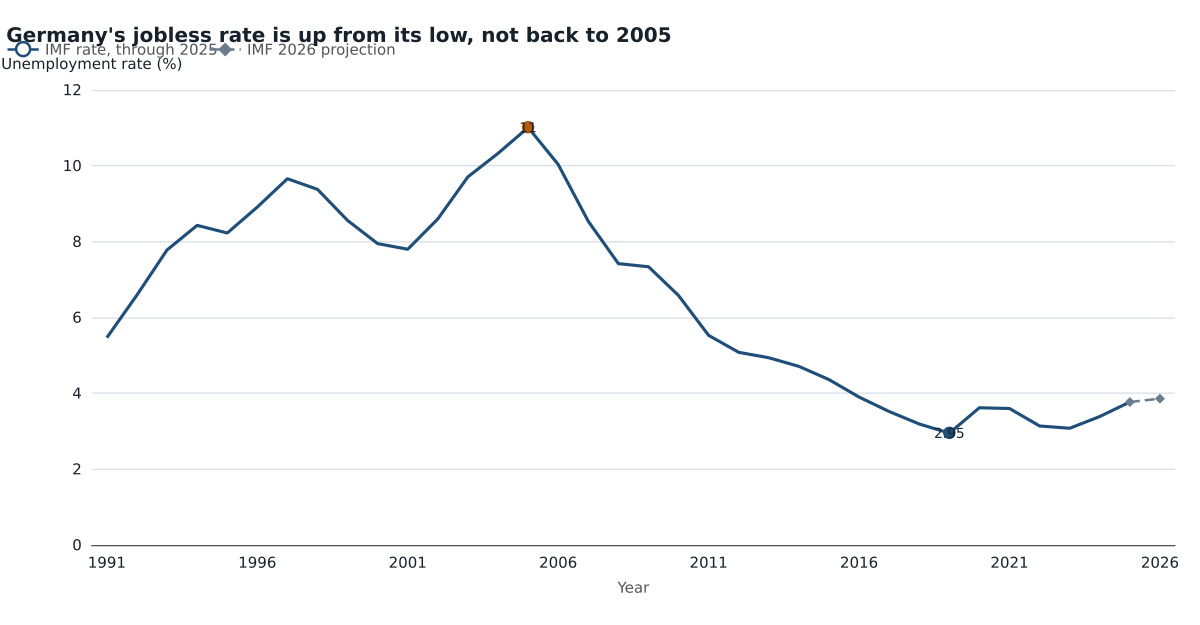
Germany’s IMF unemployment rate rose to 3.8 percent in 2025 from a 2.95 percent low in 2019, still far below the 11 percent peak of 2005, while employment stayed near 42.5 million.
The Oil Shock Is Not A U.S. Oil-Jobs Boom
U.S. oilfield payrolls remain about 40 percent below their 2014 peak; the 2026 price spike is not a hiring boom.
The Ceuta Fence Sits On An Eight-To-One Income Cliff
Spain still produces about eight times as much dollar output per person as Morocco. Headline unemployment is not the gap that explains Ceuta.