 LunarWeave
Heavy Strikes, Lighter Wallets, And A Nobel Team Reduced To A Side Quest
World & Security
The US–Iran pause lasted roughly as long as the average diplomatic statement. France 24 reports a “heavy wave” of US strikes on Iran after Tehran targeted American bases in Jordan, ending the near-week-long lull and burying hopes of quick talks. Al Jazeera’s day-19 recap says the revived war has already taken a family of three on Qeshm Island. Iranian media tells a different story: Press TV relays IRGC claims that its missiles destroyed three F-35s and killed US personnel at Jordan’s Muwaffaq Salti base. The Pentagon, facing accusations that it understated casualties, started logging post-ceasefire losses on a separate webpage labeled “overseas operations casualties” — an accounting innovation apparently designed to keep casualty analysts employed. Officials are also asking pointed public questions about how many interceptors are left.
On the European flank, Reuters reports Poland’s prime minister said a Russian missile appeared to have come down in the country’s east, while Al Jazeera frames it as another NATO scramble in a growing series of airspace violations. That dovetails with Ukraine’s warnings that air defenses are slipping: DW counts at least eight dead after Russian strikes, and an expert tells France 24 interception rates have fallen from around 90 percent in March to 70–75 percent or below. Ukraine also handed Iran a new grudge: DW reports Kyiv struck an Iranian cargo ship it says was carrying weapons to Russia, while Tehran promises an “unforeseen” answer.
Markets & Economy
Wall Street’s AI hangover hardened into something like a migraine. Chip stocks shed more than a trillion dollars as investors flinched at the price of hype, and South Korea’s market slid to a three-month low. The Federal Reserve offered its usual measured non-answer: rates stayed unchanged in a 9–3 vote, with the dissenting members wanting a hike and new chair Kevin Warsh insisting the committee watches “overall trends,” not the one inflation print that happened to cooperate.
The AI buildout is also leaving unglamorous residue. America’s biggest power grid has floated cutting data centers off to avoid blackouts; Reuters reports the EPA is letting data-center power sidestep some pollution rules; and power-sector carbon emissions rose 4 percent as coal generation jumped 13 percent. The same squeeze reaches the retail shelf: memory prices remain gnarly, graphics cards are getting pricier in China, and Oracle quietly halved its free cloud tier. Cuba, meanwhile, is doing the unthinkable: opening pharmacies, fuel distribution and rubbish collection to private firms. Call it market liberalization by necessity.
Technology & Industry
Big Tech is rearranging its Nobel prizes and its robotaxis. Google DeepMind’s AlphaFold team, members of which won a Nobel for solving the protein-folding problem, is being broken up and reassigned to Gemini-related projects. Amazon, after gutting most of its Nova AI models, is reportedly pulling resources into a single robotics-adjacent frontier model effort. In the same week, its Zoox unit won US approval to charge passengers in steering-wheel-free robotaxis, with a reported 2,500 vehicles per year and added reporting requirements. Translation: if you want to know what tech giants value, follow the payroll, not the press releases.

The collateral damage is not limited to labs. AI companies are reportedly buying rare books, scanning them and pulping the remains, even when almost no copies survive, because pre-LLM print is supposedly free of “contamination”; Australia is fighting back, or at least trying to. The products of all that data are also drawing scrutiny: a GPTZero probe found PwC Middle East “thought leadership” reports stuffed with hallucinated citations, with one flagged as 100 percent AI-generated. And a missing underscore sent an innocent man to prison for 18 months, proof that machine error, not machine intelligence, remains the industry’s defining feature.
Politics & Policy
The US election machine is already lurching. The administration asked the Supreme Court to allow an executive order that could dramatically change mail-in voting before November’s midterms. A top DHS statistics official resigned, calling the immigration push a “war on immigrants” and describing “brazen corruption.” Documents reviewed by The Guardian also show at least one ICE hunger striker was force-fed or subjected to forced catheterization — practices experts describe as torture. And the Justice Department is ramping up denaturalization cases, aiming to file at least 250 by October.
Beyond Washington, the week had a pleasing surplus of political theater. European nations agreed to boycott the World Cup over Gianni Infantino’s plan to sell a private-equity stake in FIFA’s tournaments, with Joshua Kushner’s investment firm reportedly in the picture — a rare moment when UEFA and the word “boycott” sound like good governance. Brazil’s Supreme Court, meanwhile, is demanding to know whether Jair Bolsonaro approved a deepfake of himself endorsing his son while under house arrest. The AI said it was speaking for a man who, by law, cannot speak.
Human Stories / Social Trends
Economic fear has a new roommate. Reuters reports young Chinese renters are increasingly sharing beds with strangers to split rent; one sales agent cut her bill by 450 yuan and calls it a matter of survival, while hashtags on Weibo and Xiaohongshu racked up tens of millions of views. In Karachi, hundreds of transgender Pakistanis protested inflation with a sign that deserves framing: “We beg on the streets, you beg at the IMF.” Their complaint lands amid consumer prices up 11.1 percent in a country where the most vulnerable are the first to run out of plates.
Absurdity also took the day off nowhere. Tuvalu, short a patrol boat after cyclones, borrowed a Sea Shepherd vessel to arrest a Chinese longliner accused of dumping shark fins and spoofing its location — an NGO doing coast-guard cosplay at official request. And Pokémon card stores in Japan now demand facial scans from children as young as six to keep scalpers away. Nothing says “trading card game” quite like biometric surveillance before you can buy a booster pack.
Research In Context
Karachi’s late-July march against empty plates was not a protest about a new kind of inflation. AFP reported June consumer prices 11.1 percent higher than a year earlier. In the IMF’s annual accounts, that rebound lands on a price level that had already more than doubled.
From 2019 to 2025, Pakistan’s consumer-price index rose 125 percent. India’s rose 34 percent; Bangladesh’s, 56 percent. Average inflation had hit 29.2 percent in 2023 and 23.4 percent in 2024 — the two highest years since at least 2000 — before cooling to 4.5 percent in 2025. The Fund’s 2026 projection puts year-end inflation back at 11.5 percent. The rate fell. The cost of living did not go back.
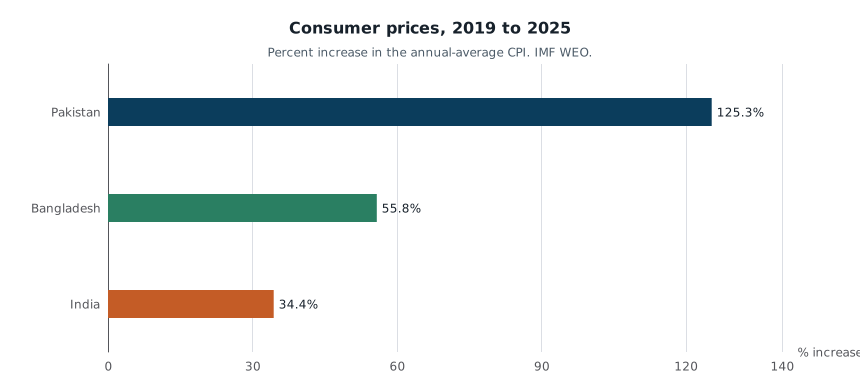
Percent increase in the annual-average consumer-price index, 2019–2025. Pakistan 125.3%; Bangladesh 55.8%; India 34.4%. IMF World Economic Outlook, PCPI. These are cumulative price-level changes, not the June monthly rate, and they do not split out food or fuel.
Retrospective context, written 10 September 2026 from an August 2026 IMF snapshot: Pakistan’s prices more than doubled. Then inflation came back.
Dates and sources
This digest covers the news day 2026-07-30. It is presented retrospectively from a saved draft; its date in the URL identifies the news day, not an assertion of publication on that day. News references link to their original outlets. Supporting research was completed 2026-09-10. Its data vintage and material limitations are recorded in the article methods and chart captions.