LunarWeave
Three Million Unemployed Is Not Germany’s Old Jobs Crisis
When German authorities say the jobless count has topped three million, the number is meant to land with a thud. Deutsche Welle reported that figure at the end of July 2026, alongside a slump in industry and 1.1 million people drawing unemployment checks. Three million is a round, political number. It is also close to the register totals that defined Germany’s long unemployment emergency in the mid-2000s.
The internationally comparable measure tells a narrower story. In the IMF’s World Economic Outlook, Germany’s unemployment rate — people without work as a share of the labour force — rose from a record low of 2.95 percent in 2019 to 3.8 percent in 2025. That is a real loosening after two years of falling output. It is not a return to 2005, when the same series peaked at 11.0 percent. Employment is still near a record. Among the large rich economies compared here, Germany still had the lowest jobless rate in 2025.
The three million headline and the IMF rate are not the same object. The Fund’s series cannot confirm or refute a July 2026 administrative headcount. What it can show is whether Germany’s labour market has actually gone back to crisis conditions.
A rise from the floor, not a climb back up the wall
Germany’s IMF unemployment rate spent the 1990s and early 2000s in a different country. After reunification it climbed from 5.5 percent in 1991 to 11.0 percent in 2005. It then fell for more than a decade, through the global financial crisis and the euro-area slump, to 2.95 percent in 2019 — the lowest reading in this series since at least 1991.
The latest move is up, not down. The rate was 3.1 percent in 2023, 3.4 percent in 2024 and 3.8 percent in 2025. That is 0.8 percentage points above the 2019 trough and still 7.2 points below the 2005 peak. The 2025 figure is about a third of that peak rate. The IMF’s 2026 projection, which is not an observation, is 3.9 percent.
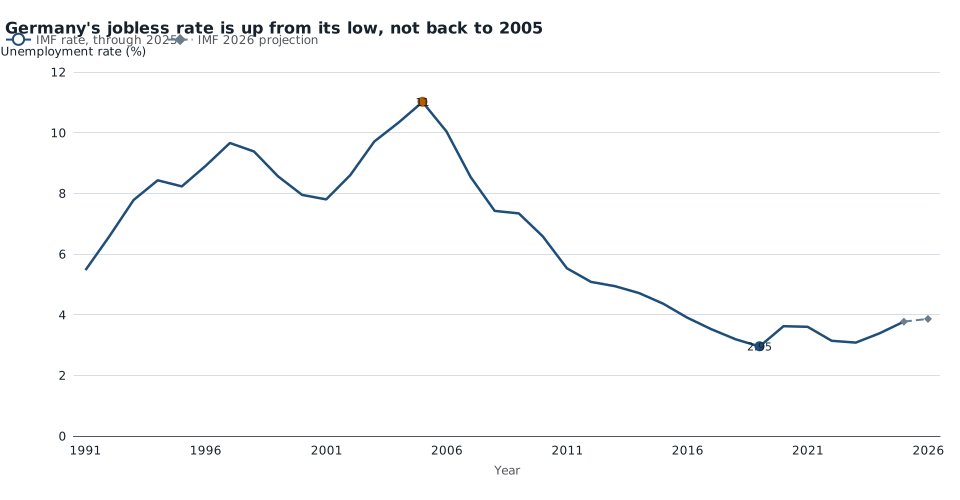
IMF unemployment rate for Germany, percent of the labour force, annual, 1991–2026. The solid line through 2025 is the IMF year series in the pinned August 2026 snapshot; 2025 is a calendar-year figure, not a July 2026 monthly print. The dashed 2026 point is an IMF projection. This labour-force measure is not the German registered-unemployed headcount. Source: IMF World Economic Outlook, series LUR. Readers choosing Germany on the unemployment-rate series page will see the same 2005, 2019, 2024 and 2025 points used here.
Those annual rates cannot be read as a snapshot of the last week of July. They also cannot be converted, without a matching register, into the three million people German agencies count as unemployed. Combining the IMF’s employment and unemployment-rate series does produce an implied ILO-style jobless stock: about 1.25 million people in 2019 and 1.66 million in 2025, against 4.41 million in 2005. That identity is a scale check on the Fund’s own concepts. It is not an official unemployed-persons series, and it is not the German register.
The jobs stock did not collapse with output
If the labour market were retracing 2005, employment would be shrinking in a serious way. It is not. IMF employment in Germany was 35.7 million in 2005, 41.1 million in 2019 and 42.5 million in 2024 — the high point in this extract. The 2025 figure is 42.46 million, about 21,000 lower, which is flat at this scale. That still leaves 1.3 million more people in work than in 2019, and 6.8 million more than in 2005.
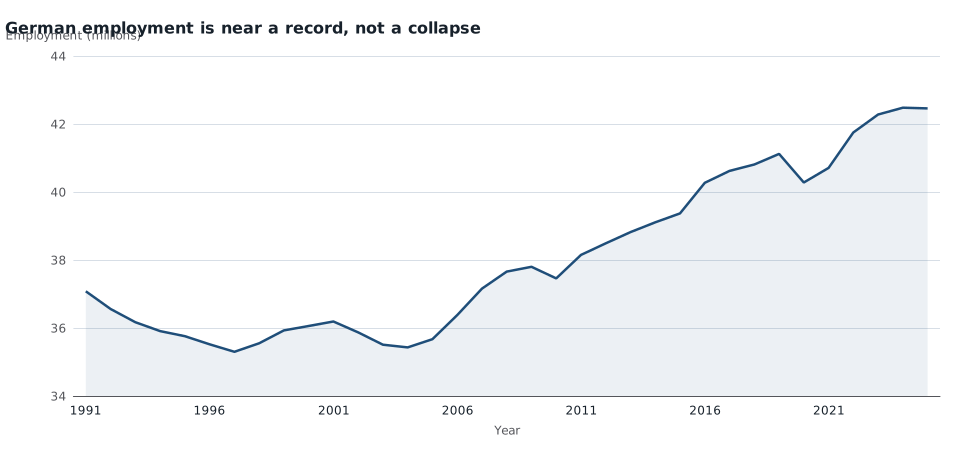
IMF employment for Germany, millions of persons, 1991–2025. The 2025 figure is the IMF year estimate in the pinned snapshot. Source: IMF World Economic Outlook, series LE. Choose Germany on the employment series page to inspect the same 2019, 2024 and 2025 points.
Employment as a share of population tells the same story. It was 43.9 percent in 2005, 50.0 percent in 2019 and 50.8 percent in 2025. Germany put a much larger slice of a slightly larger population to work over those twenty years. A three million register total is easier to reach on today’s labour force than it was when fewer people had jobs — but only if one treats the register and the IMF rate as interchangeable, which they are not.
The output backdrop makes the jobs resilience sharper, not weaker. Real GDP fell 0.9 percent in 2023 and 0.5 percent in 2024, then the IMF’s 2025 figure is a 0.2 percent increase. That leaves 2025 real output only 0.3 percent above 2019. The Fund’s output gap for 2025 is −1.1 percent of potential GDP, a slack reading, not the −3.8 percent gap of 2009. Germany has had a stalled economy and a labour market that is cooling from an unusually tight starting point.
| Year | Unemployment rate (%) | Employment (millions) | Implied ILO-style unemployed (millions) | Real GDP (% change) |
|---|---|---|---|---|
| 2005 | 11.0 | 35.7 | 4.41 | 0.9 |
| 2019 | 2.95 | 41.1 | 1.25 | 1.0 |
| 2023 | 3.1 | 42.3 | 1.35 | −0.9 |
| 2024 | 3.4 | 42.5 | 1.49 | −0.5 |
| 2025 | 3.8 | 42.5 | 1.66 | 0.2 |
Unemployment rate and employment are IMF WEO series LUR and LE. Implied unemployed is derived from those two series and is not a published jobless-stock figure. Real GDP is IMF series NGDP_RPCH. 2025 is the IMF year figure in the pinned snapshot. Figures rounded from the saved extracts.
Still the low-unemployment large economy in this group
A 3.8 percent IMF rate is not low only by Germany’s own 2005 standard. In 2025 it was the lowest among the seven large economies compared here: the Netherlands 3.9 percent, the United States 4.3 percent, the United Kingdom 4.8 percent, Italy 6.0 percent, France 7.6 percent and Spain 10.5 percent. National labour-force surveys are not identical, so the ranking is a comparison of IMF-published rates, not a claim that every country’s statistics office counts the same way.
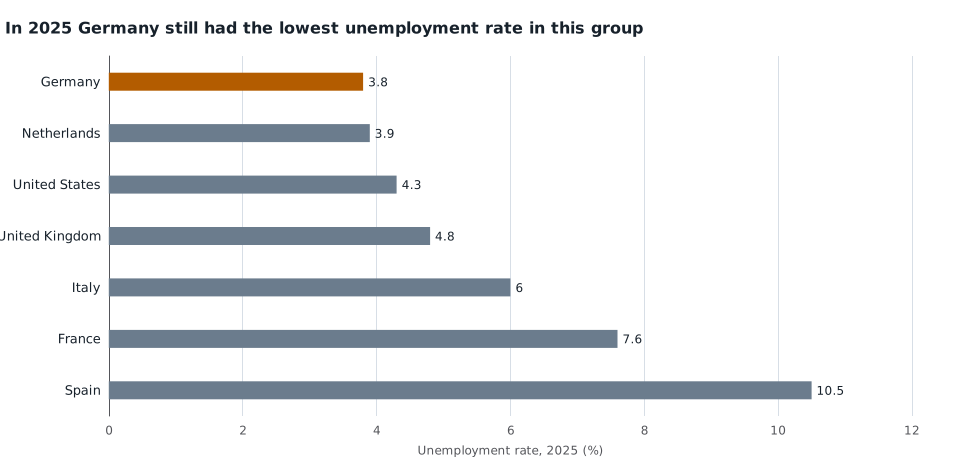
IMF unemployment rates for 2025, percent of the labour force. Annual Fund figures, not monthly administrative counts. Source: IMF World Economic Outlook, series LUR.
Italy is the useful contrast inside Europe. Its IMF rate fell from 9.9 percent in 2019 to 6.0 percent in 2025 while Germany’s rose. That does not make Italy’s labour market healthier in every dimension — employment rates, hours and contract quality are outside this extract — but it does mean Germany’s 2025 jobless rate is not high because “Europe is high.” In this set, Germany is still the tight market.
What the three million line does not settle
None of this says the industrial slump is imaginary, or that 0.8 points of extra unemployment is costless. People who lose shifts in manufacturing do not experience a national rate. The IMF series is annual, economy-wide and silent on which industries, regions or age groups are absorbing the rise. It cannot show whether the 1.1 million people DW said were drawing unemployment checks are the same people the labour-force survey would count as unemployed.
It also cannot show that three million is a misprint. Germany’s Federal Employment Agency publishes a registered-unemployed total that has long run above the survey concept used in international comparisons. The news figure belongs to that administrative world. The IMF rate belongs to another. Treating the first as proof of an 11-percent-style crisis, or the second as proof that nobody is out of work, is the same error in opposite directions.
The evidence that is in the Fund’s accounts is simpler. Germany’s labour market has given back some of the extraordinary tightness of 2019. It has done so while employment stayed near a record and while the unemployment rate remained far below the mid-2000s peak and below every large peer in this comparison. Three million on a register can be true in the same year that the labour-force survey still describes a relatively tight market. That is the tension the headline compresses, and it is the part the IMF numbers can actually measure.
Sources and methods
This article is retrospective. It was researched on 10 September 2026 using a pinned IMF World Economic Outlook snapshot dated 24 August 2026, not the data available on the 31 July 2026 news day. Observation years are not release dates. Figures through 2024 are treated as historical; 2025 is the IMF calendar-year figure in that snapshot; 2026 and later are projections and are labelled as such. Implied unemployed people are calculated as employment × (rate/100) / (1 − rate/100). Population is IMF series LP, used only for the employment-to-population shares. Deutsche Welle’s three million and 1.1 million figures are attributed reporting from a feed excerpt, not counts recovered from the IMF files.
Primary source: IMF World Economic Outlook dataset, series LUR (unemployment rate, percent of labour force), LE (employment, persons), LP (population, persons), NGDP_RPCH (real GDP, percent change) and NGAP_NPGDP (output gap, percent of potential GDP).
Research Date
The displayed date matches the related news edition. Research was completed 2026-09-10.
Related news: Daily · 2026-07-31
More Research
The Ceuta Fence Sits On An Eight-To-One Income Cliff
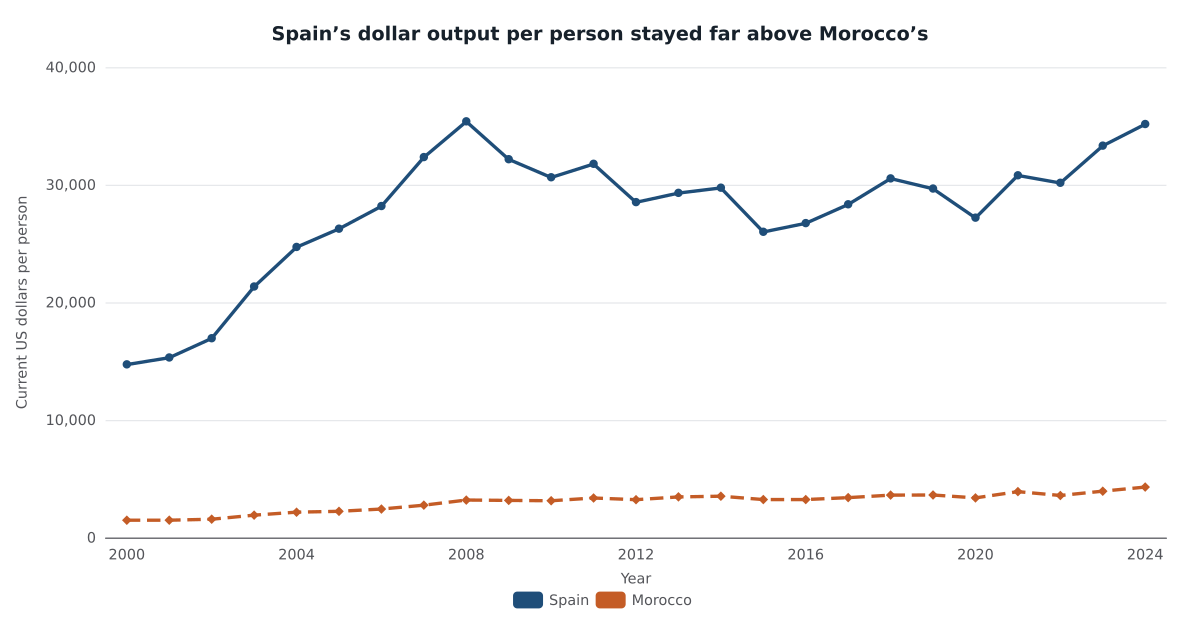
Spain still produces about eight times as much dollar output per person as Morocco. Headline unemployment is not the gap that explains Ceuta.
Pakistan’s Prices More Than Doubled. Then Inflation Came Back.
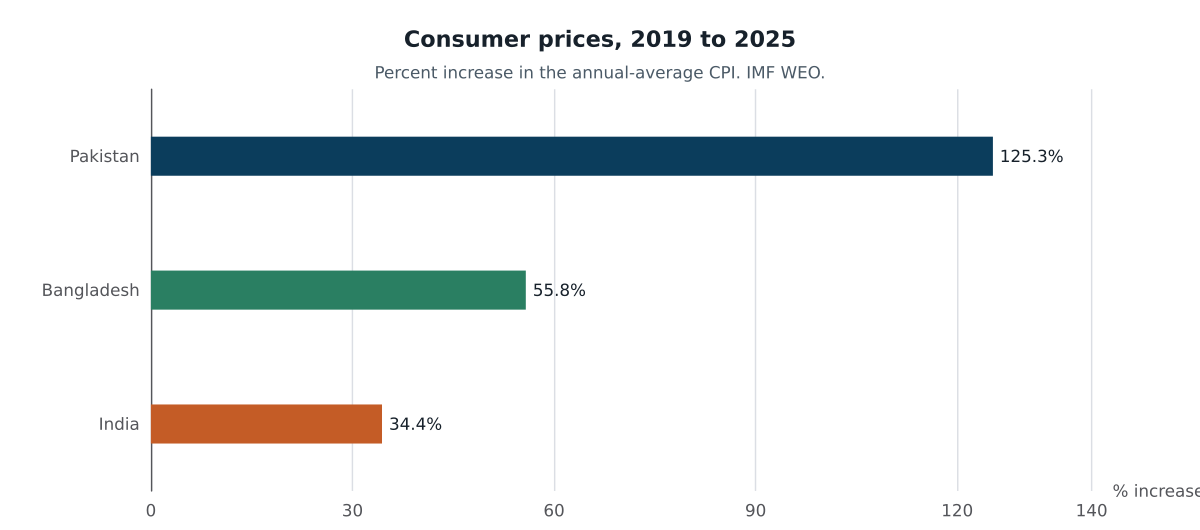
IMF accounts show Pakistan’s consumer prices rose 125 percent from 2019 to 2025. Inflation cooled in 2025 without reversing that level, then turned back up.
Airline Jobs Have Not Collapsed. The Bill Is In The Wage.
US air-transportation jobs in mid-2026 were still well above 2019. The cost pressure is in wages and hours, not a 2020-style payroll collapse.