LunarWeave
$110 Oil Is A Power-Bill Shock In Only A Few Grids
Houthi strikes on Saudi oil facilities and shipping helped send Brent crude back above $110 a barrel, a five-month high. The familiar damage path is the pump, the tanker rate and the inflation print. For most electricity systems that is still the right map. A smaller set of grids never left oil as a power-plant fuel, and several of them sit on the same geography as the attacks.
The question is not whether oil is expensive. It is whether expensive oil still turns the lights on.
The world did quit oil-for-power — in the mix, and in the kilowatt-hours
In 2000, oil-fired plants generated 1,069 terawatt-hours, 6.9 percent of world electricity. By 2023 that had fallen to 718 TWh, 2.4 percent of a grid that had almost doubled. The drop is not an illusion of a bigger denominator: oil-fired output itself was down 33 percent. Among fossil plants the retreat is even clearer. Oil accounted for 10.8 percent of fossil-fuelled generation in 2000 and 4.0 percent in 2023. Coal and gas still dominate thermal power. Oil does not.
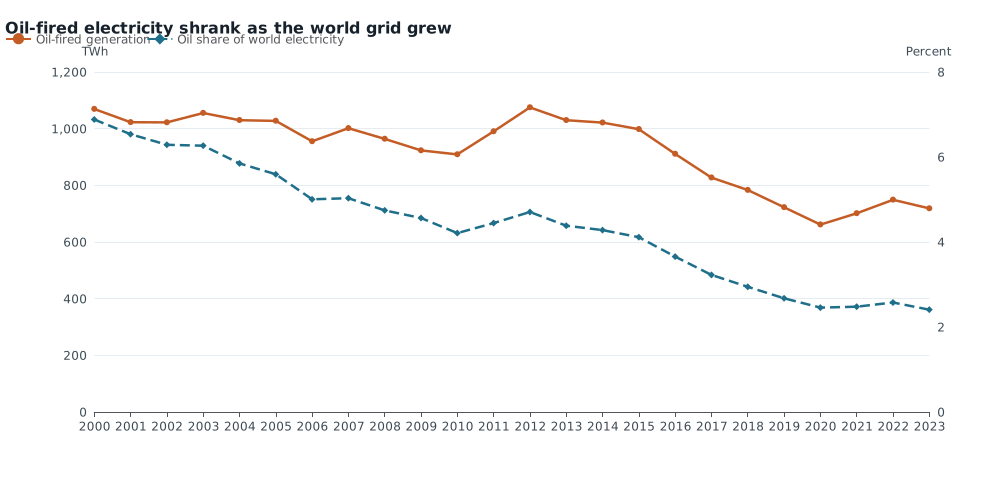
World oil-fired electricity generation in terawatt-hours (solid line, left axis) and as a share of total electricity generation (dashed line, right axis), 2000–2023. Oil generation is the sum of IRENA country observations; total generation is IRENA’s published World renewable plus non-renewable generation. 2024 generation is preliminary and omitted. Source: IRENA IRENASTAT.
That is why a $110 barrel is, for the United States, China or France, overwhelmingly a transport-and-industry story. In 2023 oil produced 0.74 percent of US electricity, 1.1 percent of France’s and 0.01 percent of China’s. Japan, which still ran oil plants after the Fukushima shutdowns, was down to 3.0 percent from 12.5 percent in 2000. Mexico cut oil’s share from 46 percent to 7.3 percent.
The United States is not a rounding error in volume. It still generated 33 TWh from oil in 2023 — fifth in the world — but that is a sliver of a 4,446 TWh system, and less than a third of the 118 TWh it burned in 2000. A price spike can still light up a few residual oil units. It does not set the American power bill.
The remaining oil kilowatt-hours piled up in the Gulf
What the world average conceals is concentration. In 2000, Saudi Arabia, Iran, Iraq and Kuwait together produced 13 percent of oil-fired electricity. In 2023 they produced 45 percent. Saudi Arabia alone generated 182 TWh from oil — a quarter of the world total, and more than Iran, Iraq and Kuwait combined.
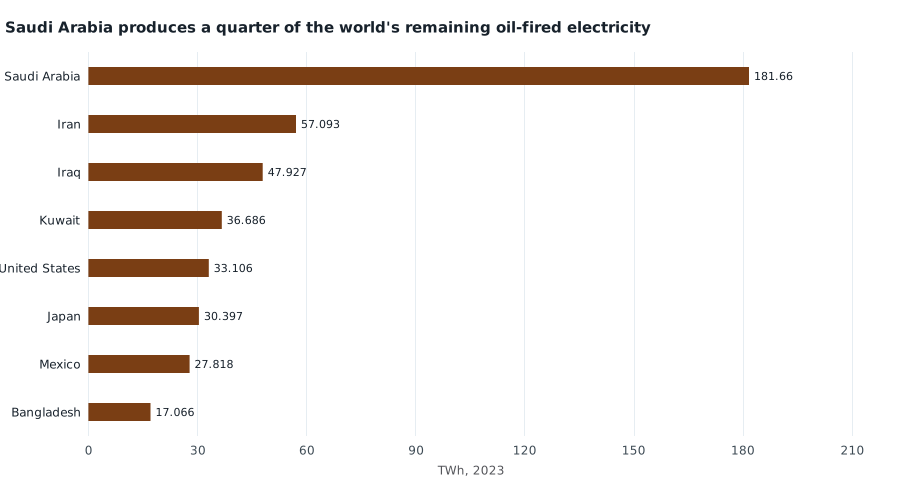
Largest country producers of oil-fired electricity in 2023, terawatt-hours. Saudi Arabia generated 182 TWh, about 25 percent of the world country-sum. The United States ranks fifth by volume but oil is under 1 percent of its mix. Source: IRENA IRENASTAT.
Saudi oil-fired output nearly tripled from 68 TWh in 2000 even as the kingdom’s oil share eased from 54 percent to 41 percent. The grid grew; oil plants grew with it. Iraq’s oil share fell from 79 percent to 51 percent, but oil generation still rose. Iran’s oil-fired output more than doubled, to 57 TWh, 15 percent of its electricity. Kuwait generated 42 percent of its power from oil.
These are not island microgrids. Saudi Arabia’s electricity system produced 445 TWh in 2023, in the same league as a large European country. When oil facilities in that system are under attack, the price shock and the power-system shock occupy the same country.
Share of the mix, not just barrels in the ranking
A high oil share on a tiny system is a different fact from a high share on a large one. Yemen generated 89 percent of its electricity from oil in 2023 — and only 5.1 TWh in total. Cuba was 78 percent oil on 15 TWh. Those shares are brutal for the people on those grids. They do not move the world oil-power total.
The large systems that still run on oil are Iraq at 51 percent, Kuwait at 42 percent and Saudi Arabia at 41 percent. Iran is lower, at 15 percent, but still far above the United States or China.
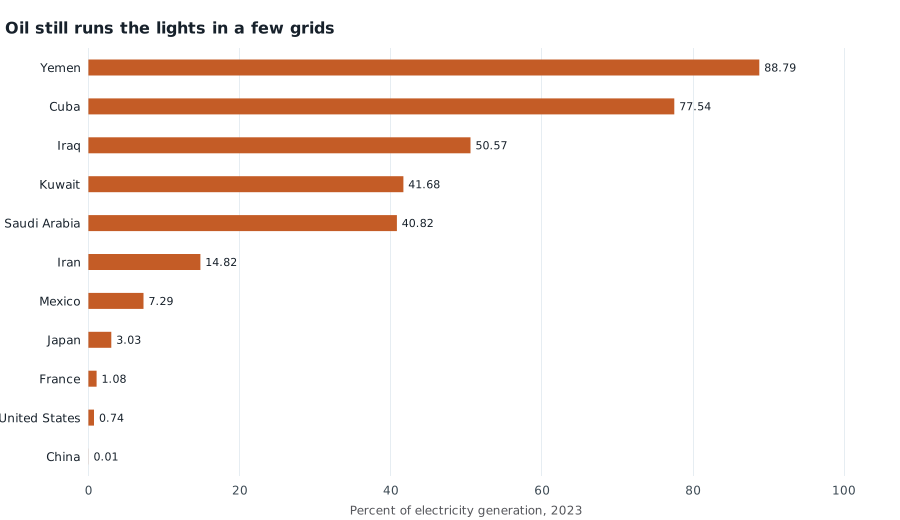
Oil-fired share of electricity generation in 2023, percent. Generation is gross output (on- and off-grid), not electricity consumption. Yemen and Cuba have very small systems; Saudi Arabia, Iraq and Kuwait are the large oil-power grids. 2024 figures are preliminary and not used. Source: IRENA IRENASTAT.
| Country | Oil-fired generation, 2023 (TWh) | Share of that country’s electricity |
|---|---|---|
| Yemen | 4.5 | 88.8% |
| Cuba | 12.0 | 77.5% |
| Iraq | 47.9 | 50.6% |
| Kuwait | 36.7 | 41.7% |
| Saudi Arabia | 181.7 | 40.8% |
| Iran | 57.1 | 14.8% |
| Mexico | 27.8 | 7.3% |
| Japan | 30.4 | 3.0% |
| France | 5.7 | 1.1% |
| United States | 33.1 | 0.74% |
| China | 1.3 | 0.01% |
Oil-fired generation as a share of each country’s total electricity generation in 2023. TWh are GWh / 1,000 from IRENA. Yemen and Cuba are small systems; volume is in the middle column.
What a $110 barrel does — and does not — hit
None of this measures the October 2026 spot price, tanker freight, or whether any particular Saudi plant was damaged. IRENA’s generation accounts run through 2023, with 2024 still flagged as preliminary. They cannot say how many oil-fired kilowatt-hours were produced in the week of the attacks.
They can say where oil-fired electricity still lives. For China, the United States and France, $110 oil is not a power-mix event. For Saudi Arabia, Iraq and Kuwait it still is, because two-fifths to one-half of the electricity those countries generate comes from burning oil. Yemen’s grid is almost entirely oil-fired, at a scale that barely registers globally and matters locally.
The attacks therefore couple two markets that most rich-country grids uncoupled years ago: the export barrel and the domestic kilowatt-hour. That is the feature of this oil shock that a gasoline price cannot capture.
Sources and methods
This is retrospective research completed on 21 October 2026, after a 20 October 2026 news cycle. It uses IRENA’s IRENASTAT electricity-generation accounts in a snapshot sealed on 8 October 2026, not information that was necessarily available on the digest date.
Figures are annual gross electricity generation in gigawatt-hours, including on-grid and off-grid output measured at generator terminals — not final consumption, not primary energy, and not transport fuel. Oil is IRENA’s “Oil” technology, distinct from oil shale/sands. Country oil shares are oil generation divided by that country’s Total Renewable plus Total Non-Renewable generation. World oil generation is the sum of country-level oil observations, because this snapshot has no World oil series; the same country-sum for renewable and non-renewable generation matches IRENA’s published World totals within 0.1 GWh. Missing country-years are not treated as zero. The United Arab Emirates and Qatar have no oil-generation series in the snapshot, so they are omitted rather than scored at zero.
IRENA notes that 2024 generation is preliminary and not accurate at aggregate levels. Headline comparisons use 2023. Several large oil-power countries show identical 2023 and 2024 oil figures, another reason not to treat 2024 as a new observation.
Oil-price prints are attributed to contemporaneous reporting, not to this dataset.
Research Date
The displayed date matches the related news edition. Research was completed 2026-10-21.
Related news: Daily · 2026-10-20
More Research
Renewables Caught Fossil Fuels On The Capacity Chart. Fossil Plants Still Set The Generation Record.
IRENA world data show renewable capacity overtaking fossil-fuel capacity in 2025 while fossil electricity generation was still at a record.
America’s Auto Plants Are Producing More. Michigan’s Factories Are Not Hiring.
US motor-vehicle manufacturing output is 36 percent above 2019. Auto-state factory jobs are mixed: Michigan is down, Texas and the South are not.
The First Permanent Nuclear Dump Is In A Small Nuclear Country
Finland licensed the first permanent high-level nuclear-waste repository. IRENA electricity data show it is a high-share, small-volume nuclear country: 42% of its power, 1.3% of recorded nuc