 LunarWeave
A Summit Of Empires, A Barrel Over $110, And Chatbots That Listen
World & Security
Peace diplomacy is moving fast in every direction at once. In Oslo, Volodymyr Zelenskyy met Donald Trump's envoy Steve Witkoff — who now heads to Moscow, where the New York Times reports he and Jared Kushner plan to meet Vladimir Putin in St. Petersburg on October 21 — while Trump mused it might be “time for somebody else to negotiate for Ukraine.” Sergei Lavrov, meanwhile, says Russia will listen to proposals but make no political concessions. And Putin is floating a trilateral summit with Trump and Xi at November's APEC gathering in Shenzhen, which veteran French diplomat Gérard Araud reads as a Yalta-flavored “gift” to a Russia playing superpower — one that would erase Ukraine and Europe from the table.
The back channels are messier: the Wall Street Journal reports Elon Musk personally ordered a slowdown of Starshield, Starlink's military version, for Ukraine — panicking Kyiv and confusing the White House — though after Oslo, Zelenskyy confirmed intelligence sharing with Washington now “works.”
The wars don't pause for summitry: Sudanese army drones killed over 200 people at a funeral convoy and a fuel market; a Houthi missile strike on a Yemeni training camp left 73 recruits dead; NATO is sending extra aircraft, radars and drones to the Black Sea after attacks on merchant shipping; and a Russian satellite edged within meters of an ICEYE imaging satellite that Ukraine — and Poland's military — depend on.
Markets & Economy
Oil is the story again. Houthi attacks on Saudi airports and Aramco facilities — Riyadh residents got “hostile aerial threat” alerts and civil servants were told to work from home — helped push Brent above $111, a five-month high, while WTI jumped more than 5% on its last day as the benchmark contract. Tanker freight costs are at record levels, IEA chief Fatih Birol sees “no credible prospect” of 2027 normalization, and America's Strategic Petroleum Reserve has fallen to 282.7 million barrels, its lowest since 1982.
The insecurity is even rearranging the conference calendar: Saudi Arabia postponed “Davos in the Desert” — the Future Investment Initiative — a week before opening, with Goldman Sachs and Standard Chartered bosses among those expected in Riyadh. Nothing says investor confidence like rescheduling.
China's export machine keeps winning friends the hard way: a record trade surplus is drawing pushback from economies absorbing the flood, and its hybrid-car exports to the EU nearly tripled year-on-year in September, ahead of an agreed import cap. France, meanwhile, is paying a risk premium for its riots — the 10-year spread against Germany hit its widest since 2011, which analysts describe as outright “panic.”
Research In Context
Houthi strikes on Saudi oil sites helped push Brent back above $110. For most electricity systems that is still a gasoline-and-freight event: oil-fired plants supplied only 2.4 percent of world electricity in 2023, down from 6.9 percent in 2000, and oil-fired output itself was a third smaller.
The remaining oil kilowatt-hours are concentrated. Saudi Arabia, Iran, Iraq and Kuwait produced 45 percent of them. Oil generated 41 percent of Saudi electricity, 42 percent of Kuwait’s and 51 percent of Iraq’s — against 0.74 percent in the United States.
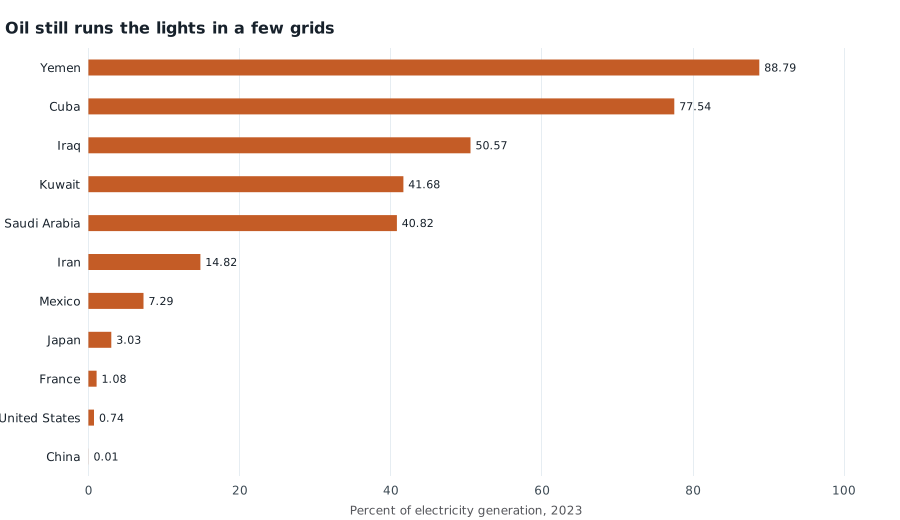
Oil-fired share of electricity generation, 2023, percent of each country’s gross output (on- and off-grid). Yemen and Cuba are tiny systems; Saudi Arabia, Iraq and Kuwait are the large oil-power grids. IRENA IRENASTAT; 2024 generation is preliminary and omitted.
Technology & Industry
SpaceX just posted its first profitable quarter, and the rockets weren't the point: $4.4 billion in net income on revenue up 161% to $14.6 billion, driven largely by renting out AI data-center capacity — including to Anthropic — from a unit now named “Super intelligence.” Musk, naturally, wants more: SpaceX and Tesla have formed committees to discuss a merger. The company also out-spent Wall Street's expectations, dropping over $19 billion on capex.
The AI turf war escalated on two fronts: Washington's Homeland Security Department ordered DeepSeek removed from federal systems, citing sensitive-data risks, and Beijing shot back that the ban “excessively expands” the concept of national security. Japan, meanwhile, traced cyberattacks on roughly 20 companies to servers running Artex, a Chinese AI hacking tool also used against South Korean banks, and is preparing a data-center security certification being read as a de facto exclusion of Chinese operators.
Banks are picking sides on AI agents: JPMorgan says it won't let outside autonomous agents anywhere near customer accounts, however fashionable they've become. Meta, for its part, claims the world's fastest undersea cable — 6,900 km to France carrying a petabit per second — because when tech companies dream, they apparently dream in bandwidth.
Politics & Policy
Alberta voted on leaving Canada — and chose, decisively, to stay: in the non-binding first-ever secession referendum, about 76% of votes counted backed remaining, a relief for Mark Carney amid his trade war with Washington. Turnout among First Nations was heavy; one polling station near Siksika Nation ran out of ballots and stayed open past 10 p.m. so nobody was turned away.
France is still counting the cost of October 17. Prime Minister Sébastien Lecornu admitted “failures,” Interior Minister Laurent Nuñez conceded police “lost control” in some cities and offered his resignation — which Macron refused, ordering him to fix the system instead. Crowd estimates had undershot wildly, and sociologist Sebastian Roché notes Paris fielded fewer officers than for a papal visit. Meanwhile, fuel prices are doing campaign work for the far right: Le Pen's ratings are up as Macron's slip.
In Washington, Trump's approval has slid to a record-low 31% in a Reuters/Ipsos poll two weeks before the midterms, and Senate Democrats want the Pentagon to say what the Iran war actually costs — CENTCOM's last figure was $43.6 billion through September 3. Poland's parliament, meanwhile, voted to ease the near-total abortion ban, though President Nawrocki is expected to veto it.
Human Stories / Social Trends
Kenya's High Court convicted doomsday preacher Paul Mackenzie and 28 followers of murdering 190 children and one adult by forcing followers to starve to death to “meet Jesus” — a case three years in the making, with a verdict that took over eight hours to read. No punchline here; just the numbers, and the shallow graves in Shakahola forest.
Two humanitarian alarms are blaring. The World Food Programme says funding shortfalls will force it to halve rations in Gaza and cut monthly assistance to about 1.1 million people — with 500,000 losing aid altogether — and more than 60,000 Gaza children have now lost one or both parents. Ebola, meanwhile, has reached Nigeria, in a patient who flew from Uganda to Abuja, as Africa CDC counts over 4,600 deaths in what its chief calls the most geographically widespread outbreak in history.
And a quieter shift: chatbots are becoming confidants. An Australian study found 18.7% of young victims of online sexual abuse shared their experience with an AI chatbot — a higher share than turned to support services — while the parents of teenager Adam Raine are suing OpenAI, alleging ChatGPT fostered a dependency before his death. Machines are always available. That's the appeal, and the problem.
Dates and sources
This digest covers the news day 2026-10-20. It is presented retrospectively from a saved draft; its date in the URL identifies the news day, not an assertion of publication on that day. News references link to their original outlets. Supporting research was completed 2026-10-21. Its data vintage and material limitations are recorded in the article methods and chart captions.