LunarWeave
South Korea's Chip Boom Still Runs On Coal, Nuclear And Gas
When South Korea reported a record October jump in exports and pointed to global demand for artificial intelligence chips, the physical question sat one layer down. Those plants do not run on a trade print. They run on a grid.
The latest complete electricity accounts from the International Renewable Energy Agency answer a narrower, more useful version of that question. By 2023, the last complete year in this snapshot, had Korea actually left coal behind — or had it merely stopped being a coal country in the old sense?
It did the second. In 2023, coal, nuclear plants and natural gas each generated between a quarter and a third of Korean electricity. Together they produced 88.8%. All renewables, including a rapidly expanded solar fleet, produced 8.4%. Coal was still the largest single source. It was no longer most of the system.
A three-way split, not a clean break
IRENA records gross generation — electricity measured at the plant, including power that plants use themselves, not only what is sold into the grid. Adding the agency's total renewable and total non-renewable series gives national output of 630.7 terawatt-hours in 2023.
Of that:
- coal generated 213.4 TWh, or 33.8%
- nuclear generated 180.5 TWh, or 28.6%
- natural gas generated 166.2 TWh, or 26.4%
- all renewables generated 52.7 TWh, or 8.4%
- oil generated 6.6 TWh, or 1.0%
A residual 11.3 TWh, or 1.8%, sits in the non-renewable total but is not identified in the coal, gas, nuclear or oil series. It is a leftover, not a named fuel, and it is not treated here as zero.
That is a different machine from the one Korea ran at the 2017 coal peak, when coal alone supplied 264.1 TWh — 45.3% of electricity — and nuclear and gas together were still smaller than coal. By 2023, coal generation was 19.2% below that peak and still first. Nuclear had become the second source. Gas was close behind.
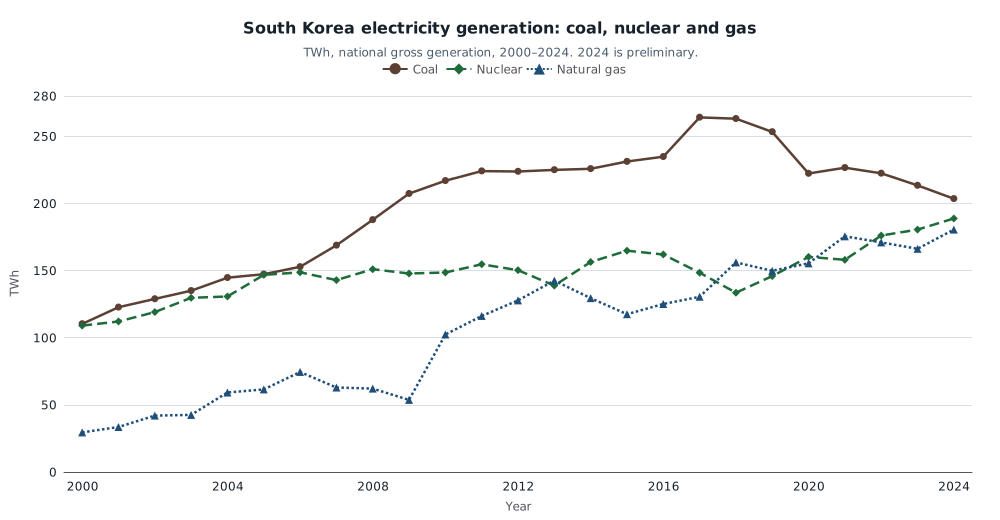
National gross electricity generation in terawatt-hours from coal, nuclear energy and natural gas, Republic of Korea, 2000–2024. Values are IRENA GWh series divided by 1,000. 2024 generation is preliminary and, IRENA warns, not accurate at aggregate levels. This is the national mix, not electricity consumed inside semiconductor plants. Source: IRENASTAT electricity statistics.
The chart is the finding. After 2017, coal stopped climbing. Nuclear recovered from a 2018 trough of 133.5 TWh, when it was only 22.3% of the mix, to a 2000–2023 record of 180.5 TWh. Gas became a pillar rather than a swing extra, though 2023 output (166.2 TWh) was still below the complete-year peak of 175.5 TWh in 2021.
| Measure | 2017 | 2023 | 2024 (preliminary) |
|---|---|---|---|
| Total generation (TWh) | 583.5 | 630.7 | 653.1 |
| Coal (TWh) | 264.1 | 213.4 | 203.5 |
| Coal share (%) | 45.3 | 33.8 | 31.2 |
| Nuclear (TWh) | 148.4 | 180.5 | 188.8 |
| Nuclear share (%) | 25.4 | 28.6 | 28.9 |
| Natural gas (TWh) | 130.5 | 166.2 | 180.5 |
| Natural gas share (%) | 22.4 | 26.4 | 27.6 |
| Renewables (TWh) | 21.1 | 52.7 | 56.9 |
| Renewables share (%) | 3.6 | 8.4 | 8.7 |
IRENA's own footnote on the country electricity table says 2024 generation is preliminary and not accurate at aggregate levels. The preliminary year continues the same pattern — coal still first, nuclear and gas close behind, renewables still under a tenth — but 2023 is the last complete year and is the basis for the claims above.
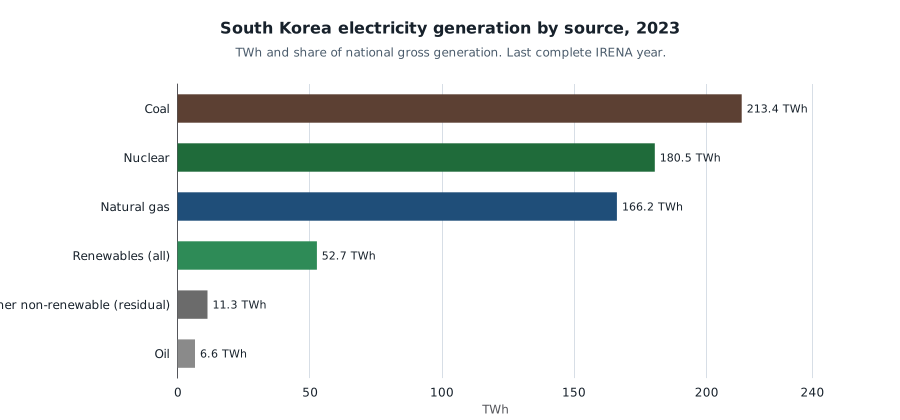
2023 national gross electricity generation in TWh. Shares of the 630.7 TWh total: coal 33.8%, nuclear 28.6%, natural gas 26.4%, all renewables 8.4%, other non-renewable residual 1.8%, oil 1.0%. Source: IRENASTAT.
Renewables grew. They did not take the load.
The renewable build-out is real, and it is still small on the electricity chart. Solar photovoltaic generation rose from almost nothing in the early 2000s to 33.2 TWh in 2023 — 5.3% of national output, and most of the renewable total. Hydropower was 3.7 TWh. The rest of the renewable series is not further identified here: wind and bioenergy extracts for Korea were empty in this snapshot, and empty is not zero.
Capacity makes the same point in a different unit. At the end of 2023 Korea had 39,514 MW of coal plant, 43,191 MW of gas plant, 24,650 MW of nuclear and 30,015 MW of renewables. Nuclear capacity then held at 24,650 MW through 2025. Renewable capacity kept rising, to 42,075 MW at end-2025. Generation for 2025 is not in this snapshot.
A megawatt of nuclear and a megawatt of solar are not interchangeable. Using 2023 generation against end-2023 capacity, the nuclear fleet implied about 7,300 full-load hours (an 84% capacity factor). The coal fleet implied about 5,400 hours (62%). All renewables together implied about 1,800 hours (20%). Those ratios are not IRENA-published capacity factors; they are generation divided by year-end capacity. They do show why a renewable fleet that has overtaken nuclear in megawatts still produces less than a third as much electricity.
Korea did not stop adding power. Total generation rose from 289.1 TWh in 2000 to 630.7 TWh in 2023, and by 6.9% from 2020 to 2023. The AI-era load, whatever its size, is arriving on a system that was still growing — and still 89% coal, nuclear and gas in the last complete year.
What the mix does not prove
This is the national generating mix, not a meter on a semiconductor fab. Some plants buy power on special contracts; some may sit behind different local resources. IRENA cannot say what share of 2023 kilowatt-hours went into chipmaking, and it cannot say what Korea generated in October 2026, when the export surge was reported.
The reported export jump itself is news, not a finding here. Monthly merchandise trade is a different measure from annual gigawatt-hours, and this analysis does not verify the trade print.
The useful fact is simpler. The country now selling AI chips to the world has already moved off a coal-majority grid. It has not moved onto a renewable one. The slack from falling coal generation was taken by nuclear recovery and a large gas fleet. That is the system a new chip cycle has to live with until later generation figures arrive.
Sources and methods
Figures are from IRENASTAT country electricity statistics for the Republic of Korea, retrieved from the pinned snapshot of 8 October 2026. Generation is annual gross output in gigawatt-hours; totals are renewable plus non-renewable generation; shares use that sum as the denominator. Capacity is end-of-year net generating capacity in megawatts. 2024 generation is preliminary. This article is retrospective research completed on 3 November 2026 about news from 2 November 2026; later IRENA revisions are not used, and observation years are not release dates.
Research Date
The displayed date matches the related news edition. Research was completed 2026-11-03.
Related news: Daily · 2026-11-02
More Research
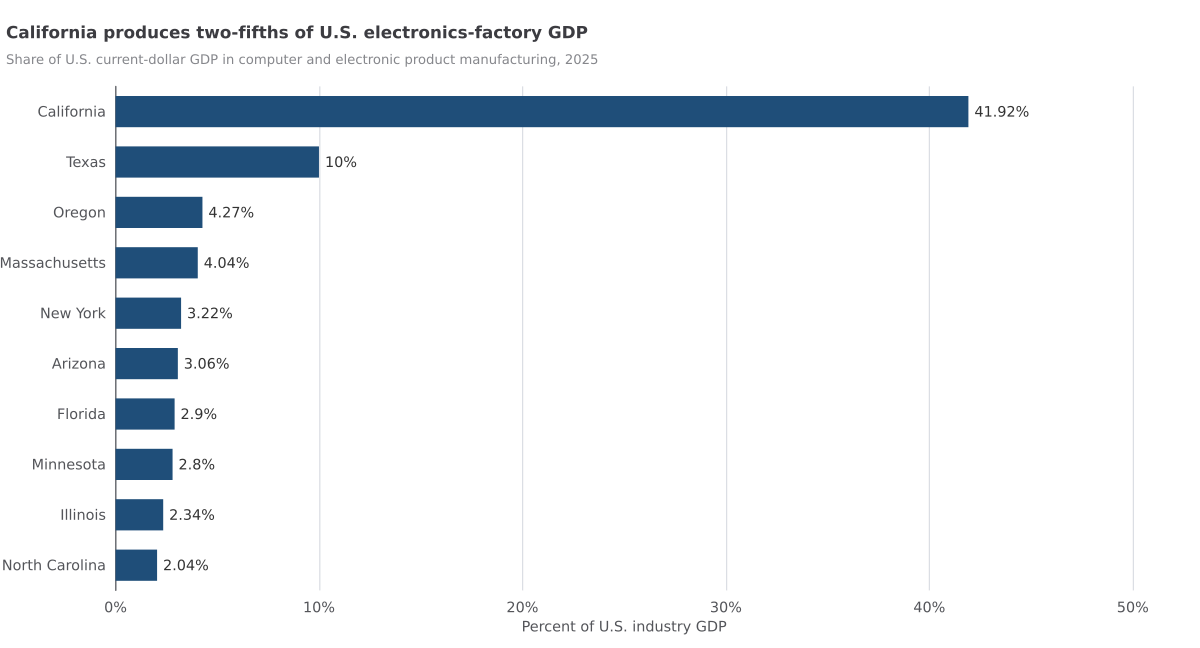
Intel’s Crash Landed On A California Industry. Oregon Already Lost The Jobs.
Intel’s reported one-day wipeout landed on a U.S. electronics-factory industry that California dominates and that has not been in a real-output boom since 2021. Oregon’s semiconductor-compon
America’s Household Electricity Bill Is Still 1.3 Percent Of Spending
BEA household electricity spending through 2025 is still 1.3 percent of US consumption, and the midterm data-center states do not share one bill.
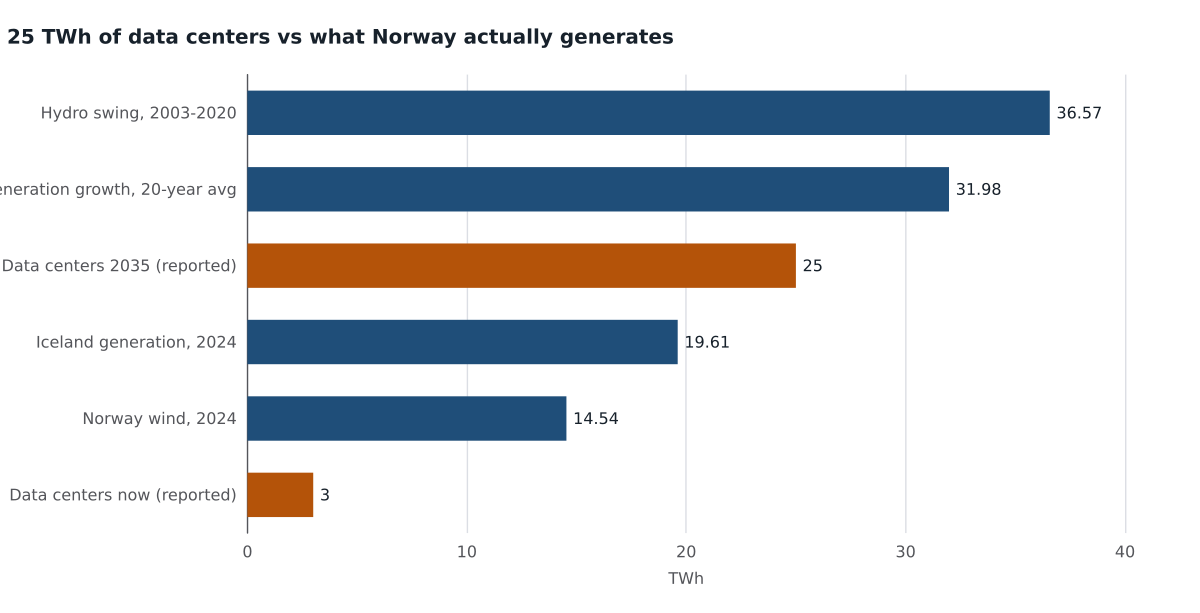
Norway’s Data-Center Plans Are Larger Than Its Wind Boom
Norway’s reported 25 TWh data-center load is 16 percent of 2024 generation and larger than its wind fleet, on a hydro grid whose dry-year swings already exceed 25 TWh.