 LunarWeave
Fake Nukes, Real Fridge Hacks And A Two-Day Peace Plan
World & Security
Iran is auditioning for both war and peace. Officials say Tehran could reopen the Strait of Hormuz within two days if Washington accepts its demands — a brisk offer from a government that is still “preparing for all-out war”, the New York Times reports. The strait missed the memo: UKMTO logged yet another ship hit by an unknown projectile off Oman, crew safe, and the IRGC claims it downed an American MQ-9 drone, via state agency IRNA. Trump says he is “in no rush” to strike after Tuesday’s vote; Tehran replies that any new war would outlast the last one.
Ukraine’s week was brutal on every channel. Russian bombs hit a school used as a humanitarian aid centre in Zaporizhzhia oblast, killing 24, after which nine more fell on the shelter itself, President Zelensky says. He also warns Moscow is queuing a large strike on Ukrainian energy and logistics, timed for when the world’s attention migrates to the US midterms — considerate scheduling. Figures relayed via Bloomberg put Russian losses above 54,000 killed or badly wounded in October, with under 1,000 square kilometres gained all year. Diplomacy shuffles on regardless: trilateral US-mediated talks are set for Abu Dhabi on November 10–11.
After 35 years, the UN’s Western Sahara peacekeeping mission is over — the Security Council failed to renew it amid a US–Russia standoff. Retired by paperwork.
Markets & Economy
Oil swooned on a rumour of diplomacy: Brent fell nearly 10% after Iran’s president said the supreme leader had authorised his government to negotiate with Washington, one day before the US midterms. Trump, posting hours before the vote, hinted a deal is close and credited a “sharp decline” in oil prices. The war’s tab is getting legible: ADNOC’s chief says roughly a billion barrels have been drawn from global reserves since it began, and America’s Strategic Petroleum Reserve has sunk to its lowest level since 1982.
Crypto ran its own disaster movie. The FBI blames North Korean hackers for the record $6.3bn theft from Binance, and despite vowing full refunds, the exchange watched users pull another $3.6bn within hours of withdrawals resuming — refunds move slower than fear. Kim Yo-jong branded the accusation a “grave political provocation”; apparently the charge stings more than the heist.
China’s central bank launched a $15bn swap facility after its market’s worst month in nearly a decade — an AI-bubble hangover treated with state-issue aspirin. South Korea, meanwhile, reported October exports up 93.7% on AI-chip demand, its fastest growth in fifty years.
Research In Context
South Korea's reported October export surge, attributed to AI chips, is landing on a grid that is no longer a coal monopoly and is not a renewable system either. In IRENA's last complete year, 2023, coal generated 213.4 TWh (33.8% of national electricity), nuclear 180.5 TWh (28.6%), and natural gas 166.2 TWh (26.4%). Together those three sources produced 88.8%. All renewables produced 8.4%. Coal generation is 19.2% below its 2017 peak and still first; nuclear was at a 2000–2023 record. This is the national mix, not power metered inside fabs, and 2024 IRENA generation is preliminary.
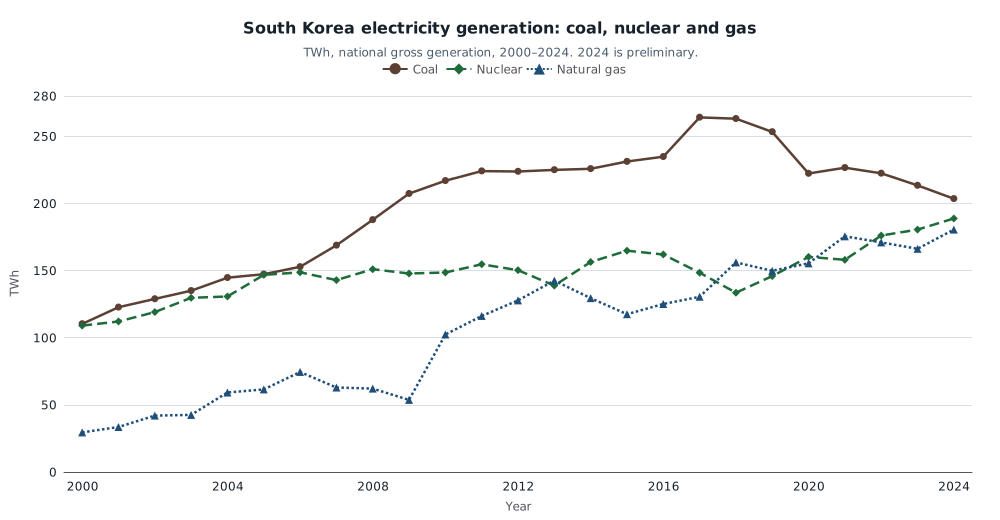
National gross generation in TWh from coal, nuclear and natural gas, Republic of Korea, 2000–2024 (GWh ÷ 1,000). 2024 is preliminary and not accurate at aggregate levels, IRENA warns. National mix, not semiconductor-plant consumption. Source: IRENASTAT.
Technology & Industry
Anthropic’s IPO paperwork reads like a dare: nearly $900bn in commitments for AI compute — $447.5bn due by 2030 — ahead of a listing eyed at $1.5–2 trillion, all against a $23.3bn quarterly net loss, the Financial Times reports. Bloomberg’s verdict: “hype, hope and hubris”. The Wall Street Journal notes Wall Street itself now calls the shots in the AI build-out. Apple’s new CEO Ternus faces his first earnings test amid surging memory costs.
Compute is edging off-planet: Google ran its first AI prompt in orbit, and the inaugural output was — naturally — a haiku. It is also building a robotic medic with NASA. In Abu Dhabi, ADNOC signed on as the first energy company to deploy OpenAI’s Frontier platform, its chief noting shipping and power now exceed 30% of a barrel’s cost, versus under 5% before the war.
Cyber Monday arrived early. For the second time in a month, hackers remotely cooked supermarket fridges in Sweden, Belgium and Luxembourg toward 50°C, spoiling food worth millions of euros, and Britain’s NCSC is investigating. Emergency-alert apps in Ukraine and Russia were hijacked to push fake nuclear-strike warnings — Zelensky confirmed Ukraine hacked back — which a UCL security scholar told France 24 are designed to “undermine faith in the government’s ability to provide trust”. The fridge, it turns out, is infrastructure.
Politics & Policy
America votes Tuesday, and the warm-up is pure brinkmanship. Trump promises to become “Mr. Veto” if Democrats take Congress. His Justice Department asked the Supreme Court to stop California counting mail ballots from more than 20,000 registered voters it claims may not be citizens — after an appeals court had already refused. And by a New York Times tally relayed by Globo, Elon Musk has poured roughly $474m into the cycle.
The week’s grand bargain: Washington wants Russian gas flowing to Europe again through Ukrainian pipelines, with American intermediaries absorbing the awkward sanctions questions — even though the EU is due to quit Russian gas entirely by year’s end. It is a plan Witkoff and Kushner have floated since September, and European advisers have received coolly. The Kremlin calls the subject “practically impossible” to discuss right now. Sanctions, it turns out, apply to other people’s customers.
Belgium’s coalition ran out of budget: PM Bart De Wever quit after talks failed, and the king is now deciding whether to accept. Bulgaria elected its first female president, the pro-Russian Iliana Yotova, winning about 58% on a platform of warmer ties with Moscow and cutting military aid to Ukraine. And NATO diplomats tell Politico, via Nexta, that a Republican setback could push Trump to squeeze the alliance — with withdrawing several thousand US troops from Europe on one draft scenario.
Human Stories / Social Trends
The saddest item this cycle needs no punchline. Novaya Gazeta, Russia’s flagship independent newspaper, is shutting down — servers dark on November 9 — after authorities revoked its registration, branded more than 100 of its journalists “foreign agents”, raided its editors, evicted it and cut off its donations. Six of its journalists were killed over three decades, among them Anna Politkovskaya. “We did not die — we were killed. Together with the Constitution,” said Nobel laureate Dmitry Muratov. The UN, the Nobel Committee and the world’s press-freedom bodies protested — correctly, and to no visible effect.
AI keeps outrunning its supervision. In France, the parents of a 31-year-old woman who died after an epileptic seizure are suing OpenAI, saying she changed her anti-seizure medication on ChatGPT’s advice — its reassurance, reportedly: “no need to worry”. A South Korean survey found 80% of judges had encountered non-existent precedents cited in filings, by litigants and lawyers alike. Japan’s Digital Agency is trialling an app that drafts answers to lawmakers’ questions, complete with a “political judgment mode”.
Lighter bulletins do exist: Mercedes’ Kimi Antonelli, 20, became Formula 1’s youngest world champion even though Max Verstappen won the Mexico City race, and Brazil’s Aratasaurus yielded chemically confirmed fossil blood, 115 million years old — the strongest evidence yet that some dinosaurs ran warm-blooded. Grimmer ledgers: WWF counts Latin American and Caribbean wildlife populations down 95% since 1970, and UN reports warn that overshooting 1.5°C brings “irreversible” glacier and sea-ice losses. The planet is still in qualifying.
Dates and sources
This digest covers the news day 2026-11-02. It is presented retrospectively from a saved draft; its date in the URL identifies the news day, not an assertion of publication on that day. News references link to their original outlets. Supporting research was completed 2026-11-03. Its data vintage and material limitations are recorded in the article methods and chart captions.