LunarWeave
Iraq’s Budget Was Already In The Red When The Strait Closed
A blocked Strait of Hormuz is a shipping story until it hits a government payroll. In August 2026, Deutsche Welle reported that Iraq could not export enough oil to fund a huge public sector, that salaries were under threat, and that protests had started. Oil prices rose as hopes of a reopening faded. Those are reports of a volume shock — barrels that cannot leave. The fiscal accounts answer a prior question: did Iraq’s government have a cushion when the tankers stopped?
It did not. In the IMF World Economic Outlook snapshot used here, Iraq was already running a general-government deficit in 2025, before treating later 2026 figures as a measurement of the blockade. Revenue was 36.3 percent of GDP; spending was 42.7 percent; the gap was 6.4 percent of GDP. On a $264 billion economy that is about $96 billion coming in and $113 billion going out. A closed strait did not create that hole. It arrived on top of it.
The IMF’s general-government deficit is the broad public-sector balance, not the oil ministry’s cash account. Readers need to choose Iraq in the chart selector. The same caveat applies throughout: these are annual fiscal ratios, not tanker counts, and 2025 values are staff estimates.
Spending rose as oil cooled
The squeeze was visible on both sides of the ledger. From 2022 to 2025 the IMF’s average petroleum spot price fell from $96.36 a barrel to $67.74, a 30 percent drop. Iraq’s government revenue fell with it, from 42.0 percent of GDP to 36.3 percent — about $121 billion to $96 billion. Government spending moved the other way: from 33.9 percent of GDP to 42.7 percent, or from about $98 billion to $113 billion. That is not a ratio illusion from a shrinking economy. The dollar total rose.
The 2022 surplus of 8.1 percent of GDP was gone by 2023. Deficits then widened to 3.5 percent of GDP in 2024 and 6.4 percent in 2025. Gross government debt climbed from 39 percent of GDP to 54 percent over the same three years. Real GDP was estimated to have contracted 0.4 percent in 2025. The current account, a rough check on whether export earnings still covered the import bill, swung from a surplus of 13.4 percent of GDP in 2022 to a deficit of 1.7 percent in 2025.
None of that is a measurement of Hormuz. It is the starting position. A country already spending more than it collected, with export earnings already fading, does not meet a blockade with spare cash.
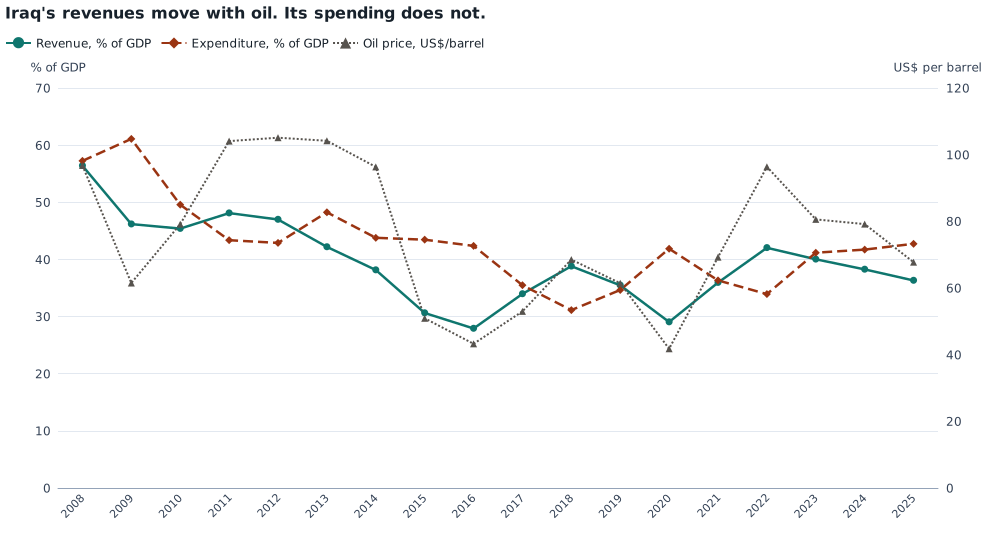
Iraq general-government revenue and expenditure as a percent of GDP, 2008–2025, against the IMF average petroleum spot price in US dollars per barrel. 2025 figures are IMF estimates, not blockade outturns. Revenue as a share of GDP is not an oil-versus-non-oil split. Source: IMF World Economic Outlook.
From 2010 through 2025, that average oil price and Iraq’s revenue ratio moved together (correlation 0.90). The full 2004–2025 window looks much weaker, because the reconstruction years after 2003 scramble the ratio. Correlation is not a proof that oil is the tax base — the WEO series used here does not split oil from non-oil revenue — but the crash years make the dependence hard to miss.
Every recent oil crash opened a double-digit hole
When oil prices collapsed and tankers were still moving, Iraq’s budget did not glide. It fell through the floor.
In 2012 the average petroleum spot price was $105.10 a barrel and Iraq ran a surplus of 4.1 percent of GDP. By 2016 the price was $43.26. Revenue had dropped from 47.0 percent of GDP to 27.9 percent, and from about $102 billion to $47 billion — a 54 percent decline in dollar collections. Spending barely budged as a share of the economy: 42.9 percent in 2012, 42.4 percent in 2016. The balance went from that 4.1 percent surplus to a 14.4 percent deficit. Over 2014–16, spending stayed inside a 1.4 percentage-point band while revenue swung by 10.2 points.
The same pattern shows up in the other two crashes. In 2009, after oil fell from $96.77 to $61.50, the deficit reached 14.9 percent of GDP. In 2020, with oil at $41.77, revenue was 29.1 percent of GDP, spending 41.9 percent, and the deficit 12.8 percent. Debt jumped to 72 percent of GDP that year.
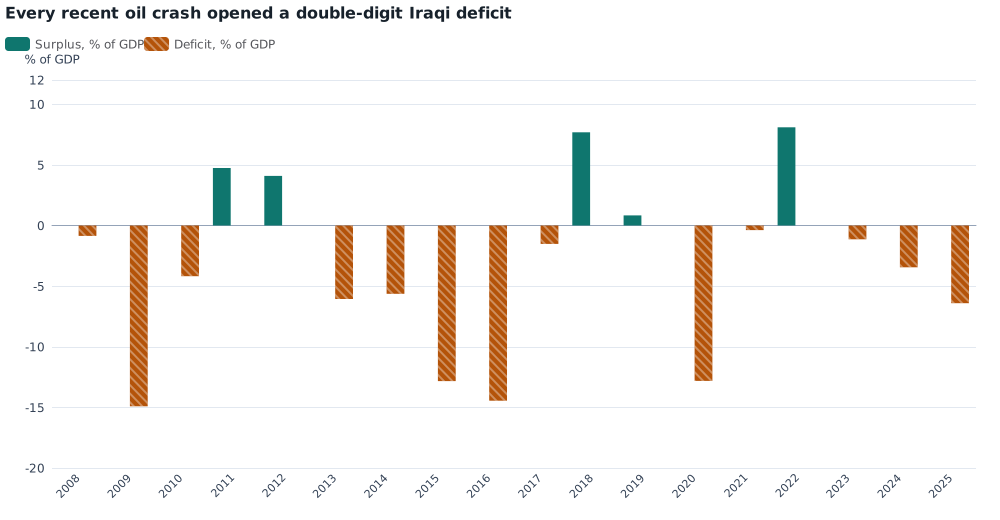
Iraq general-government net lending/borrowing as a percent of GDP, 2008–2025. Positive values are surpluses. 2025 is an IMF estimate. Source: IMF World Economic Outlook.
| Episode | Oil price, $/barrel | Revenue, % of GDP | Balance, % of GDP |
|---|---|---|---|
| 2008 → 2009 | 96.77 → 61.50 | 56.4 → 46.2 | −0.9 → −14.9 |
| 2012 → 2016 | 105.10 → 43.26 | 47.0 → 27.9 | +4.1 → −14.4 |
| 2019 → 2020 | 61.43 → 41.77 | 35.5 → 29.1 | +0.8 → −12.8 |
| 2022 → 2025 | 96.36 → 67.74 | 42.0 → 36.3 | +8.1 → −6.4 |
A price crash with exports still flowing is a milder test than a strait that will not open. The historical record is not a forecast of 2026. It is evidence that Iraq’s budget has no habit of shrinking when oil income does.
Large spending, thin buffers
Is the public sector “huge”? The WEO cannot count state employees. What it can say is that general-government spending is large relative to the size of the economy — and large relative to what Iraq can reliably collect.
In 2024 Iraq spent 41.7 percent of GDP. That is more than Saudi Arabia (29.2 percent), the UAE (21.4 percent) or Qatar (26.0 percent), and in the same neighborhood as Norway (46.9 percent) and Germany (49.4 percent). Among the oil exporters compared here, only Kuwait and Norway spent more, once Libya’s 96 percent reading is set aside as an outlier that would crush the scale. Iraq did that on GDP per person of about $6,450. Norway’s figure was about $89,700; Saudi Arabia’s about $35,500.
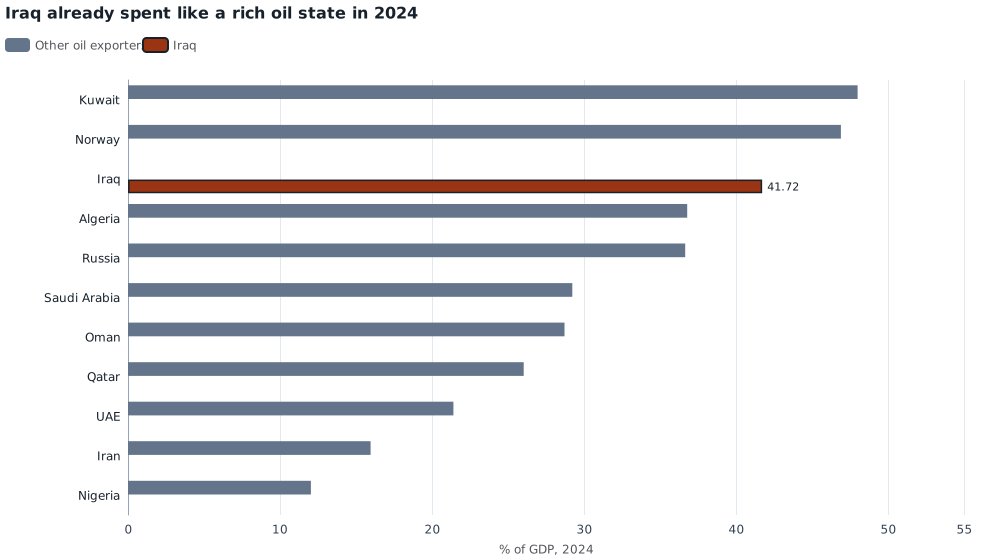
General-government expenditure as a percent of GDP in 2024 for selected oil exporters. Libya omitted. Spending shares are not payroll headcounts. Source: IMF World Economic Outlook.
The comparison that matters is not the spending rank. It is the buffer. Kuwait, which spent even more, ran a surplus of 26 percent of GDP in 2024. Norway ran 13 percent. Iraq ran a 3.5 percent deficit, which the IMF then saw widening to 6.4 percent in 2025 — a deeper hole than Saudi Arabia’s 5.8 percent or Iran’s 5.7 percent that year.
A rich oil state can spend 40-plus percent of GDP if it still collects more than it spends, or if it can draw on savings the WEO does not show here. Iraq was doing the spending without the surplus.
What a closed strait does not change
Deutsche Welle’s salary-and-protest reporting is not verified by these accounts, and the accounts do not measure how many barrels left Basra in July and August 2026. They also do not split oil from non-oil tax, so they cannot say what share of the 36 percent revenue ratio would survive if no crude moved. Some Iraqi oil has historically left by pipeline as well as by the Gulf; this dataset cannot size that split.
What it can size is the habit. When oil income falls, Iraqi revenue falls with it, spending does not, and the deficit opens to double digits. That happened in 2009, 2015–16 and 2020 with the strait open. By 2025 the government was already back in deficit, on an estimated $5,800 of GDP per person, after raising dollar spending into a cooler oil market. A blockade is a harsher shock than a price drop. It is hitting a budget that was not holding a surplus in reserve.
Sources and methods
Retrospective research, 10 September 2026, on news from 12 August 2026. Figures are from the IMF World Economic Outlook snapshot ingested 10 August 2026. Series are annual. 2025 values are IMF staff estimates in that vintage, not realized blockade outcomes; 2026–31 projections are unused. General government is the IMF’s broad public-sector concept (codes GGR_NGDP, GGX_NGDP, GGXCNL_NGDP, GGXWDG_NGDP). Dollar revenue and spending are derived as the percent-of-GDP ratio times current-dollar GDP (NGDPD), which the snapshot stores in US dollars. Oil prices are the WEO average petroleum spot series (POILAPSP) on the world aggregate G001. GDP per capita is current US dollars (NGDPDPC). Empty WEO extracts for Iraqi export values and unemployment were dropped rather than treated as zero. Live MacroVedia pages checked on 10 September 2026 matched the cited Iraq points; the portals are not the original producer, and geography is not pre-selected in the URL.
Research Date
The displayed date matches the related news edition. Research was completed 2026-09-10.
Related news: Daily · 2026-08-12
More Research
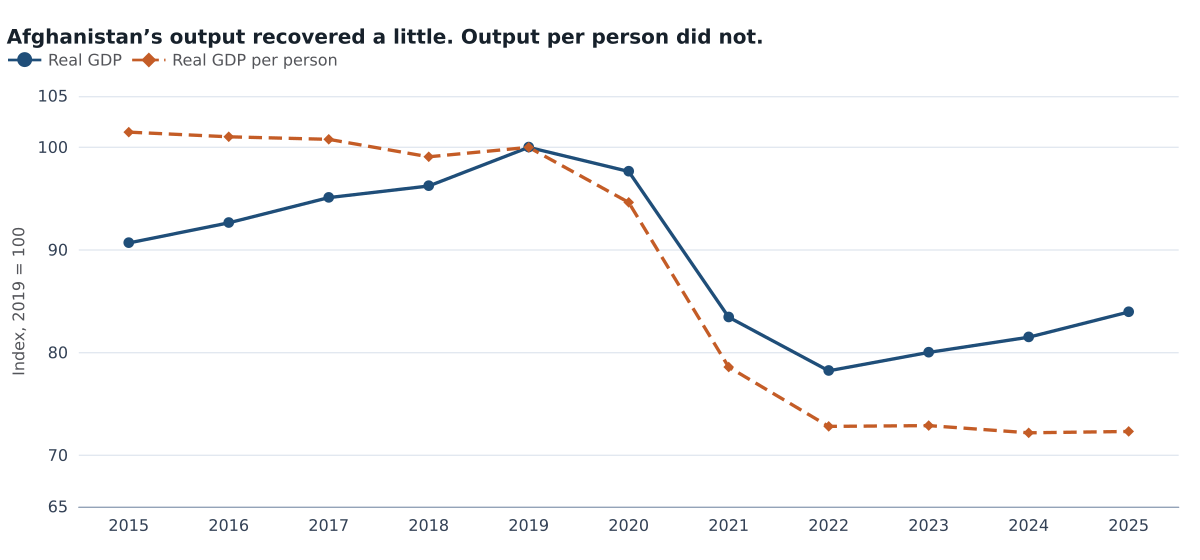
The Afghan Economy’s Rebound Never Reached Its People
IMF accounts show Afghanistan’s real output per person still about 28 percent below 2019, five years after the Taliban takeover.
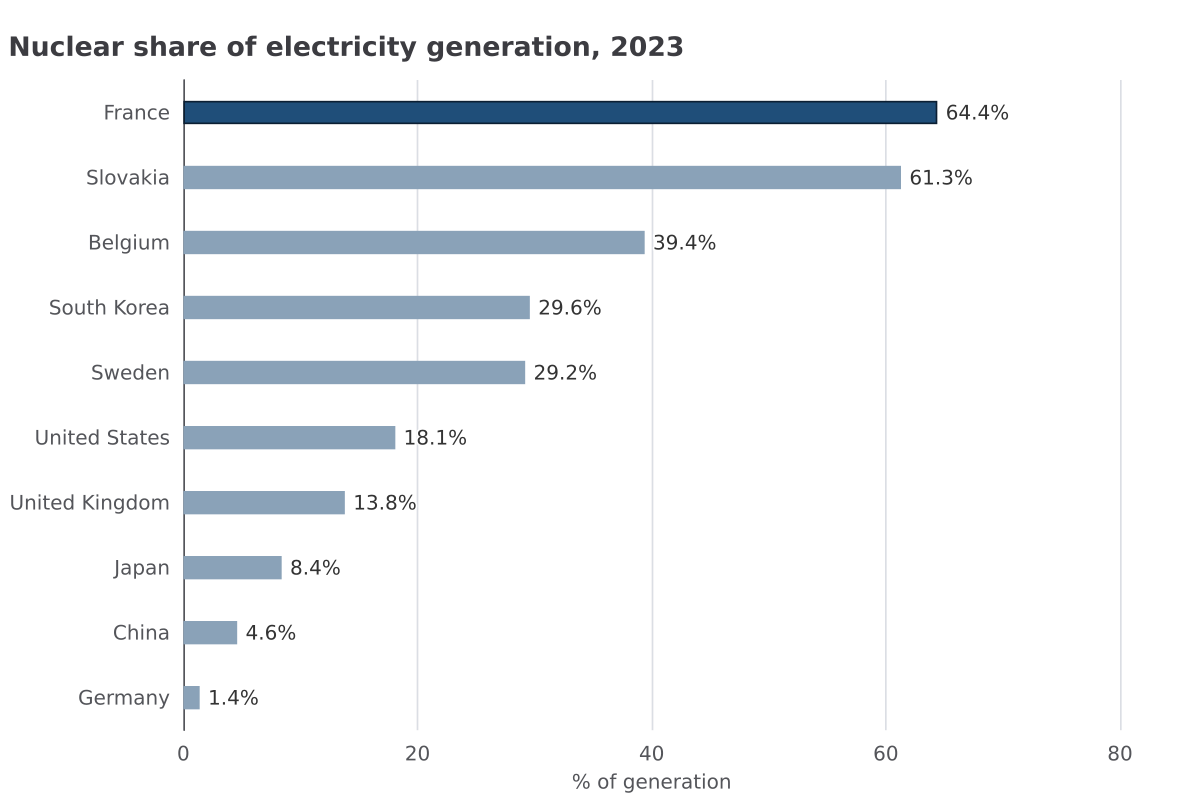
Two-Thirds Of France’s Electricity Still Comes From Nuclear Plants
France added wind and solar, but nuclear plants still generated 64% of its electricity in 2023 — which is why a jellyfish clog at Gravelines is a national grid story.
The Surplus On Hormuz Is Not Iran’s
IMF current-account books for 2024 put the large Gulf surplus in the UAE, Kuwait and Qatar, not Iran — the country a Hormuz blockade is meant to squeeze.