LunarWeave
Two-Thirds Of France’s Electricity Still Comes From Nuclear Plants
When a swarm of jellyfish clogged cooling pumps at Gravelines on the Channel coast, EDF took three reactors offline and cut a fourth to half power. The operator said the episode did not threaten safety or the environment. That is not the same as saying it was a sideshow.
France has spent a quarter-century covering rooftops and ridgelines with solar panels and wind turbines. On paper, the generating fleet is no longer a nuclear monoculture. In the electrons that actually reach the grid, it still is. In 2023 — the latest year of complete generation data in IRENASTAT — nuclear plants produced 338 terawatt-hours, 64.4% of French electricity. Wind, solar, hydro and other renewables supplied 26.6%. Everything else, including gas and a remnant of coal, supplied 9.0%.
A coastal clog can become a national power-system story because nuclear plants still do most of the work.
The fleet barely shrank. Its share of capacity did.
France’s on-grid nuclear capacity was 63.2 gigawatts in 2000 and 61.4 gigawatts in 2023. It stayed at 61.4 gigawatts through 2025 in the same IRENA tables. The only clear step down is between 2019 and 2020, when 1.7 gigawatts disappeared from the nuclear column and never returned.
What changed is everything around those reactors. On-grid renewable capacity rose from 24.0 gigawatts in 2000 to 69.6 gigawatts in 2023 and 83.3 gigawatts in 2025. Solar went from almost nothing (7 megawatts) to 19.7 gigawatts in 2023 and 30.9 gigawatts in 2025. Wind went from 38 megawatts to 23.1 gigawatts, then 25.7 gigawatts. Hydropower, already large, barely moved.
Nuclear therefore slipped from 56.1% of on-grid capacity in 2000 to 40.7% in 2023 and 37.4% in 2025. A visitor looking at nameplate capacity could conclude that France had diversified. A visitor looking at output would not.
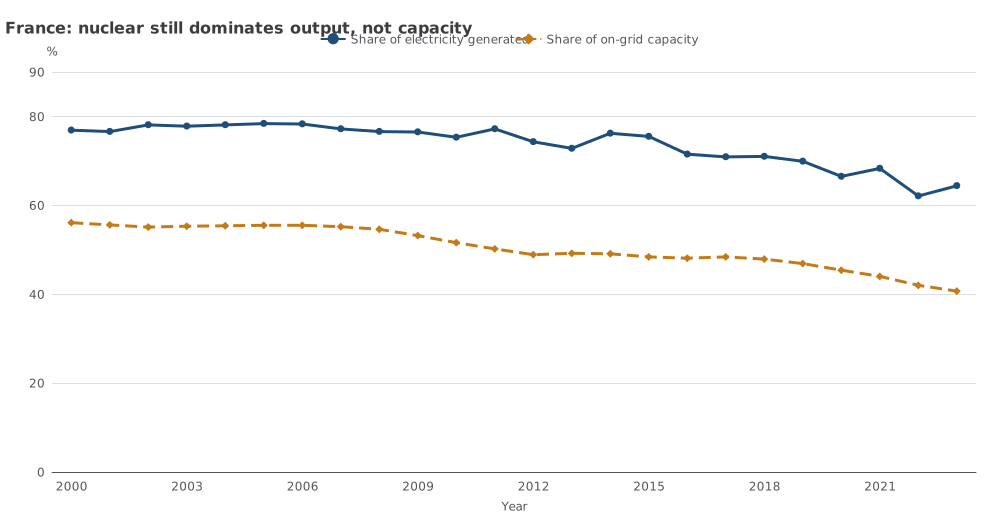
Nuclear electricity as a share of France’s total generation (renewable plus non-renewable, GWh) and as a share of on-grid generating capacity (renewable plus non-renewable, MW), 2000–2023. Source: IRENASTAT country electricity statistics. Generation is not published for 2024–2025 in this snapshot.
The gap is capacity factor, not an accounting trick. Reactors run most of the year. Solar and wind do not. Adding gigawatts of variable plant lowers nuclear’s share of the fleet much faster than it lowers nuclear’s share of the kilowatt-hours. IRENA’s own renewable-share series confirms the generation side: renewables were 12.6% of French electricity in 2000 and 26.6% in 2023 — a real gain, and not a changing of the guard.
| 2000 | 2023 | |
|---|---|---|
| Nuclear generation | 415.2 TWh | 338.2 TWh |
| Nuclear share of generation | 76.9% | 64.4% |
| Nuclear on-grid capacity | 63.2 GW | 61.4 GW |
| Nuclear share of on-grid capacity | 56.1% | 40.7% |
| Renewable on-grid capacity | 24.0 GW | 69.6 GW |
Nuclear output itself is lower than it was. Generation peaked above 440 TWh in the mid-2000s, was still 399 TWh in 2019 (69.9% of electricity), then slumped to 295 TWh in 2022. Even in that worst year of the 2000–2023 series, nuclear still supplied 62.1% of French electricity. The 2023 rebound to 338 TWh lifted the share only to 64.4%, because total generation recovered too. The floor, in other words, is still a majority.
Gas and coal did not take over the gap. Coal generation was 30.9 TWh in 2000 and 3.1 TWh in 2023. Gas rose for a time — 45.7 TWh in 2022, when nuclear was weakest — then fell back to 29.8 TWh. The non-nuclear, non-renewable remainder was 9.0% of output in 2023.
Other large grids do not look like this
The United States generated more nuclear electricity than France in 2023 — 808 TWh against 338 TWh — but those American reactors were only 18.1% of a much larger system. China produced 435 TWh of nuclear power and it was 4.6% of Chinese electricity. South Korea, often grouped with France as a nuclear-intensive industrial economy, was at 29.6%. The United Kingdom was at 13.8%, Japan at 8.4%, Germany at 1.4%.
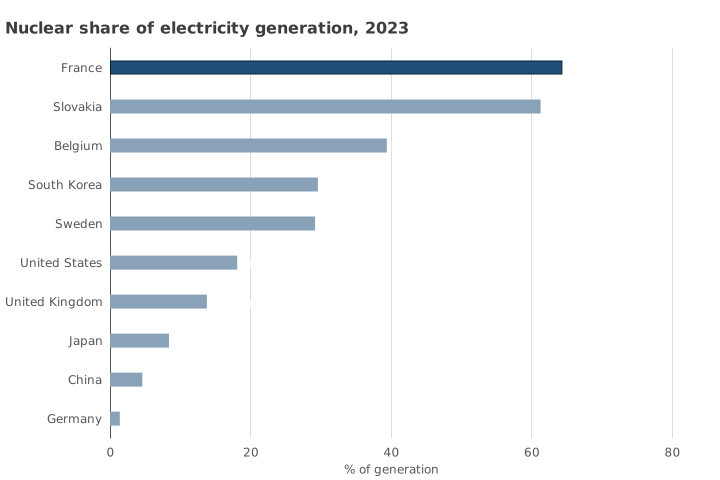
Nuclear generation as a percentage of total electricity generation (IRENA renewable plus non-renewable, GWh) in 2023. Slovakia is a much smaller grid with a similarly high nuclear share; it is not a similarly sized power system. Source: IRENASTAT.
Slovakia is the honest exception on the chart: 61.3% of its electricity was nuclear in 2023, close to France’s share. Slovakia’s entire nuclear output was 18 TWh, about one-eighteenth of France’s. Belgium, at 39.4%, is closer to South Korea than to France and still generates an order of magnitude less nuclear power. High shares exist in small systems. High shares in a system the size of France’s do not.
That is the distinction the jellyfish ran into. An outage at one coastal site is local news in a country where nuclear is a fifth of generation or less. In France it is an event on the main generating technology — still 61.4 gigawatts of nuclear plant, still about two-thirds of output — even after the renewable buildout that has taken nuclear below two-fifths of capacity.
These figures cannot say how many megawatts Gravelines lost for how many hours, or whether 2024–25 generation stayed near the 2023 rebound. They can say why a biological clog at a Channel plant is not a quirky footnote. France did diversify its fleet. It has not yet diversified the work.
Sources and methods
This article is retrospective. It was researched on 10 September 2026, using an IRENASTAT snapshot compiled on 24 August 2026, and is not an account of what was knowable on 11 August 2026, when EDF reported the Gravelines shutdown.
Electricity generation is IRENA country data, all grids, in gigawatt-hours. Total generation is total renewable plus total non-renewable; nuclear is a subset of non-renewable. Pumped storage is not added to that total. The derived renewable share of generation matches IRENA’s published renewable-share series to two decimal places in every overlapping French year. Capacity figures are on-grid megawatts. Nuclear’s capacity share is nuclear divided by on-grid renewable plus on-grid non-renewable. IRENA’s separate renewable share of capacity is a few tenths of a percentage point different from that on-grid identity; the article uses the on-grid identity for nuclear and quotes IRENA’s official series for the renewable generation share. Observation dates of 1 January are treated as calendar years. Generation in this snapshot ends in 2023; capacity continues through 2025. Those 2025 capacity values are not independently classified here as preliminary or final.
The Gravelines incident is taken from contemporary reporting, including the South China Morning Post account of EDF’s statement. IRENA does not publish plant-level capacity or outage megawatts, so the article does not convert three shutdown reactors into a national percentage. Correlation between a jellyfish clog and a particular day’s French demand is not estimated.
Research Date
The displayed date matches the related news edition. Research was completed 2026-09-10.
Related news: Daily · 2026-08-11
More Research
Iraq’s Budget Was Already In The Red When The Strait Closed
IMF accounts show Iraq already running a 2025 deficit, with spending that does not fall when oil income does — the fiscal backdrop to the Hormuz blockade.
Colombia’s New Government Inherits A Stalled Economy And A 6 Percent Budget Hole
Colombia’s new government promised a cartel war just as a magnitude-7.4 earthquake hit. IMF accounts show growth already stalled and the budget deficit back near 6 percent of GDP; a $1bn US
The Afghan Economy’s Rebound Never Reached Its People
IMF accounts show Afghanistan’s real output per person still about 28 percent below 2019, five years after the Taliban takeover.