LunarWeave
Colombia’s New Government Inherits A Stalled Economy And A 6 Percent Budget Hole
A new Colombian president promised an all-out war on drug cartels. Washington answered with a $1 billion security package. Days into the term, the military killed an alleged rebel leader, and a magnitude-7.4 earthquake then struck the west of the country, killing more than 100 people by evening according to Deutsche Welle, and trapping others under rubble in Cali, Pereira and Manizales. The political story is a hard reset. The economic one is less cinematic: Colombia is not a collapsed state, but it is entering a security war and a disaster response after growth had already stalled and after a one-year fiscal improvement had already reversed.
The International Monetary Fund’s World Economic Outlook, not the first-day speeches, is the record of that bind. Real GDP growth fell to 0.8 percent in 2023 and 1.5 percent in 2024. The general-government deficit — net lending or borrowing for the whole public sector, not a single ministry’s headline budget — was 6.0 percent of GDP in 2024. The IMF still sees a deficit of 5.7 percent of GDP in 2025. A billion dollars is real money in a security ministry. It is 0.22 percent of the IMF’s 2025 dollar GDP for Colombia, and about 4 percent of that year’s fiscal hole.
Readers should choose Colombia in the MacroVedia chart selectors; those pages are multi-country views of the same IMF series.
The expansion of the 2000s did not return
Colombia grew 7.3 percent in 2022, completing a rebound from the 7.2 percent pandemic contraction of 2020. That rebound is over. In 2023 real output barely rose. In 2024 it rose 1.5 percent. Together those two years lifted the level of real GDP by 2.3 percent — less than Colombia often managed in a single year during 2004–2014, when growth averaged 4.8 percent a year.
The IMF does not see a snap-back. Its 2025 and 2026 figures in the same database, which include projections, are 2.6 percent and 2.3 percent. That is better than a stall. It is not the old slope, and it is not a growth rate that quickly erodes a 6 percent of GDP deficit.
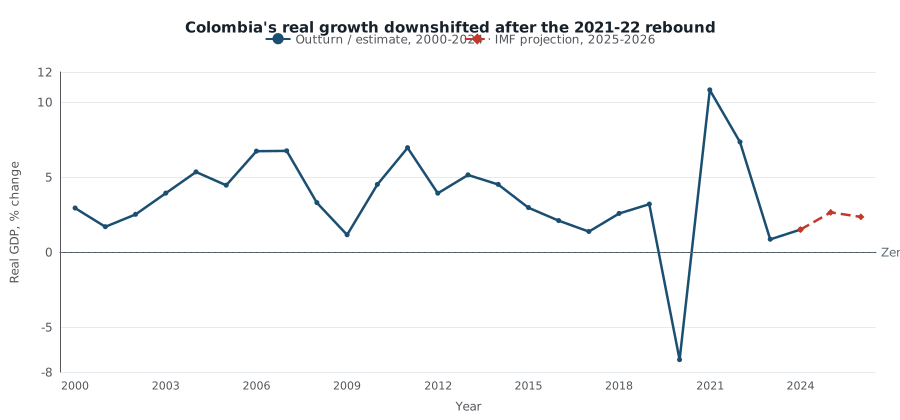
Real GDP, annual percent change, Colombia. Solid line through 2024; dashed line is IMF 2025–2026 projections. Source: IMF World Economic Outlook.
Brazil, facing a similarly wide budget deficit, still grew 3.4 percent in 2024. Mexico’s 2024 growth (1.4 percent) looked more like Colombia’s. The regional comparison matters because it undercuts two equally lazy stories: that Andean economies are all booming on commodities, and that Colombia is uniquely broken. It is the combination that is uncomfortable — slow growth and a wide deficit.
The 2023 fiscal improvement was a one-year event
After pandemic deficits of 7.1 percent of GDP in 2020 and 7.3 percent in 2021, the 2023 accounts looked like a turn. General-government net borrowing shrank to 2.9 percent of GDP. In 2024 it was 6.0 percent again.
That reversal is an arithmetic identity in the IMF tables, not a mystery about secret spending. Revenue jumped to 32.2 percent of GDP in 2023, then fell back to 28.3 percent in 2024 — a drop of 3.8 percentage points. Expenditure moved the other way, and only slightly: 35.1 percent of GDP in 2023, 34.4 percent in 2024. The hole reopened because the extra revenue did not stay, not because the state suddenly ballooned.
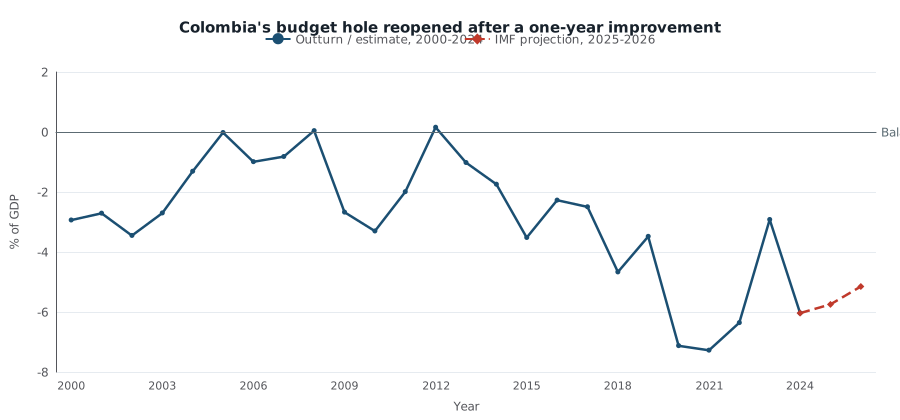
General-government net lending/borrowing, percent of GDP, Colombia. Negative values are deficits. Dashed segment: IMF 2025–2026 projections. Source: IMF World Economic Outlook.
The IMF’s 2025 and 2026 balances are still minus 5.7 percent and minus 5.2 percent of GDP. Gross general-government debt was 61.0 percent of GDP in 2024, against 32.4 percent in 2008 and a pandemic peak of 65.3 percent in 2020. That is not Brazil’s 87 percent of GDP, and it is not Peru’s 32 percent. It is a country that used up a lot of the room it once had.
| Year | Real GDP growth | Budget balance | Consumer-price inflation |
|---|---|---|---|
| 2022 | 7.3% | −6.4% of GDP | 10.2% |
| 2023 | 0.8% | −2.9% of GDP | 11.7% |
| 2024 | 1.5% | −6.0% of GDP | 6.6% |
| 2025* | 2.6% | −5.7% of GDP | 5.1% |
| 2026* | 2.3% | −5.2% of GDP | 5.9% |
*2025–2026 are IMF estimates/projections in the pinned World Economic Outlook snapshot. Budget balance is general-government net lending/borrowing. Inflation is the annual average of consumer prices.
Inflation has come off the 11.7 percent average of 2023, to 6.6 percent in 2024. The unemployment rate was 9.1 percent in 2024. Those figures describe strain, not a labour-market collapse, and they leave less room to finance a disaster with the printing press than a true slump would.
A billion dollars against a $26 billion gap
The IMF puts Colombia’s 2025 GDP at $457.4 billion at current dollar prices. A $1 billion package is 0.22 percent of that total, or 0.66 percent of general-government expenditure (about $152 billion). The 2025 deficit implied by the IMF’s ratios is $26.3 billion. The US pledge is 3.8 percent of that one-year hole.
Those ratios do not say the money is useless. Security aid is not a budget-balancing grant, and it is not a reconstruction fund. They do say that Washington’s cheque does not close the fiscal gap the new government already had, and that an earthquake and a cartel war would both have to be paid for on top of a deficit the IMF still puts near 6 percent of GDP. This article cannot price rubble in Pereira or a campaign against armed groups. It can say the starting position is tight.
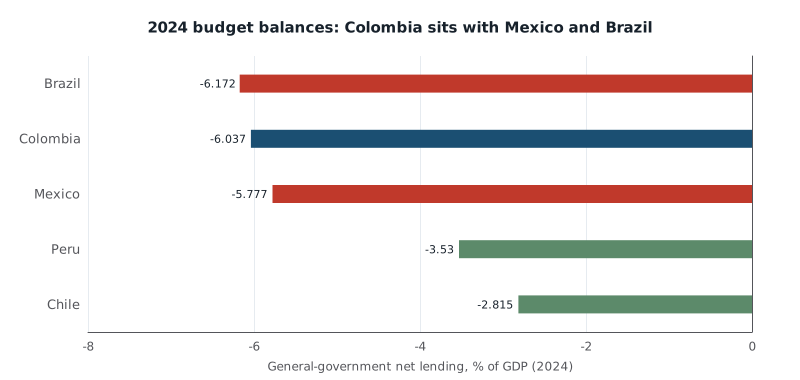
General-government net lending/borrowing, percent of GDP, 2024. Colombia’s 6.0 percent deficit sits with Mexico (5.8 percent) and Brazil (6.2 percent), not with Peru (3.5 percent) or Chile (2.8 percent). Source: IMF World Economic Outlook.
Among those five countries, Colombia is in the wide-deficit group. What it does not have, on the 2024 numbers, is Brazil’s growth. A government that has just promised an “all-out war,” and that must also answer for collapsed buildings, is therefore spending political capital in an economy that had already downshifted.
What the books cannot settle
The IMF series used here are annual and national. They do not measure damage in Valle del Cauca, Risaralda or Caldas. They do not say whether the 2023 revenue spike was a one-off tax haul, a price boom, or something else — only that it did not persist in 2024. Dollar GDP is a conversion, not proof of real expansion; the 2025 dollar figure is an IMF estimate, and this article does not use the even larger 2026 dollar total. Death tolls moved through the day in wire reports and are not a finding of this research.
The useful conclusion is narrower. Abelardo de la Espriella did not inherit a wrecked national account. He inherited a middle-income economy whose growth engine had already cooled, whose public debt is almost twice the 2008 ratio, and whose budget deficit is back in the range last seen during the pandemic. The United States can underwrite a security push. It cannot, with $1 billion, replace the 3.8 percentage points of GDP in revenue that vanished between 2023 and 2024.
Sources and methods
Retrospective research completed 10 September 2026, using a pinned IMF World Economic Outlook snapshot (normalized 24 August 2026; source run 10 August 2026). The digest date of the triggering news is 10 August 2026; later releases are not treated as having been known that day. Annual values for 2025–2026 in this database include IMF estimates and projections. Observation dates are not publication dates. General-government net lending/borrowing is revenue minus expenditure for the public sector as defined by the IMF, expressed as a percent of GDP; a negative number is a deficit. Cross-country comparisons use that same IMF definition, which can differ from national headline budgets. The $1 billion security package and earthquake fatality reports are attributed news, not IMF series.
Research Date
The displayed date matches the related news edition. Research was completed 2026-09-10.
Related news: Daily · 2026-08-10
More Research
Two-Thirds Of France’s Electricity Still Comes From Nuclear Plants
France added wind and solar, but nuclear plants still generated 64% of its electricity in 2023 — which is why a jellyfish clog at Gravelines is a national grid story.
India Can Fill Half Its Grid With Non-Fossil Plants And Still Run On Coal
IRENA shows India’s solar-led capacity boom through 2025, while 2023 generation was still three-quarters coal.
Iraq’s Budget Was Already In The Red When The Strait Closed
IMF accounts show Iraq already running a 2025 deficit, with spending that does not fall when oil income does — the fiscal backdrop to the Hormuz blockade.