LunarWeave
India Can Fill Half Its Grid With Non-Fossil Plants And Still Run On Coal
When a government says more than half its power capacity is non-fossil, it is easy to hear that most of the country’s electricity is already clean. Those are not the same fact. Nameplate megawatts count plants that exist. Kilowatt-hours count plants that actually ran.
In August 2026, Times of India reported that India had crossed 300 gigawatts of non-fossil electricity capacity — more than half the national total — and was aiming for 500 GW by 2030. The feed excerpt is a claim, not a verified census. What IRENA can show, with a later snapshot of its electricity statistics, is the path up to 2025 and the electricity those plants produced through 2023. The buildout is real. So is the coal.
A solar-led climb that has not yet reached a capacity majority in IRENA’s books
In 2025 IRENA records 250.5 GW of renewable capacity in India — 245.1 GW on-grid and 5.4 GW off-grid. Nuclear adds 8.8 GW, taking renewable-plus-nuclear capacity to 259.3 GW. That is 44.3% of a 585.1 GW system once pumped-storage hydro is included in the denominator, or 45.5% if pumped storage itself is counted as non-fossil. IRENA’s own published renewable share of capacity is 42.8%. Fossil plants still total 318.6 GW, 273.1 GW of them coal.
None of those 2025 totals is 300 GW, and none is more than half. They also do not disprove a mid-2026 official figure. IRENA’s latest capacity year in this snapshot is 2025; the news is from August 2026. India added 45.7 GW of renewable-plus-nuclear capacity in 2025 alone, 37.0 GW of it solar. Another 34–41 GW on top of the 2025 stock would reach 300 GW, depending on whether pumped storage is in the non-fossil total. That pace is plausible. It is not yet in the international series.
What the international series does show is the composition of the climb. Solar (on-grid plus off-grid) reached 135.5 GW in 2025, ahead of on-grid wind (54.5 GW) and renewable hydropower (49.0 GW). Coal capacity was still rising: 213.2 GW in 2015, 273.1 GW in 2025.
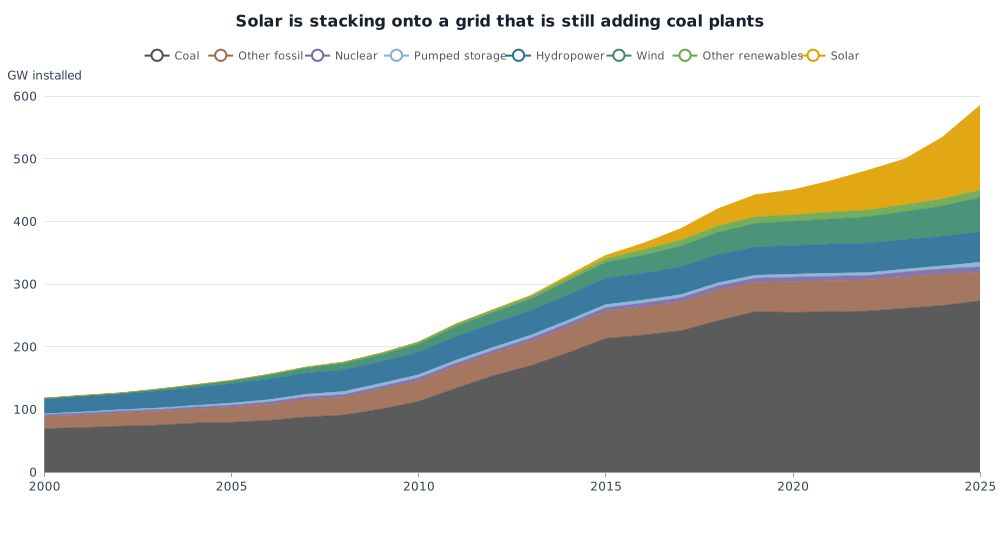
India installed electricity capacity by technology, gigawatts, 2000–2025. Solar is on-grid solar energy plus off-grid solar; wind and hydropower are on-grid; other renewables are the residual of IRENA total renewable energy. Pumped storage is shown separately and is not inside IRENA total renewable energy. Source: IRENA Renewable Energy Statistics. Year labels are stored as January 1 dates; IRENA capacity is conventionally year-end installed capacity.
Three-quarters of the electricity was still coal
Capacity is the wrong scoreboard if the question is what powered Indian homes, factories and trains. IRENA’s generation series in this snapshot end in 2023. That year India generated 1,863 TWh. Coal produced 1,390 TWh — 74.6% of the total. Renewables produced 370 TWh (19.9% on IRENA’s published share). Nuclear added 46 TWh. Renewable-plus-nuclear electricity was 416 TWh, or 22.3% of output.
Coal’s share of generation has been high for a long time. The more awkward fact is the level: coal generation rose from 981 TWh in 2015 to 1,390 TWh in 2023, a 42% increase. India is not replacing coal kilowatt-hours with solar kilowatt-hours. It is adding solar on top of a coal system that is still growing.
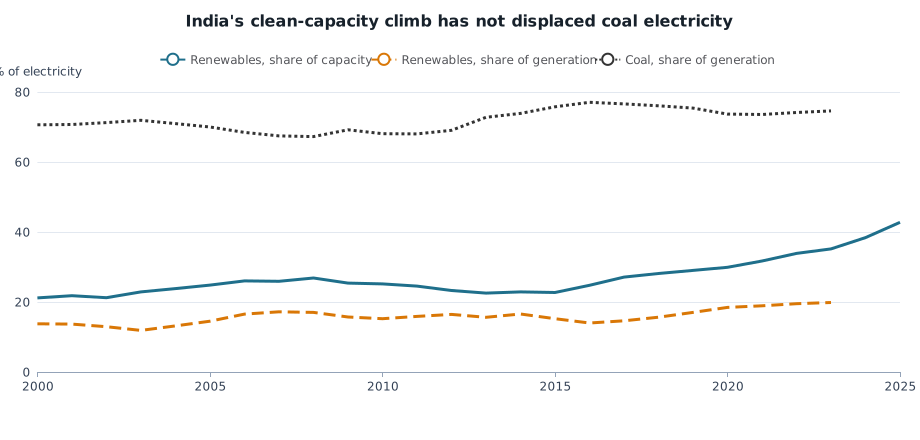
Share of India's electricity, percent. Renewable share of installed capacity, 2000–2025; renewable share of generation and coal share of generation, 2000–2023 (generation not yet published for 2024–25 in this IRENA snapshot). Source: IRENA. Coal generation is coal-and-peat generation divided by total renewable plus total non-renewable generation.
A capacity-generation gap is not unique to India. In 2023 China’s renewable share of capacity was already 49.8% against 30.1% of generation; the world was 43.1% versus 29.9%. India sat lower on both: 35.2% of capacity, 19.9% of generation. By 2025 India’s renewable capacity share had reached 42.8%, still below China’s 58.0% and a global 49.4%. The Indian peculiarity is not that solar plants have low utilisation. It is that coal still supplies about three-quarters of the electrons.
Why a gigawatt of solar is not a gigawatt of coal
Plants do not run the same number of hours. Matching 2023 generation to 2023 capacity gives a rough implied capacity factor — output divided by what the installed fleet could have produced running all year. Coal ran at about 61%, nuclear at 71%, hydropower at 39%, onshore wind at 19%, and solar at 17%.
| Source (2023) | Capacity (GW) | Generation (TWh) | Implied capacity factor |
|---|---|---|---|
| Coal | 261.3 | 1,390.3 | 61% |
| Nuclear | 7.5 | 46.4 | 71% |
| Hydropower (on-grid renewable) | 47.2 | 161.5 | 39% |
| Onshore wind | 44.7 | 74.7 | 19% |
| Solar | 73.1 | 108.1 | 17% |
Those factors are accounting identities, not forecasts, and they mix slightly different IRENA technology labels (solar capacity is all solar energy; solar generation here is photovoltaic). They are enough to explain the 2023 mix. Coal was 52.3% of capacity and 74.6% of generation. Solar was 14.6% of capacity and 5.8% of generation. Other fossil plants (gas and oil) were 10.1% of capacity and only 2.7% of output — a reminder that some thermal capacity sits idle.
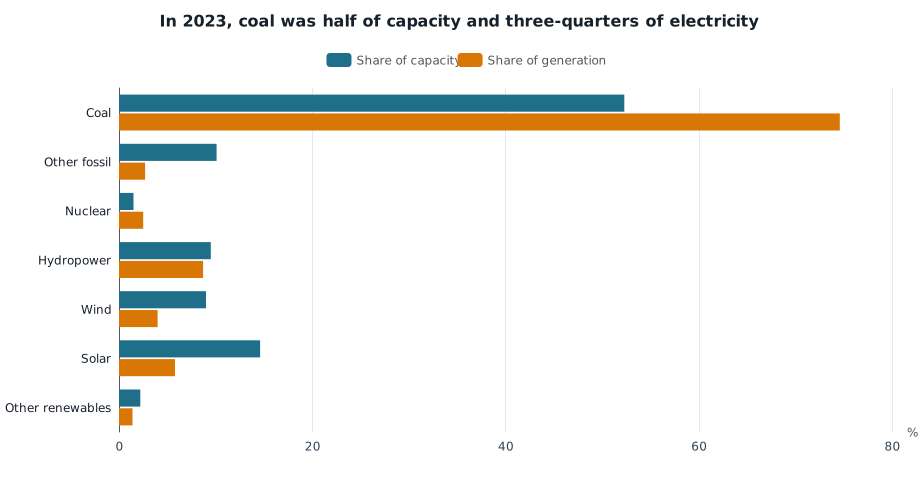
Percent of India's 2023 electricity capacity versus 2023 electricity generation, by source. Capacity total includes renewable, fossil, nuclear and pumped storage; pumped storage is omitted from the bars because it is not assigned generation in this split. A 7.3 TWh residual of other non-renewable generation (0.4% of output) is also omitted. Source: IRENA.
What a 500 GW target would and would not settle
India’s 2030 non-fossil capacity goal is a construction target. From IRENA’s 259 GW of renewable-plus-nuclear capacity in 2025, 500 GW would require about 48 GW a year. That is close to the 46 GW added in 2025. Hitting the target would be a genuine industrial achievement.
It would not, by itself, make most Indian electricity non-fossil. The new capacity is mostly solar, the lowest-utilisation large source in the 2023 table. Coal capacity is still being added. And generation data lag: even if 2024–26 solar output rose with the new panels, IRENA has not yet published those kilowatt-hours here. The conservative reading of the evidence is narrower, and sharper. India is installing a solar fleet at a pace that can produce 300 GW headlines. As of the latest comparable year, three-quarters of the country’s electricity still came from coal, and coal generation was still rising.
Methods and sources
This is retrospective research, written 10 September 2026, about reporting dated 9 August 2026. It uses a pinned IRENA snapshot ingested on 24 August 2026, not an as-of-August-9 vintage. Capacity series run through 2025; generation and renewable generation-share series run through 2023. Observation dates are stored as 1 January of each year and are not release dates; IRENA capacity is conventionally year-end installed capacity.
Non-fossil capacity is renewable (on-grid plus off-grid) plus nuclear. Pumped storage is reported separately because IRENA does not include it in total renewable energy. Off-grid fossil capacity returned no observations and is not treated as zero. Totals are reconstructed from IRENA technology series; they match IRENA’s published renewable capacity share to 0.04 percentage points. The Times of India 300 GW / majority-capacity claim is a feed excerpt and is not independently verified here.
Primary data: IRENASTAT / IRENA Renewable Energy Statistics.
Research Date
The displayed date matches the related news edition. Research was completed 2026-09-10.
Related news: Daily · 2026-08-09
More Research
Colombia’s New Government Inherits A Stalled Economy And A 6 Percent Budget Hole
Colombia’s new government promised a cartel war just as a magnitude-7.4 earthquake hit. IMF accounts show growth already stalled and the budget deficit back near 6 percent of GDP; a $1bn US
Russia’s Wartime Surplus Lasted One Year
IMF accounts show Russia’s 2022 current-account windfall collapsing by 2024, as export volumes fell and imports rebounded.
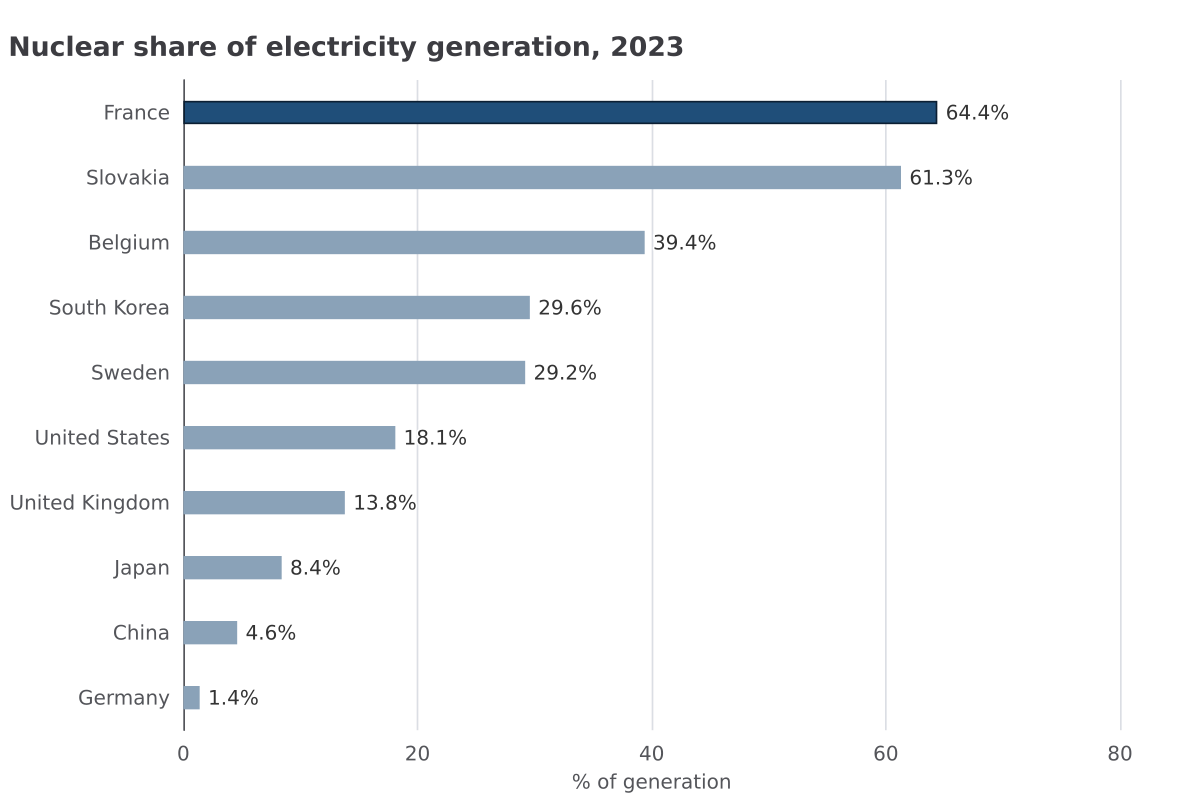
Two-Thirds Of France’s Electricity Still Comes From Nuclear Plants
France added wind and solar, but nuclear plants still generated 64% of its electricity in 2023 — which is why a jellyfish clog at Gravelines is a national grid story.