 LunarWeave
Rubble, Verdicts And A Reactor Stalled By Jellyfish
World & Security
Colombia spent Tuesday digging through concrete after a 7.4-magnitude quake hit its coffee-growing west, leaving at least 164 dead by one official count; the toll had reached 224 by evening. A president who took office days before the disaster declared a state of emergency as rescuers cleared streets in Cali, Pereira and the surrounding countryside.
Syria’s Fourth Criminal Court handed Bashar al-Assad and his brother Maher death sentences in absentia for crimes against humanity and war crimes during a conflict that killed roughly half a million people. A cousin, Atef Najib, was convicted from a courtroom cage. The same region produced a different answer hours away: Lebanon became the first Middle Eastern country to formally abolish the death penalty, replacing it with life imprisonment under hard labour.
On Ukraine, Russian strikes killed at least ten people overnight, Kyiv said, and Volodymyr Zelensky said Zaporizhzhia was hit with North Korean ballistic missiles, Zircons and guided aerial bombs — an allegation that came with no supporting evidence, The Hindu noted. In a quieter move, Russia released ailing former U.S. Marine Robert Gilman after four years on “humanitarian” grounds.
Markets & Economy
Nvidia has moved from selling the shovels to financing the gold rush: the chipmaker is working with six Wall Street institutions to raise more than $500bn for AI infrastructure, and its CEO says Nvidia can backstop up to $125bn of that itself. The buzzword of the moment is “AI as an asset class”; the dissenting view is blunter: one prominent economist warns the AI math doesn’t make sense, with profits still funded by investors rather than earned from customers.
Oil markets are doing their usual geopolitics impression: Qatar said only six ships transited the Strait of Hormuz on Monday, against 130–140 before the war, and crude held near one-week highs as reopening talks stalled. Add Libya to the supply-side worries — a drone attack ignited the Zawiya refinery while the central bank governor resigned without explanation. That is a bad week for energy certainty.
Australia’s industrial umpire gave gig-economy drivers something more tangible than a “thank you”: a minimum rate of $31.30 an hour plus injury insurance for on-demand delivery work, starting August 17. Consider it the rare app update that improves the worker’s terms.
Technology & Industry
Britain’s hospitality sector has drawn a line on wearable cameras: courts in England and Wales will confiscate Meta glasses from anyone trying to enter with them, joining pubs, restaurants, theatre groups and private clubs that have already banned the devices. Meta argues the recording light can’t be disabled; venue owners just hear “always-on camera” and reach for the door policy.
Meta is also busy in court and in model releases: a U.S. appeals court let thousands of lawsuits over allegedly addictive youth features proceed against Meta, Google, TikTok and Snapchat, ruling that Section 230 is a defence, not immunity. Around the same time, Zuckerberg released Muse Glimmer, an open-weight model small enough for one graphics card, and argued for lighter regulation so U.S. open AI can compete with Chinese rivals. The company says bigger models are coming; plaintiffs may say the same about briefs.
And in France, a school of jellyfish achieved what no regulator has: three reactors at the Gravelines nuclear plant were shut down after the swarm clogged cooling pumps, with a fourth cut to half power. EDF insists there is no safety or environmental impact, which is precisely what the jellyfish would say if they could.
Research In Context
A jellyfish swarm that took three Gravelines reactors offline, and halved a fourth, hit the technology that still supplies most French electricity. In 2023, nuclear plants produced 64.4% of France’s power — 338 TWh — even after wind and solar had cut nuclear’s share of on-grid capacity to 40.7%. The United States, which generated more nuclear electricity in absolute terms, got only 18.1% of its power from reactors; Germany got 1.4%.
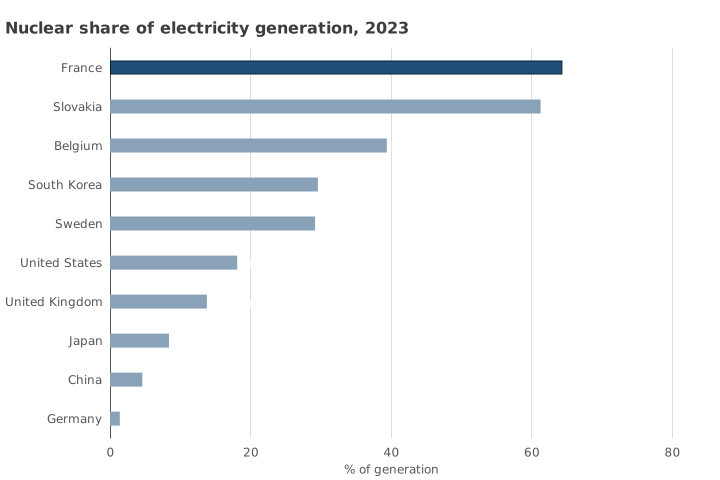
Nuclear share of electricity generation, 2023, in percent of total generation (IRENA renewable plus non-renewable, GWh). Slovakia is a much smaller grid. Source: IRENASTAT. Generation in this snapshot ends in 2023.
That mix, not the jellyfish themselves, is why a Channel clog is a national grid event. Full comparison and capacity-versus-output history.
Politics & Policy
Donald Trump signed an executive order recommending fewer childhood vaccinations per visit and splitting the combined MMR shot into three separate injections, calling the announcement a “major victory” for parental rights and “gold standard science”. Medical organisations counter that the changes lack scientific backing and could leave children under-protected. The order is a strong statement; the science is a strong disagreement.
Presidential travel also made news without actually leaving the ground: the Washington Post and New York Times reported Trump was covertly moved off Air Force One in Turkey, via an airport catering truck, onto a military flight after an Iranian assassination threat. Democrats want a congressional briefing, noting that more than a hundred aides, officials and journalists flew onward unknowingly. A decoy plane is one thing; decoy passengers are another.
Europe offered two studies in political change: Hungary’s parliament elected Andras Baka, the former supreme court chief dismissed under Viktor Orbán, as president. And Russia’s Supreme Court barred the anti-war Yabloko party from parliamentary elections, after a legal challenge that even Kremlin-watchers found perplexing — the case reportedly tangled with a children’s song, doves, suprematist art and a Hiroshima photograph.
Human Stories / Social Trends
Five years after the Taliban returned to power, UNESCO counts 2.4 million Afghan girls shut out of secondary education, a number that could reach four million by 2030. The statistics hide the private grief: one father told AFP he cannot find any justification for the ban and goes into another room to hide to cry, while others described secret lessons, unaffordable private schools and daughters who have stopped asking why they can’t go out.
In Kazakhstan, hope has four legs and a name: Umit, a wild-caught female tiger from the Russian Far East, was released into a reserve on the edge of Lake Balkhash, making Kazakhstan the first country to restore a tiger range after the animal was thought extinct there for more than 70 years. A male is still being monitored before his own release; two cubs are being raised with minimal human contact, presumably so they don’t develop a taste for staff.
For a quieter revolution, the New York Times took a spin around Lahore on an electric motorcycle, where high petrol prices are pushing riders toward battery-powered bikes. The noise pollution is dropping; the torque is not.
Dates and sources
This digest covers the news day 2026-08-11. It is presented retrospectively from a saved draft; its date in the URL identifies the news day, not an assertion of publication on that day. News references link to their original outlets. Supporting research was completed 2026-09-10. Its data vintage and material limitations are recorded in the article methods and chart captions.