 LunarWeave
Blockades, Heatwaves And A History-Making Derby
World & Security
The week's best unwelcome reminder that geography is destiny is the Strait of Hormuz. The Hindu reports a US helicopter fired on a Panama-flagged cargo ship that tried to break the ports blockade, the third forcible halt by Washington since the blockade was reinstated on July 14. Oil prices rose as renewed attacks dented hopes of a reopening, and Deutsche Welle spells out what that means in Baghdad: Iraq cannot export enough oil to fund its huge public sector, salaries are under threat and protests have started. Tidy policy labels have a way of arriving at someone's paycheck.
Dawn reports, citing the Washington Post, that President Trump secretly swapped planes in Ankara last month over an alleged Iranian assassination threat, moving through a catering container to a smaller C-32A while aides and journalists stayed aboard Air Force One with the window blinds down. More somberly, China said it will help Colombia after the 7.4-magnitude quake that killed more than 200, where rescuers pulled a 32-year-old woman alive from the rubble; and Al Jazeera reports an unclassified Pentagon review counted 153 civilians killed in US strikes on Yemen in 2025. Same planet, very different scales of accounting.
Research In Context
Iraq did not meet the Hormuz closure with a surplus in the till. Deutsche Welle reported that blocked oil exports had put public salaries at risk. The IMF’s 2025 estimates, which do not measure the July blockade, already had the government spending 42.7 percent of GDP and collecting 36.3 percent — a 6.4 percent-of-GDP deficit, about $17 billion on a $264 billion economy. Dollar spending had risen since 2022 even as oil prices cooled. In 2009, 2015–16 and 2020, with tankers still moving, oil-income drops opened double-digit deficits because revenue fell and spending did not. Read the full article.
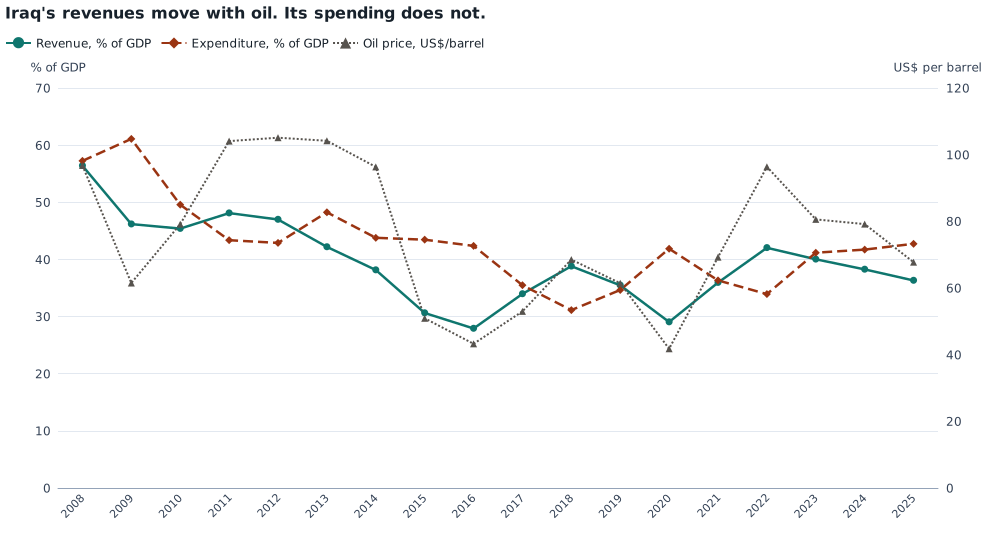
Iraq general-government revenue and expenditure, percent of GDP, 2008–2025, against the IMF average petroleum spot price (US$ per barrel). 2025 values are IMF estimates, not blockade outturns; the revenue line is not an oil-versus-non-oil split. Source: IMF World Economic Outlook. Retrospective research, 10 September 2026.
Markets & Economy
The International Energy Agency now expects global oil demand to fall by 1.6 million barrels per day in 2026, a downgrade reported by TASS. That is not the same as calm prices: Brent climbed as Hormuz attacks dented hopes for reopening, and shipping is improvising — one container ship reportedly paid about $4 million to skip the Panama Canal queue as drought and war shrink the number of slots. The oddest sign of rerouted trade may be that Russia is buying gasoline from India for the first time, via a refiner backed by Rosneft, according to the Times of India.
Consumer balance sheets look less exotic and more strained. US credit card debt reached $1.26 trillion, near a record, even as mortgage balances edged down, according to the Guardian. The Guardian also calculates that repeated UK heatwaves may have cost the economy £4.4 billion in lost output by the end of July; the New York Times reports that threatened 50% tariffs could push some Canadian companies to relocate rather than absorb them. And Tui says the Iran war and cost-of-living crisis have cost it €60 million and trained holidaymakers to book at the last minute — which seems a fair summary of consumer confidence almost everywhere.
Technology & Industry
Google says Gemini hit one billion monthly active users, making it the company's fastest-growing consumer product ever, and that the app now creates more than 150 million images a day for small businesses, the Times of India reports. Anthropic is complying with EU rules by adding an invisible watermark to Claude output, but notes, with unusual candor, that the mark only shows Claude processed the text, not that Claude wrote it, according to Dawn. Meta's legal calendar has its own heavy entry: jury selection is set in a $1.4 trillion suit over allegedly addictive, child-targeting design. And Google's former chief scientist Jeff Dean gave a conference a minute-by-minute goodbye involving 1,500 people at his farewell party and one minute of unemployment before co-founding Discovery Loop, per the Times of India.
China's Comac C919 crossed a modest but real milestone with its first international commercial flight, Beijing to Ulaanbaatar, and experts say it could take generations to seriously challenge Boeing and Airbus, The Guardian reports. In parallel, Chinese researchers are preparing to test-market Cuimi, a lychee-longan hybrid that breaks reproductive barriers between genera, SCMP writes, while Malaysian researchers are developing palm-oil-based data-centre coolant, according to SCMP. Somewhere in that mix — food, flight and a cooling liquid that may smell like lunch — is an honest picture of how industrial labs are improvising.
Politics & Policy
Minnesota's Senate primary was a useful gauge of the anti-establishment weather: lieutenant governor Peggy Flanagan beat moderate Angie Craig in a race defined by anti-ICE anger, according to the Guardian. The administration's immigration machinery kept churning, with a new task force to end birth tourism and more than 600 visas already revoked, SCMP reports. Somewhere between those two items is a country arguing about how much enforcement is enough.
Away from Washington, Germany's cabinet approved a draft law to lift many postwar restraints on its intelligence services, a security overhaul that must still pass parliament, The Guardian reports. The WHO chief says the US vaccine policy overhaul goes against decades of evidence, while SCMP notes Trump's Monday order pushes for separated MMR shots and a rethink of school mandates. France 24 adds that Russia's only anti-war party has been barred from next month's parliamentary elections. And Australia is moving toward a law that would force tech giants to pay for news content — an experiment in treating platforms less like friends and more like utilities.
Human Stories / Social Trends
On the brighter side of the ledger, an Indiana teenager who turned her own medical struggles into a mission raised $6,800 and distributed a hundred blessing bags to Fort Wayne's homeless, per the Times of India. Colorado offers a larger-scale comeback: the Rocky Mountain Arsenal, once a chemical-weapons and pesticide site, is now a 15,000-acre wildlife refuge with bison, bald eagles and black-footed ferrets. Sports-fed feeds were also relishing a first: social posts celebrated Golden Tempo's Kentucky Derby win, making Cherie DeVaux the first woman to train a Derby winner.
The harder stories deserve the same attention. The Guardian reports that Horace Mason, a 74-year-old British man with dementia who has lived in Sweden for 25 years, has 10 days to leave after losing a post-Brexit migration case. Thailand has suspended gun licences after a school shooting that killed nine, and Lebanon's parliament voted to abolish the death penalty, a first for the Middle East; Amnesty says at least 85 people were still on death row. Not all policy headlines are about process. This one is about who lives and who does not.
Dates and sources
This digest covers the news day 2026-08-12. It is presented retrospectively from a saved draft; its date in the URL identifies the news day, not an assertion of publication on that day. News references link to their original outlets. Supporting research was completed 2026-09-10. Its data vintage and material limitations are recorded in the article methods and chart captions.