 LunarWeave
Caviar Diplomacy, Tariff Theatrics, And One Glorious Eclipse
World & Security
Disasters coordinated their timing. Colombia is still digging through a magnitude 7.4 quake that killed 265 and left hundreds missing, and a DW review of 2026’s big tremors in Colombia, Venezuela and Mindanao notes that magnitude alone never decides the scale of destruction. Congo’s Ebola outbreak, meanwhile, has spread to a sixth province, with 2,128 dead among about 4,566 recorded cases; the WHO says it is on track to surpass the deadliest Ebola outbreak on record.
Ukraine’s war keeps producing unbearable specifics. UN monitors put July’s civilian toll at its highest since May 2022 — 437 killed, 2,610 wounded — and a Shahed drone hit a passenger train in the Odesa region, killing two railway workers and forcing 340 passengers, including 67 children, to evacuate. The Black Sea grain war is also escalating: Russia struck Ukraine’s Izmail port a day after Kyiv hit Novorossiysk’s grain terminals, and Ukraine was reported to have proposed a mutual halt to attacks on civilian shipping. Russia, in turn, has warned of global food “chaos” as its own grain terminals sit damaged.
Putin toured the disputed Kuril Islands for the first time — even accepting caviar at a fish plant — infuriating Japan, which calls the territory its own. In the Iran war, Washington is reportedly falling back on economic pressure after bombing failed to force a capitulation, while Tehran insists it has full control over the Strait of Hormuz. A Pentagon review also confirmed that US strikes in Yemen in April 2025 killed 153 civilians — a number worth repeating whenever this is described as a tidy operation.
Markets & Economy
Trade enforcement is having a branding moment. A US report accuses Chinese exporters of dodging tariffs through more than 40 third countries, dubbing the practice “The Great Transshipment Scam”. The oil market shows why enforcement is hard: Russia provided roughly half of India’s June crude imports — $7.2 billion of a $14.8 billion total — according to a GTRI analysis cited by the Times of India. Britain is feeling the squeeze too: UK GDP grew just 0.4 per cent in the second quarter as the Iran war pushed up energy prices.
Europe’s summer is arriving with an invoice. The drought shrivelling crops from Dutch potatoes to Bosnian corn could shave about 1 per cent off EU GDP in 2026, or roughly €180 billion, according to a warning from Dutch lender Triodos reported by France 24. Romania was forced to shut its only nuclear plant because the Danube fell too low to cool it — a failure with precedent only in 2003, according to Al Jazeera — while Hungary scrambled to keep its own Paks plant alive on the same fading river. British universities, meanwhile, say a collapse in international student numbers is pushing the sector toward a financial crisis.
China’s chipmakers are minting money on domestic AI demand: SMIC profits rose 261.7 per cent and Hua Hong’s 385.9 per cent in the second quarter. Citi analysts see Chinese carmakers taking 15 to 30 per cent of Europe’s market by 2035 unless Brussels tightens tariffs further. And by way of contrast, Tesla paid Elon Musk 2.5 million times its average worker’s pay in 2025 — a ratio that makes the rest of the S&P 500 look almost egalitarian.
Technology & Industry
China’s answer to Boeing locked in its second-ever international commercial flight when an Air China C919 landed in Ulaanbaatar from Beijing in one hour 41 minutes; flight-trackers noted the jet is scheduled to replace the 737 MAX on the route within a week. The previous day’s first international C919 service earned a water-salute, with Chinese media declaring the aircraft had officially acquired the qualification for regular international commercial operations — and Comac says the plane has now served 58 routes and 26 cities. Boeing and Airbus can pretend not to notice; the runway is still there.
Commercial AI is going through an awkward teenage phase. Sergey Brin is reportedly telling DeepMind staff to throw everything at Gemini and catch up to the frontier after Demis Hassabis stepped aside as CEO amid release delays and coding-benchmark misses. Alibaba chose a softer sell, publishing its Qwen3.8-Max weights for free — while quietly requiring companies above $50 million in relevant revenue to buy a commercial licence. Free as in free to download, not free to ignore the billing department.
Meta, in its two annual moods, says it removed 756,000 suspected under-16 accounts in Australia just as jury selection began in a federal trial over claims that its platforms harm children’s mental health and track them illegally. Both statements can be true; that’s the problem. Taiwan, meanwhile, says it was targeted last month by an AI-driven hacking campaign against government agencies.
Politics & Policy
Courts remain the institution refusing the administration’s preferred narrative. A federal judge in Boston dismissed the Trump administration’s lawsuit against Harvard over the alleged failure to protect Jewish and Israeli students, ruling the case failed to show an ongoing civil-rights violation. Human Rights Watch, meanwhile, says key federal agencies have stopped providing civil-rights oversight altogether, and the administration finalized a rule ending federal support for gender-affirming care through Medicaid and CHIP.
The White House saw its most visible defender leave the podium: Karoline Leavitt is stepping down to spend more time with her children, at a moment when her boss’s approval ratings are at historic lows. Also in monetising-the-presidency news, press groups sued Trump Media over a paid service giving subscribers early access to the president’s posts; financial disclosure reporting by the Guardian describes $2.2 billion in 2025 revenues and a presidency that ethics experts call “most openly corrupt”. The quotation marks are doing heavy lifting, but the receipts are not.
Germany briefly united the ideological fringes: far-right AfD leader Björn Höcke offered to back left-populist Sahra Wagenknecht as Thuringia’s premier. Russia’s highest court barred the anti-war Yabloko party from September’s election, as reported by DW. And in Britain, an oversight letter about the UK-France migration deal found 94 of 304 age-disputed cases involved children who had been treated as adults.
Human Stories / Social Trends
Europe is sweating through Britain’s fifth heatwave of the year, and hospitals are not coping. The Royal College of Nursing reports members collapsing in wards above 30C with no air conditioning, fans or even windows that open, calling conditions “inhumane”; Kew Gardens logged 38.1C, the UK’s hottest day of 2026 so far. More than 135 million people across Europe have been facing temperatures above 35C, according to Al Jazeera. A DW news roundup put Germany’s reported heat-related deaths so far this year at around 12,500 — a number that should worry every country building hospitals without air conditioning.
Afghanistan marked five years of Taliban rule, and the accounting is brutal. The New York Times reports that decrees curtailing women’s rights to study, work, travel and act independently now threaten permanent damage to the country. The humanitarian plumbing is failing too: Save the Children says clinic closures and collapsing healthcare funding have left 3.7 million Afghan children acutely malnourished — one in ten. Not a cheerful anniversary, but one worth noting without euphemism.
For good news, Spain’s first total solar eclipse in over a century drew millions into the streets to cheer the darkening sky — proof that crowds still gather for things that aren’t protests, sales or emergencies. Air India ordered drug testing for all pilots after one reportedly tested positive for cannabis, though the airline says the result was never shared with it; testing everyone is one way around that caveat. And a Pakistani court ordered an independent inquiry into an HIV outbreak among children at a Karachi hospital, calling earlier departmental probes “insufficient” — which is public-official for ‘start again’.
Research In Context
Five years into Taliban rule, clinic-closure warnings and bans on women’s work sit on an economy that has stopped shrinking without restoring living standards. In the IMF’s accounts, Afghanistan’s real GDP fell 14.5 percent in 2021 — the worst year in the 2003–2025 series — and another 6.2 percent in 2022. Output has since inched up, but real GDP per person in 2025 is still about 28 percent below 2019 and essentially unchanged since the 2022 trough. A 16 percent rise in population absorbed the rebound, and general government revenue is still well below its pre-takeover share of GDP.
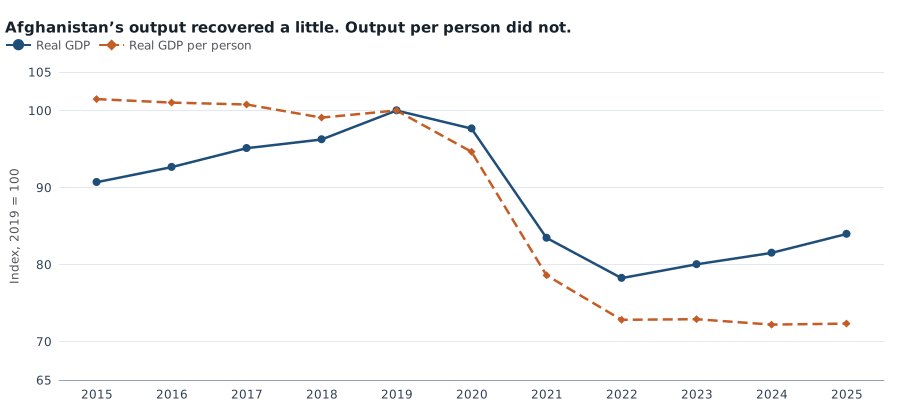
Index of Afghanistan constant-price GDP and GDP per person, 2015–2025 (2019 = 100). Source: IMF World Economic Outlook. 2024–2025 are estimates; the series do not measure malnutrition or women’s exclusion.
That smaller per-person base is the economic backdrop to this week’s humanitarian reporting. Full analysis.
Dates and sources
This digest covers the news day 2026-08-13. It is presented retrospectively from a saved draft; its date in the URL identifies the news day, not an assertion of publication on that day. News references link to their original outlets. Supporting research was completed 2026-09-10. Its data vintage and material limitations are recorded in the article methods and chart captions.