LunarWeave
The Afghan Economy’s Rebound Never Reached Its People
Five years after the Taliban returned to power, the humanitarian ledger is still being written in the present tense. The New York Times reported that decrees limiting women’s rights to study, work, travel and act independently now threaten lasting damage. Save the Children, quoted by Al Jazeera, said clinic closures and collapsing healthcare funding have left 3.7 million Afghan children acutely malnourished — one in ten. Those are reported claims, not figures this article can re-measure.
They do raise an economic question that official accounts can answer. If the country has “stabilised” since the 2021 collapse, is that a recovery in living standards, or only the end of the freefall? In the International Monetary Fund’s World Economic Outlook, Afghanistan’s real output per person is still about 28 percent below its 2019 level — and it has barely moved since the 2022 trough.
The crash of 2021 was not an ordinary recession
The IMF’s constant-price GDP growth series for Afghanistan begins in 2003. On that record, 2021 is the worst year. Real GDP contracted 14.5 percent as the Islamic Republic collapsed, foreign troops left, and aid and the banking system seized up. A further 6.2 percent drop followed in 2022. Taken together, constant-price output in 2022 was 20 percent smaller than in 2020.
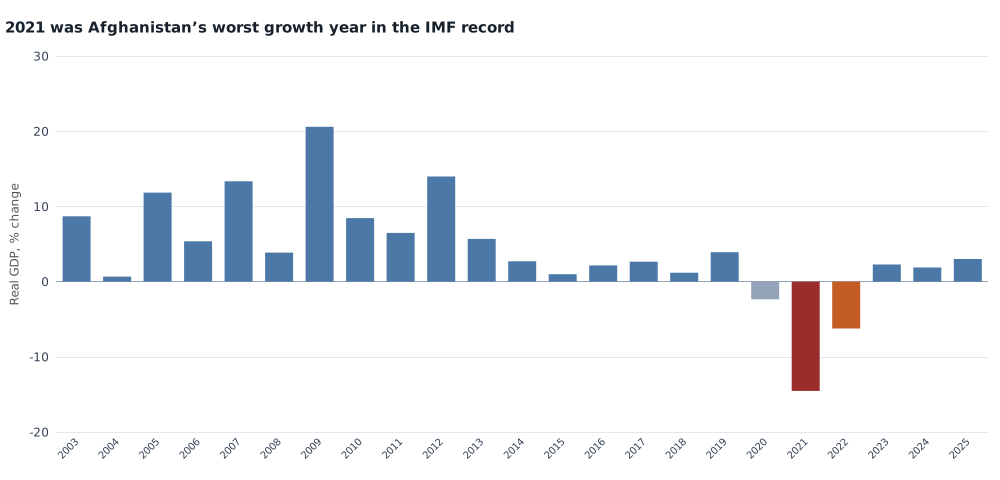
Annual percent change in Afghanistan’s constant-price GDP, 2003–2025. The 2021 contraction is the lowest reading in the IMF series. Source: IMF World Economic Outlook (NGDP_RPCH). Values after 2023 are IMF estimates in this vintage. Choose Afghanistan in the growth-rate chart selector.
The rebound that followed has been real, and modest. The Fund puts growth at 2.3 percent in 2023, 1.9 percent in 2024 and 3.0 percent in 2025. Three years of low-single-digit expansion are not nothing in a country that had just lost a fifth of its output. They are also not a restoration. Constant-price GDP in 2025 was still 16 percent below 2019, the last pre-pandemic, pre-takeover year in these accounts.
Current-dollar GDP can look healthier because prices and the exchange rate move. In 2025 the IMF’s dollar estimate is about $19.7 billion, or $448 per person — up from $356 in 2021, but still a current-price snapshot, not proof that real living standards have recovered.
Population growth ate the rebound
Total output and output per person have told different stories since 2022. Constant-price GDP rose 7.3 percent from the 2022 trough to 2025. Constant-price GDP per person fell another 0.7 percent over the same stretch. In other words, the “recovery” has only about kept pace with a larger population. It has not rebuilt what was lost.
The IMF’s population series rises from 37.8 million in 2019 to 43.8 million in 2025, a 16 percent increase, or about 6.1 million more people sharing a smaller pie. Indexed to 2019, real GDP in 2025 sits at 84. Real output per person sits at 72.
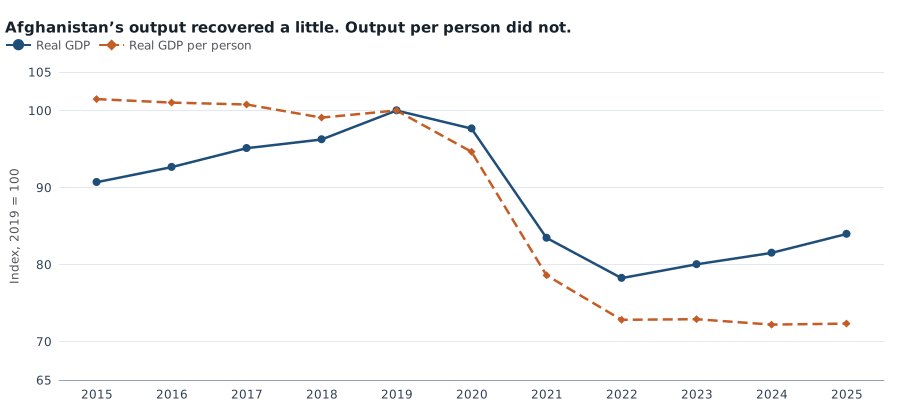
Index of Afghanistan’s constant-price GDP and constant-price GDP per person, 2015–2025 (2019 = 100). Source: IMF World Economic Outlook (NGDP_R, NGDPRPC). 2024–2025 are IMF estimates in this vintage. Choose Afghanistan in the per-person output chart selector.
The same pattern appears in the Fund’s constant-PPP measure of GDP per person: about 2,721 international dollars in 2019, and 1,968 in 2025. That is a different unit from the national-currency index, not a second independent census of welfare, but it moves in the same direction.
| Year | Real GDP growth | Real GDP (2019=100) | Real GDP per person (2019=100) |
|---|---|---|---|
| 2019 | 3.9% | 100.0 | 100.0 |
| 2020 | −2.4% | 97.6 | 94.6 |
| 2021 | −14.5% | 83.4 | 78.6 |
| 2022 | −6.2% | 78.2 | 72.8 |
| 2023 | 2.3% | 80.0 | 72.9 |
| 2024 | 1.9% | 81.5 | 72.2 |
| 2025 | 3.0% | 84.0 | 72.3 |
Growth is IMF NGDP_RPCH; indexes are calculated from constant-price GDP and GDP per capita. 2024–2025 are estimates in this vintage.
A 3 percent growth year in 2025, then, is not evidence that Afghans have recouped the takeover shock. It is evidence that the contraction has stopped. On a per-person basis, the country is still where it was at the bottom.
The state shrank with the economy
The fiscal accounts make the same point in a different unit. IMF general government revenue was about 27 percent of GDP in 2019 and 15 percent in 2022. The 2025 estimate is 19 percent of GDP — and it is copied exactly from 2024 in this vintage, a reminder that the latest year is an IMF staff figure, not a fresh outturn. Expenditure followed the same collapse: 28 percent of GDP in 2020, 16 percent in 2022, and 20 percent in the 2025 estimate.
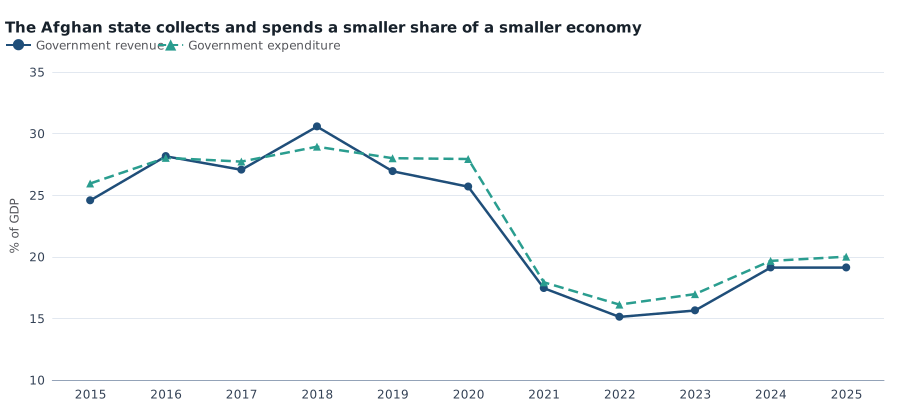
IMF general government revenue and expenditure as a percent of GDP, Afghanistan, 2015–2025. Source: IMF World Economic Outlook (GGR_NGDP, GGX_NGDP). The identical 2024 and 2025 revenue figures mark an estimate. Choose Afghanistan in the revenue chart selector.
That is not a clinic-by-clinic ledger, and it cannot confirm Save the Children’s malnutrition count. It does show that the public sector is collecting and spending a smaller share of an economy that is itself smaller than before the takeover. A health system that was already aid-dependent would feel that twice: less domestic revenue, and less foreign support, on top of a poorer population.
Prices tell a related story. Average consumer-price inflation ran at 10.6 percent in 2022, then turned into deflation of 7.7 percent in 2023 and 4.3 percent in 2024. A burst of inflation followed by falling prices is what a demand collapse looks like in the CPI, not a return to the pre-2021 economy.
What the accounts cannot settle
These are national accounts for a country whose statistical system was disrupted, then run under a government most donors do not recognise. The IMF figures for 2024 and 2025 should be read as estimates. They do not measure the exclusion of women from work and school, the quality of remaining health care, or the share of output that never reaches households. A constant-price GDP series also cannot say whether the lost fifth of output was aid-financed services that will not return.
What the vintage can settle is narrower, and still consequential. On the IMF’s own numbers, the deepest contraction in the 2003–2025 series came in the takeover year. The rebound since 2023 has not restored 2019 output. Because the population is millions larger, real output per person is still about 28 percent below that benchmark and has been flat since 2022. The humanitarian emergency described this month is landing on that smaller per-person economic base, not on an economy that has already climbed back.
Methods and sources. This is retrospective research completed on 10 September 2026, using a pinned IMF World Economic Outlook snapshot whose underlying raw run is dated 10 August 2026 — not an as-of reconstruction of what was knowable on the 13 August 2026 news day. Annual observations run through 2025; Afghanistan has no 2026 value in the extract. Growth rates, indexes and percent changes were calculated from those annual series. Official source: IMF World Economic Outlook.
Research Date
The displayed date matches the related news edition. Research was completed 2026-09-10.
Related news: Daily · 2026-08-13
More Research
The Surplus On Hormuz Is Not Iran’s
IMF current-account books for 2024 put the large Gulf surplus in the UAE, Kuwait and Qatar, not Iran — the country a Hormuz blockade is meant to squeeze.
Iraq’s Budget Was Already In The Red When The Strait Closed
IMF accounts show Iraq already running a 2025 deficit, with spending that does not fall when oil income does — the fiscal backdrop to the Hormuz blockade.
Russia Is Larger Than Before The Invasion. The War Boom Is Over.
IMF accounts show Russia’s 2023–24 war boom slowing to about 1 percent growth, not an output collapse.