LunarWeave
The Information Boom Is In Output, Not In California Payrolls
Microsoft is offering voluntary buyouts to about 60,000 people, according to reporting by Nikkei Asia and Iltalehti, while it budgets a huge AI build-out. Chinese AI-linked shares have been reported in a sharp slide. If that combination were already a hangover in the US real economy, it would show up in the official accounts of the information sector — software publishing, telecoms, data processing, web search, broadcasting and the rest of the industries that sell code, connectivity and content.
It does not show up as shrinking output. It shows up as a split. US information-sector production is still sprinting. Information payrolls in California, which still has the largest such workforce among the states in this comparison, are already far below their 2022 peak.
Output has not rolled over
In the second quarter of 2026, US information-sector real GDP was running at a $2.09 trillion annual rate in chained 2017 dollars, seasonally adjusted. That was 10.3 percent above the same quarter of 2025. The whole economy grew 2.2 percent over the same year.
From late 2019 to mid-2026, information real GDP rose 73 percent. All-industry real GDP rose 16 percent. In current dollars, information accounted for 5.9 percent of US GDP in 2026 Q2, up from 5.4 percent in 2019 Q4. BEA's contribution figures put information at 0.85 percentage points of real GDP growth in 2026 Q1 and 0.52 points in Q2 — a large slice of a slow expansion.
Those are not stock prices, and they are not a forecast. They are the Bureau of Economic Analysis's GDP-by-state accounts for the United States, in the 30 September 2026 regional release. The information sector in those books is NAICS 51: it includes software publishers, but also motion pictures, telecoms, broadcasting and data processing. It is broader than "AI companies," and it does not include computer-systems consultancies, which BEA classifies under professional services.
The quarterly path has no 2025–26 air pocket. Real information GDP rose in every quarter from 2024 Q1 through 2026 Q2. Whatever is happening in Chinese AI equities, the official US production measure for this sector was still accelerating into mid-2026.
The jobs already left California
Payrolls tell a different story — and a narrower one, because the employment figures here are state totals, not a national information headcount.
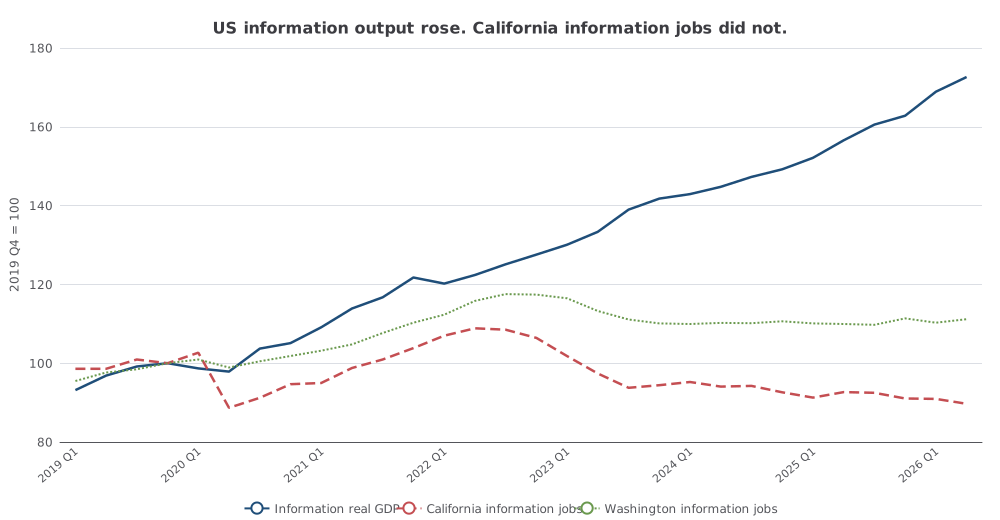
US information-sector real GDP (chained 2017 dollars, seasonally adjusted annual rate) and statewide information payrolls in California and Washington, each indexed to 2019 Q4 = 100. Jobs use the quarter-ending month. Sources: BEA, GDP by state; BLS State and Area Employment. Indexed series are not GDP shares. Latest BLS month is August 2026.
California information employment, seasonally adjusted, peaked at 629,800 in August 2022. By August 2026 it was 510,700 — 19 percent below that peak, a loss of 119,100 jobs, and 11 percent below December 2019. That is not a one-state curiosity of Hollywood versus software: California's information supersector mixes both, plus telecoms. The drop is still the largest among the states compared here, and it was already in train before the latest round of buyout headlines.
Washington, where Microsoft is based, looks different. Information payrolls there peaked at 175,300 in August 2022 and were 164,100 in August 2026, down 6 percent from the peak but still 10 percent above December 2019. New York, Texas and Massachusetts are all 11 to 12 percent below their own 2022 highs.
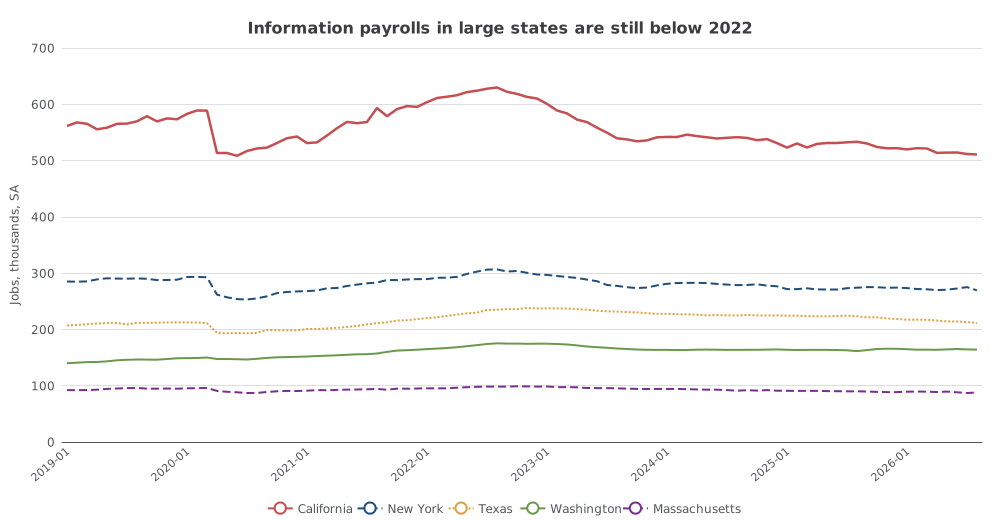
Seasonally adjusted information-sector (NAICS 51) payroll employment, thousands of jobs, January 2019–August 2026. Statewide totals, not a US national information payroll. Source: BLS State and Area Employment, 2025 benchmark, through August 2026.
Taken together, those five states had 1.45 million information jobs in August 2022 and 1.24 million in August 2026, a decline of 202,000, or 14 percent. That selected-state total is not the missing national figure; it is large enough to show that the 2022 information-jobs peak has not come back in the places that held most of it.
A reported 60,000-person Microsoft offer is smaller than the jobs California information has already lost since 2022. It is not, on these figures, evidence that the US information economy has started to shrink. It is evidence that headcount and output have decoupled.
Paychecks still dominate systems design. They do not dominate software publishing.
The national accounts make the same split in a different way: not jobs versus output, but labour costs versus operating surplus inside each industry's GDP.
Publishing industries except internet — the BEA grouping that includes software publishers — raised real GDP 87 percent from 2019 to 2025. Compensation of employees rose 66 percent. Gross operating surplus, the profit-like remainder after pay, rose 98 percent. The pay share of that industry's current-dollar GDP fell from 43.3 percent in 2019 to 39.3 percent in 2025; the surplus share rose from 54.3 percent to 58.9 percent.
Computer systems design and related services, which is not inside information, is the industry that writes, integrates and runs other firms' systems. Its real GDP rose 83 percent over the same years. It is still a paycheck business: compensation was 81.6 percent of its GDP in 2019 and 83.4 percent in 2025. Surplus was only 14 percent in 2025.
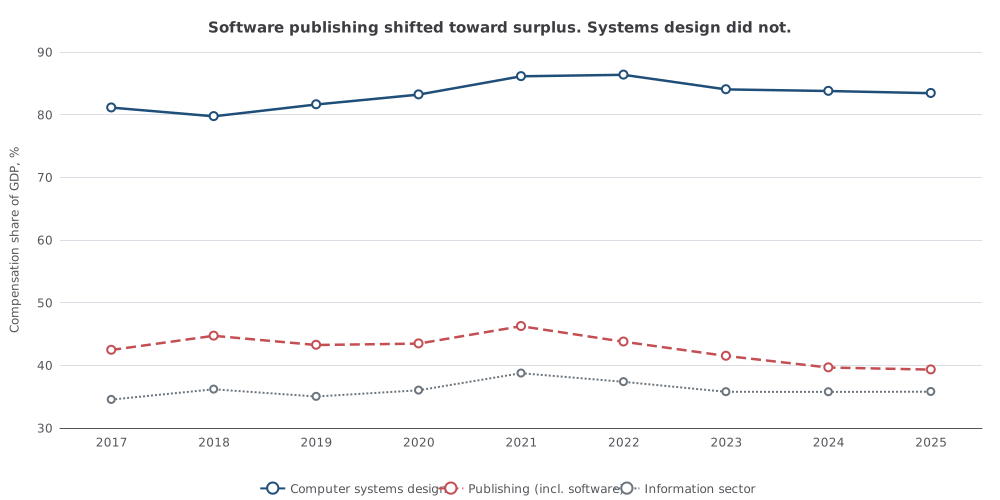
Compensation of employees as a percent of current-dollar GDP, 2017–2025. Computer systems design sits in professional services, not in information. Source: BEA, GDP by state. Compensation is converted from thousands of dollars before dividing by GDP in millions.
The information sector as a whole did not copy publishing's shift. Its compensation share was 35.0 percent of current-dollar GDP in 2019 and 35.8 percent in 2025 — already far below the 51 percent pay share of the whole economy in 2025, because telecoms, software and data processing have long been capital-heavy. By 2026 Q2 the information pay share had eased to 34.9 percent, a small move, not a collapse.
| Industry (current-dollar GDP) | Pay share, 2019 | Pay share, 2025 | Real GDP, 2019–25 |
|---|---|---|---|
| Information (NAICS 51) | 35.0% | 35.8% | +62% |
| Publishing except internet (incl. software) | 43.3% | 39.3% | +87% |
| Computer systems design (professional services) | 81.6% | 83.4% | +83% |
| All industries | — | — | +16% |
The machines-and-payroll slogan fits software publishing better than it fits the information sector, and it does not fit systems design at all. Companies that sell packaged software and digital products have been expanding surplus faster than pay. Companies that sell people who implement systems have not.
What the split does not prove
None of this says the reported Microsoft offers will be accepted, or that they will show up in next year's payrolls. BLS state employment is a survey of jobs, not of named firms. NAICS 51 in California is not a Silicon Valley census: motion pictures and telecoms move in the same supersector. Computer systems design is the closest official industry to "AI implementation labour," and it is still growing as a pay-heavy activity in the annual accounts through 2025.
The figures also cannot settle whether a $2 trillion AI listing is dear or cheap. They can settle a simpler question. The hangover visible in some AI-linked equities has not arrived as a contraction in US information-sector output. Through mid-2026 that output was still rising several times faster than the rest of the economy, while information payrolls in California — and, more modestly, in New York, Texas and Massachusetts — were already well below their 2022 peaks. The boom is in what the sector produces. The shake-out is in who it puts on the payroll.
Sources and methods
This is a retrospective analysis. The news is from 27 October 2026; the calculations use later pinned statistical snapshots, not an as-of-that-day reconstruction. BEA regional GDP and income are from the 30 September 2026 release (annual through 2025, quarterly through 2026 Q2). BLS State and Area Employment is the 24 August 2026 snapshot, 2025 benchmark, monthly through August 2026.
Real GDP is in chained 2017 dollars; quarterly values are seasonally adjusted annual rates. Shares of GDP use current dollars only. Compensation and gross operating surplus are converted from thousands of dollars to millions before dividing by GDP. Chained-dollar industry totals are not added to form shares. Employment series are statewide, seasonally adjusted, in thousands. The five-state job total is a selected sum, not a national information payroll.
Microsoft's reported 60,000 buyout offers are company news, not a BLS count, and are not verified here. The Finnish-language Iltalehti report supports the 60,000 figure; a "three-quarters of staff" reading is not used.
Research Date
The displayed date matches the related news edition. Research was completed 2026-10-28.
Related news: Daily · 2026-10-27
More Research
Microsoft’s 60,000-Person Offer Is Almost The Size Of Seattle’s Software Payroll
Microsoft’s 60,000-person voluntary-exit pool is 92 percent as large as Seattle-area software-publishing employment, a payroll already 16.6 percent below its 2022 peak even as Washington inf
Georgia Already Builds Cars. Audi Is Joining A Small, Rebuilt Industry.
Georgia’s motor-vehicle industry collapsed in 2009 and came back. Audi’s $4 billion plant is large for that rebuilt, still-small auto state.
The Paycheck Is A Shrinking Share Of America's Official Income
Work is a smaller slice of U.S. personal income than before the pandemic. Transfers and asset income grew faster than wages.