LunarWeave
Microsoft’s 60,000-Person Offer Is Almost The Size Of Seattle’s Software Payroll
Microsoft is asking as many as 60,000 employees to leave. That is not a rounding error in the labor market around its headquarters. It is nearly as large as the entire software-publishing industry still standing in Seattle.
Dawn reported on 26 October 2026 that the company had opened a voluntary-exit offer to about 60,000 staff on selected teams in the United States, Canada, India and Britain — vice-president level and below, with some data-centre, sales and marketing groups excluded. Dawn, citing Microsoft filings, put global headcount at 223,000 at the end of June, so the pool is about 27 percent of the company. It is the second such offer this year. It is not a completed layoff, and it is not a Seattle-only cut.
The useful question is scale. How large is a 60,000-person buyout against the payroll Microsoft actually sits in — and has that payroll already been shrinking while the state’s information output kept rising?
A buyout the size of the home market
The Bureau of Labor Statistics counts 65,300 software-publishing jobs in the Seattle-Bellevue-Kent metropolitan division in August 2026, and 84,600 in Washington state. Those are not-seasonally-adjusted establishment payrolls for NAICS 5112, the industry that includes Microsoft’s core software business and other publishers. August figures are preliminary.
Sixty thousand eligible exits are 92 percent of the Seattle-area software-publishing payroll and 71 percent of the statewide one. Against Washington’s broader information supersector — software, telecoms, data processing, publishing and related media — the same 60,000 people are 37 percent of 164,100 seasonally adjusted jobs.
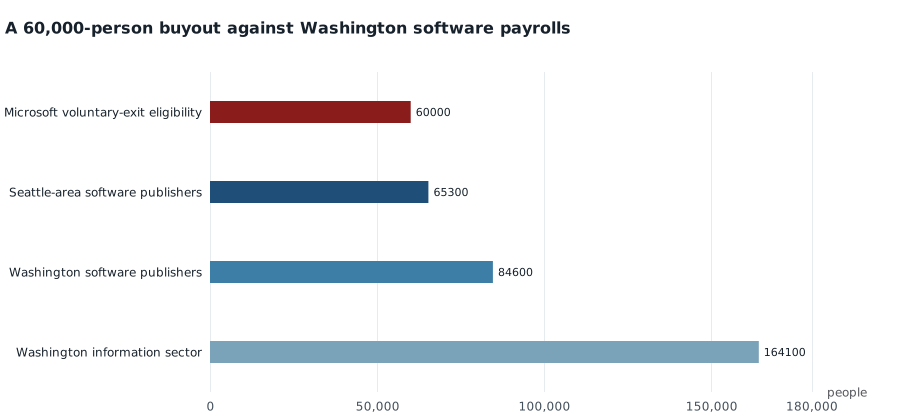
People. Microsoft’s reported voluntary-exit eligibility compared with August 2026 BLS payrolls. August figures are preliminary. Eligibility is not a completed cut and is not located entirely in Washington. Sources: Dawn reporting; BLS State and Area Employment.
| Measure | People | Notes |
|---|---|---|
| Microsoft voluntary-exit eligibility | 60,000 | Reported; US, Canada, India, UK |
| Seattle-Bellevue-Kent software publishers | 65,300 | Aug 2026, not seasonally adjusted, preliminary |
| Washington software publishers | 84,600 | Aug 2026, not seasonally adjusted, preliminary |
| Washington information supersector | 164,100 | Aug 2026, seasonally adjusted, preliminary |
The comparison is a scale check, not a forecast of local quits. Most of the 60,000 eligible workers are not in Redmond. Software publishers are not only Microsoft. What the numbers do show is that the offer is large relative to the industry cluster that made Microsoft a regional employer in the first place.
The Seattle software payroll has already shrunk
That cluster is smaller than it was at the end of the pandemic hiring boom. Seattle-Bellevue-Kent software-publishing employment peaked at 78,300 in June 2022. By August 2026 it was 65,300 — 13,000 jobs, or 16.6 percent, below the peak, and 13.5 percent below August 2022. Statewide software publishing fell much less, 5.1 percent from its own 2022 high. In August 2019, Seattle still held 96 percent of Washington’s software-publishing jobs; in August 2026 it held 77 percent. Some of that gap is other parts of the state. Some of it is jobs that no longer show up at a Seattle establishment.
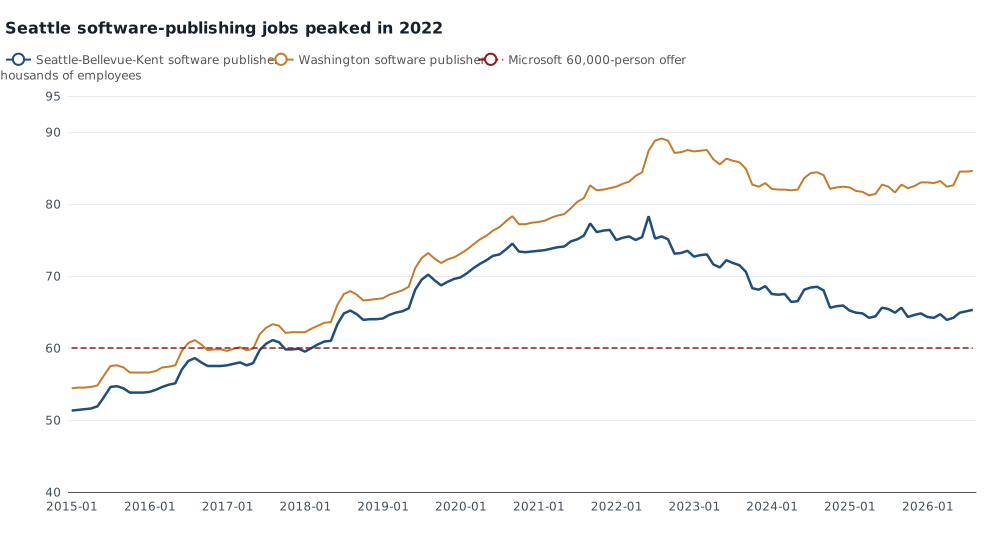
Thousands of employees, not seasonally adjusted, January 2015–August 2026. The dashed line is Microsoft’s reported 60,000-person offer. August 2026 values are preliminary. Source: BLS State and Area Employment.
Washington’s whole information supersector, which is seasonally adjusted, peaked at 175,300 jobs in August 2022 and was 164,100 in August 2026 — down 6 percent. That is a milder decline than in other large tech states. California’s information payroll is 19 percent below its August 2022 peak; New York’s is 12 percent below; Texas’s is 11 percent below. Microsoft’s home state held onto more of the 2022 bulge than California did. It did not hold onto the Seattle software peak.
Output kept climbing
Jobs are not the same as the industry’s weight in the economy. BEA state GDP accounts put Washington information-sector real value added at $173.8 billion in 2025 (chained 2017 dollars), 24 percent of the state’s $715.9 billion real GDP. Nationally, information is 8 percent of real GDP. More than half of Washington’s information output — $89.7 billion — is in publishing industries except internet, the BEA group that includes software publishers. That publishing share is 52 percent in Washington and 28 percent in the United States.
The payroll and the output have been moving in different directions. From 2022 to 2025, Washington’s average information employment fell 4.4 percent, from 171,400 to 163,800. Real information GDP rose 40 percent, from $124.1 billion to $173.8 billion. By the second quarter of 2026 it was still $177.2 billion, 34 percent above late 2022. Compensation paid in the sector rose too, from $46.7 billion in 2022 to $60.4 billion in 2025.
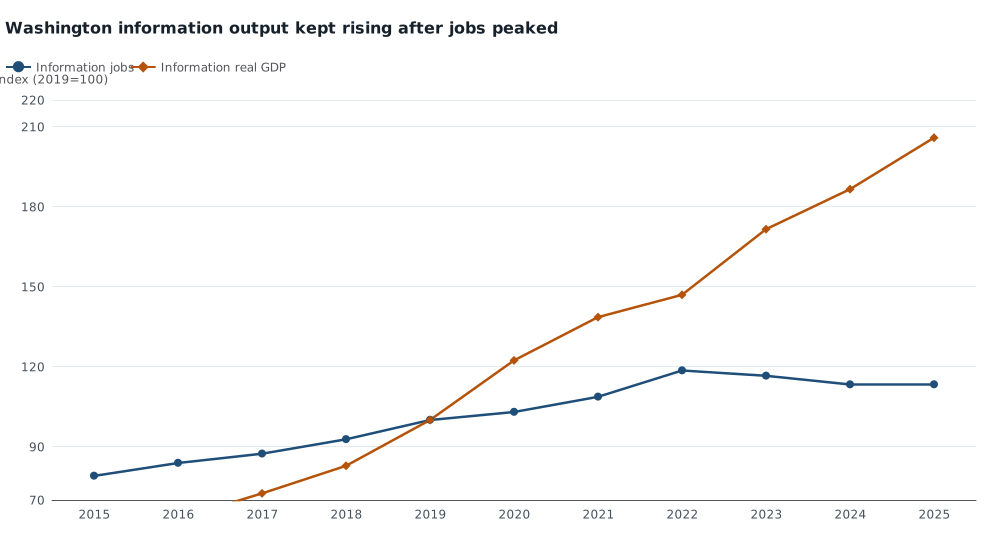
Index, 2019 = 100. Jobs are annual averages of seasonally adjusted BLS payrolls. Real GDP is BEA value added in chained 2017 dollars. GDP includes software and other intellectual property, so it is not a headcount of programmers. Sources: BLS; BEA.
That gap is not proof that “AI replaced 13,000 Seattle software jobs.” BEA information GDP includes software originals and other intellectual property; a smaller staff can still book a larger measured product when the product is code. Compensation can rise while headcount falls if the remaining jobs pay more. The data also cannot say how many of the missing Seattle payrolls moved to other states, to contractors, or off the books of a local establishment.
What they can say is narrower, and still consequential. Microsoft is offering a voluntary exit on a scale that would be transformative inside the Seattle software-publishing industry if it landed there. It is not landing only there. Even so, the home-market payroll has already been shrinking for four years, while the same sector’s measured output in Washington has kept setting highs. The AI spending boom is showing up more clearly in value added than in the job count around headquarters.
Sources and methods
This is retrospective research completed on 27 October 2026, after the 26 October 2026 reporting. It does not claim that later data were known that day.
Payrolls are monthly BLS State and Area Employment series from the 24 August 2026 public snapshot (benchmark year 2025). Software publishers are not seasonally adjusted; the information supersector and Washington total nonfarm series used here are seasonally adjusted. August 2026 observations carry BLS’s preliminary footnote. Values are in thousands of employees; people counts multiply by 1,000. Establishment surveys place jobs where the employer reports them, which can shift with remote work.
Output and compensation are BEA regional GDP and income from the 30 September 2026 state accounts. Real GDP is chained 2017 dollars. “Publishing industries (except Internet)” is a broader BEA industry than BLS software publishers and should not be treated as the same series. Shares use each source’s own all-industry total for the same geography and year.
The 60,000-person eligibility figure and the 223,000 June headcount are news-reported, not BLS observations. They are used only as a scale comparison.
Research Date
The displayed date matches the related news edition. Research was completed 2026-10-27.
Related news: Daily · 2026-10-26
More Research
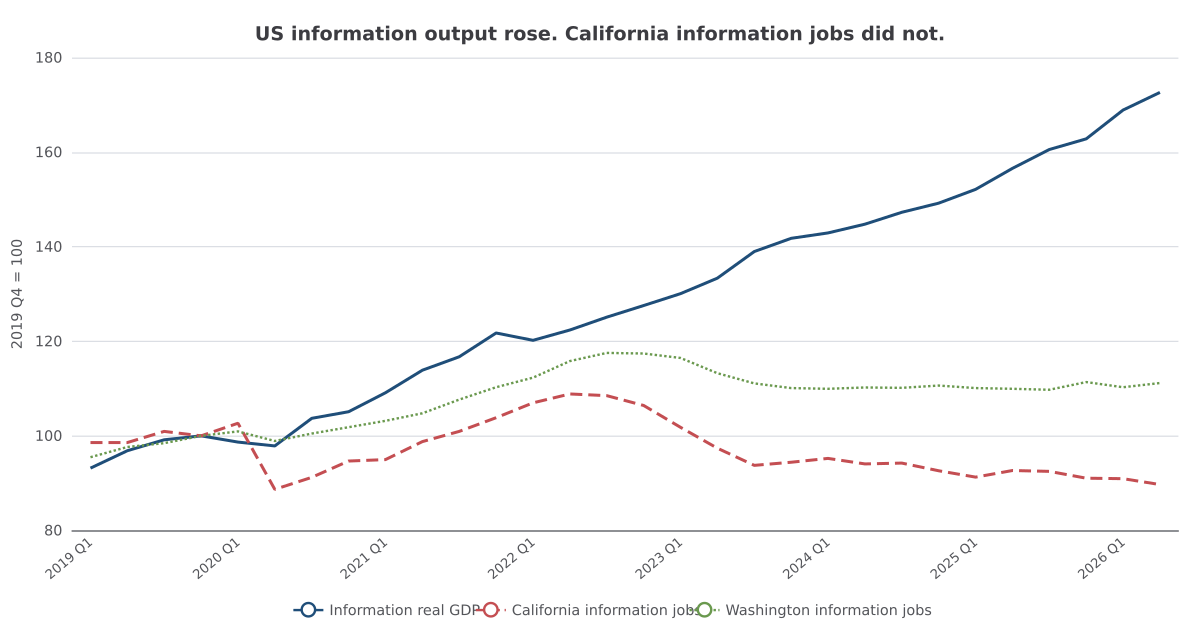
The Information Boom Is In Output, Not In California Payrolls
US information-sector output was still rising several times faster than the whole economy in mid-2026, while California information payrolls were already 19 percent below their 2022 peak.
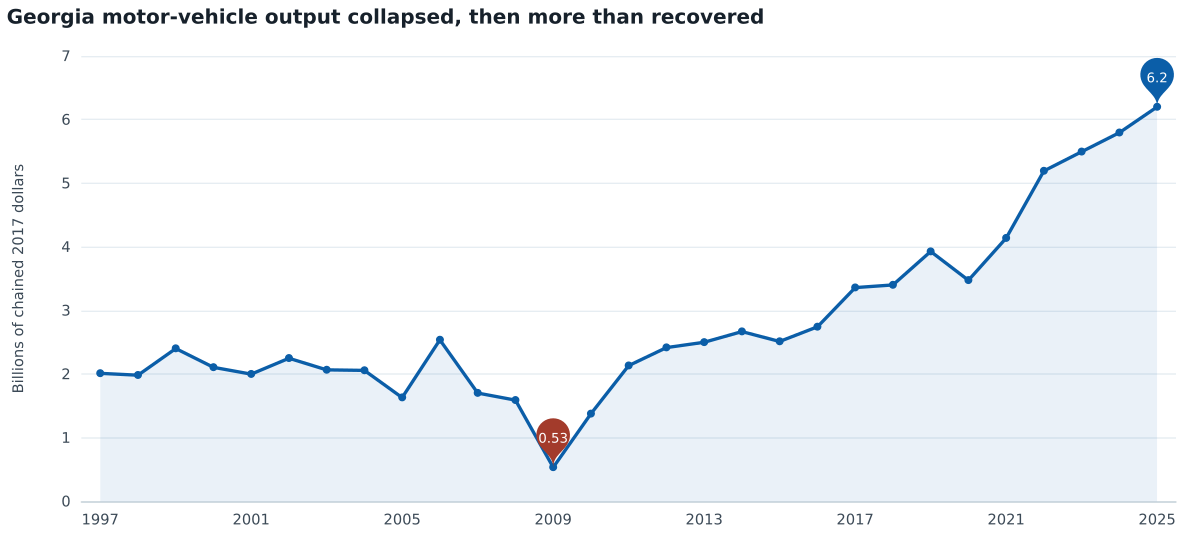
Georgia Already Builds Cars. Audi Is Joining A Small, Rebuilt Industry.
Georgia’s motor-vehicle industry collapsed in 2009 and came back. Audi’s $4 billion plant is large for that rebuilt, still-small auto state.
The Paycheck Is A Shrinking Share Of America's Official Income
Work is a smaller slice of U.S. personal income than before the pandemic. Transfers and asset income grew faster than wages.