LunarWeave
Georgia Already Builds Cars. Audi Is Joining A Small, Rebuilt Industry.
Audi’s first American factory is being sold as a conversion story: a German luxury brand putting $4 billion into Georgia, with its chief executive on stage at a Donald Trump rally, while Volkswagen cuts jobs at home. The Guardian reported a Macon plant and about 4,500 jobs. Trump’s line, as relayed in Czech reporting, was that tariffs are why they came.
The political claim is that trade barriers are dragging carmaking onto American soil. The economic question is more basic. Is Georgia a blank state waiting for an auto industry, or a place that already has one?
Bureau of Economic Analysis figures for GDP by state answer that without guessing at plant-level employment. In 2025, Georgia’s motor vehicles, bodies, trailers and parts industry — NAICS 3361–3363, the factories that assemble vehicles and make the parts that go into them, not aircraft — produced $5.04 billion of value added. That is tenth among 51 states and the District of Columbia, and 2.7 percent of the U.S. industry’s $185.1 billion. It is only 0.54 percent of Georgia’s $936 billion economy. The state already makes cars. Cars are not the state.
The industry that almost disappeared
The more consequential fact is how close that industry came to vanishing. In chained 2017 dollars, which strip out price changes, Georgia’s motor-vehicle output fell from $2.01 billion in 1997 to $0.53 billion in 2009 — about 27 percent of its late-1990s level. Current-dollar value added in the crisis year was $545 million.
That trough is not a rounding error in a noisy series. It is the financial-crisis collapse of a durable-goods industry, visible in the same BEA accounts for the United States as a whole, where real motor-vehicle GDP fell by nearly half between 1997 and 2009. Georgia’s drop was steeper.
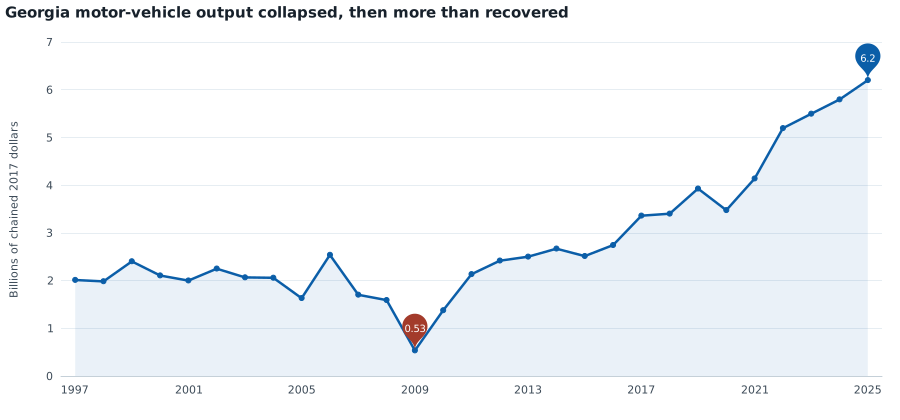
Georgia real GDP in motor vehicles, bodies, trailers and parts, billions of chained 2017 dollars, 1997–2025. The 2009 trough is $0.53 billion; 2025 is $6.20 billion. Source: U.S. Bureau of Economic Analysis, GDP by state. Real industry GDP measures volume, not a factory’s announced capital spending, and is not additive across industries.
The rebuild is just as clear. By 2025, real output had reached $6.20 billion — 11.6 times the 2009 trough and 3.1 times the 1997 level. The wage-and-benefits bill moved with it. Compensation of employees in the same industry was $0.72 billion in 2009 and $3.08 billion in 2025. Compensation is not a headcount, and BEA suppresses the Georgia figure in some years, including 2023; those gaps are missing data, not zeros. Where the series is published, it shows a labor base that shrank in the crisis and later more than recovered.
Audi is therefore not founding a car industry in Georgia. It is arriving after one was already reconstructed.
Tenth is not first
Rebuilt is not the same as large. Michigan’s 2025 motor-vehicle GDP was $40.8 billion, about eight times Georgia’s. Texas was $28.4 billion; Indiana, $19.9 billion. Even nearby Southern auto states outproduce Georgia: Alabama $8.3 billion, Tennessee $8.2 billion, South Carolina $6.2 billion. California, at $11.3 billion, still outranks all of them except the three leaders.
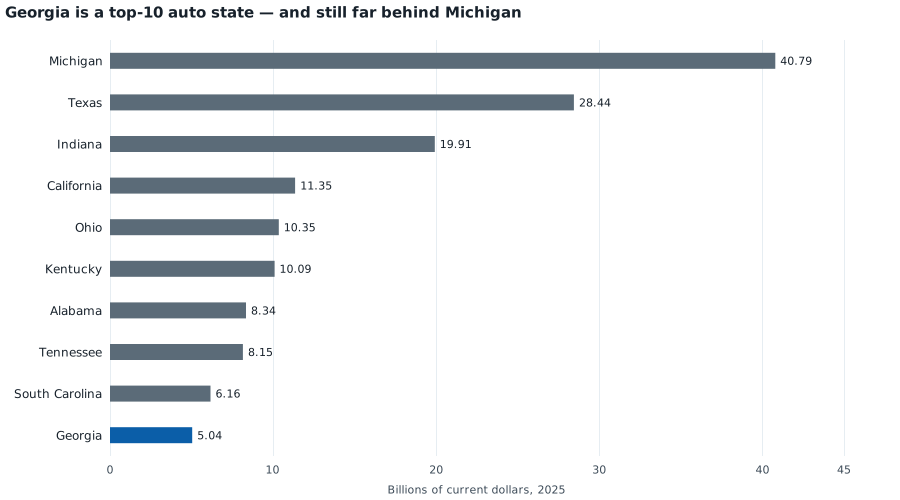
Current-dollar GDP in motor vehicles, bodies, trailers and parts, 2025, top ten of 51 states and the District of Columbia. Units are billions of current dollars. Georgia is tenth at $5.04 billion; Michigan is first at $40.8 billion. Source: U.S. Bureau of Economic Analysis. Value added is not the same as announced plant investment.
| State | 2025 motor-vehicle GDP |
|---|---|
| Michigan | $40.8 billion |
| Texas | $28.4 billion |
| Indiana | $19.9 billion |
| California | $11.3 billion |
| Ohio | $10.3 billion |
| Kentucky | $10.1 billion |
| Alabama | $8.3 billion |
| Tennessee | $8.2 billion |
| South Carolina | $6.2 billion |
| Georgia | $5.04 billion |
The geography is the opposite of a greenfield surprise. Foreign-owned assembly has clustered across the South for decades. Alabama’s real motor-vehicle GDP in 2025 was about 15 times its 1997 level; Texas was about 13 times. Georgia’s real output only a little more than tripled over the same span, because it started higher than Alabama and then went through a deeper crash. Ohio, a legacy auto state, was barely larger in real terms in 2025 than in 1997.
A $4 billion factory is still a large increment for Georgia. Capital spending is not GDP: one is a stock of investment, the other is a year’s value added. Even with that distinction, $4 billion is about four-fifths of Georgia’s entire 2025 motor-vehicle value added. If the plant produces at scale and keeps a thick in-state supplier network, it can move a tenth-place state. If much of the value is created in engines, electronics or stampings made elsewhere, Georgia’s GDP accounts will show a smaller bump than the ribbon-cutting suggests. The announcement does not decide which.
What the accounts cannot settle
They also cannot settle the tariff story. BEA’s industry accounts say where value added already sits. They do not say why Audi chose Macon, whether the plant would have been built without U.S. levies, or how many of the reported 4,500 jobs will appear in payrolls. This catalogue does not include a Georgia series for motor-vehicle manufacturing employment, so the jobs figure stays in the reporting, unverified here.
What the accounts do settle is the starting point. Georgia is not waiting for car factories. It already has a rebuilt motor-vehicle industry that is large enough to rank tenth in the country and small enough that a single $4 billion plant is a genuine event. The political argument is about bringing manufacturing back. The state data say the more precise issue is whether this plant enlarges a Southern auto corridor that already exists — and whether Georgia, still the junior partner to Alabama, Tennessee and South Carolina, captures the value added or mainly the groundbreaking.
Methods and sources
Figures are annual calendar-year GDP by state from the U.S. Bureau of Economic Analysis, GDP by state, industry line “motor vehicles, bodies and trailers, and parts manufacturing.” Current-dollar values are millions of current dollars converted here to billions. Real values are millions of chained 2017 dollars, a volume measure; chained-dollar industry series are not additive across industries. Compensation is thousands of current dollars converted to billions; it includes wages and supplements, not employment. Rankings use the 51 published state and District of Columbia areas with non-missing 2025 current-dollar values. The U.S. total is BEA’s national aggregate in the same tables, not a sum of chained industry parts.
This is retrospective research dated 26 October 2026. It uses BEA’s 30 September 2026 annual state GDP release, with observations through 2025, as context for reporting published on 25 October 2026. Later BEA revisions can change the 2025 estimates. The plant’s capital cost and job count are taken from contemporaneous reporting, not from BEA. BEA’s regional methodology describes the industry definitions used here.
Research Date
The displayed date matches the related news edition. Research was completed 2026-10-26.
Related news: Daily · 2026-10-25
More Research
Microsoft’s 60,000-Person Offer Is Almost The Size Of Seattle’s Software Payroll
Microsoft’s 60,000-person voluntary-exit pool is 92 percent as large as Seattle-area software-publishing employment, a payroll already 16.6 percent below its 2022 peak even as Washington inf
The Paycheck Is A Shrinking Share Of America's Official Income
Work is a smaller slice of U.S. personal income than before the pandemic. Transfers and asset income grew faster than wages.
The Information Boom Is In Output, Not In California Payrolls
US information-sector output was still rising several times faster than the whole economy in mid-2026, while California information payrolls were already 19 percent below their 2022 peak.