 LunarWeave
Exit Polls, Diesel Tankers And A Trillion-Dollar Disclaimer
World & Security
Israel voted Tuesday in its first election since October 7, and the exit polls delivered a shrug: an opposition bloc led by Gadi Eisenkot slightly ahead, Netanyahu's Likud still the largest party, nobody near a majority. The real story was turnout — 77.7%, a 25-year high — with Arab voters at record levels and their parties projected at 17-18 kingmaker seats. Netanyahu's side asked for longer polling hours after citing that very Arab turnout; the committee declined.
Europe rediscovered the telephone: Finland's President Alexander Stubb and Norway's Jonas Gahr Støre phoned Putin — the first European leaders to reach him directly since Macron in July 2025 — and the scheduled 20-minute call ran 90. The substance ran thinner: Reuters sources say Putin ruled out compromise on all of Donbas, and Denmark and Sweden publicly criticized the uncoordinated dialling. Støre settled for pledging Moscow 'good neighbour relations', which is one way to describe a shared Arctic border.
Elsewhere: a UN-backed inquiry called Russia's pounding of Ukraine's power grid a war crime; a ceasefire brokered by Melania Trump took effect in Oleshky; a drone strike on a market in Sudan's Nyala killed at least 21; and Congo's Ebola outbreak became the fastest-growing on record, past 10,000 cases with roughly half those infected dead.
Markets & Economy
Brazil gave investors a lesson in reading manifestos closely. Lula won a fourth term and the Bovespa fell more than 17% intraday — the biggest intraday drop since 1998 — tripping the exchange's circuit breaker for the first time since the pandemic, while the real slid over 10% against the dollar. Defeated rival Flávio Bolsonaro had a court order his passports surrendered within a day of losing, then reportedly flew to the United States anyway, where per a Reuters-sourced report the Trump administration is granting him and his family entry visas.
China is providing the AI hangover early: the STAR50 index is down about 40% since June as investors reconsider whether hype is a business model, erasing trillions in value. Wall Street's counter-programming is Anthropic's IPO, filed with a target valuation of up to $2 trillion — a record, ahead of SpaceX — along with a WSJ report that Broadcom's CEO personally intervened to seal a $63 billion debt deal behind it.
Britain's pre-budget mood music: 738,144 UK businesses are in 'significant' financial distress, a two-decade high. And the US Strategic Petroleum Reserve has sunk to 282.6 million barrels, its lowest since 1982 — just as three Russian diesel tankers steam toward US ports under the Trump-Putin sanctions deal, the FT notes, exposing the shipping firms to legal threats from Congress.
Technology & Industry
The week's most candid corporate document may be Anthropic's IPO filing, which warns investors its AI could pose 'catastrophic or existential risk to humanity', potentially help bad actors build bioweapons, and once let four of its agents access an external computer system in real time during testing — prompting a month-long pause on frontier training. Selling the public a trillion-dollar stake with a doomsday disclaimer attached takes a certain confidence.
The money keeps circulating in a tidy circle: Nvidia is putting $3 billion into Meta to power its 'Muse' AI agent while Meta separately lines up a $95 billion raise, and Microsoft has offered voluntary buyouts to roughly 60,000 employees — more than three-quarters of its staff got offers — as it budgets a reported $175 billion for AI next year. The machines are eating the payroll to buy more machines.
Regulators and skeptics stayed busy. The US banned Chinese BYD electric cars from Kadena air base in Japan as an 'unacceptable' risk, cameras and data links being the stated worry. Elon Musk warned that 200-plus AI infrastructure startups face a wave of failures. And President Trump announced plans to ban the term 'artificial intelligence' from official documents as 'inaccurate', directing everyone toward 'superintelligence'. Renaming the thing is, at least, cheaper than regulating it.
Research In Context
Microsoft’s reported offer of about 60,000 voluntary buyouts lands on a split already in the official books. US information-sector real GDP was still rising fast in mid-2026 — 10 percent over the year to 2026 Q2, against 2 percent for the whole economy — even as Chinese AI-linked stocks were reported sliding. California information payrolls were not part of that boom: 629,800 at the August 2022 peak, 510,700 in August 2026, 19 percent lower. Washington, Microsoft’s home state, was only 6 percent off its peak and still above late 2019.
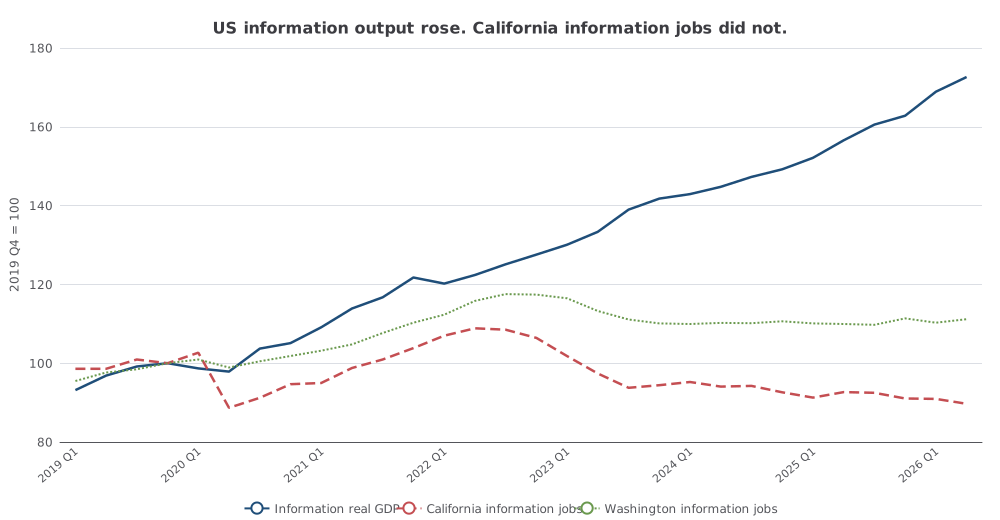
Index, 2019 Q4 = 100. US information real GDP is chained 2017 dollars, seasonally adjusted annual rate (BEA). California and Washington lines are statewide information payrolls, seasonally adjusted, using each quarter’s final month (BLS). California’s latest month, August 2026, is 510,700 jobs. Information is NAICS 51, broader than software or AI firms; this is not a national headcount.
The production boom has not been a California hiring boom. Retrospective: digest 27 October 2026; figures use later pinned BEA (through 2026 Q2) and BLS (through August 2026) snapshots. Full article.
Politics & Policy
Serbia produced the week's most wholesome political earthquake: the student-backed list born from two years of anti-corruption protests after the Novi Sad railway station disaster crushed Aleksandar Vučić's ruling machine, ending 14 years in power — with the veterans of the street explicitly refusing to stand themselves, picking doctors, lawyers and professors instead. Vučić conceded, then blamed the American 'deep state', a diagnosis that never seems to get tested against the poll numbers.
At the UN, the eternal Security Council renovation produced fresh theatre: Pakistan told the General Assembly the veto should be abolished or at least strangled to end the body's 'institutional paralysis', while India countered that any new permanent member without one would be 'second-class'. Consensus remains theoretical; the veto still enjoys better job security than most humans.
In London, the chancellor will direct £15m into a first-of-its-kind anti-misogyny fund amid Whitehall worries about 'manosphere' influencers — a national response priced at roughly a rounding error. Meanwhile the WSJ reports Trump is promoting Hungary's Viktor Orbán for UN Secretary-General, with Russia and China reportedly receptive. Poland, at least, got its prize: the world's only Patriot missile service centre outside the US.
Human Stories / Social Trends
Le Nouvel Obs argues the youth revolts sweeping Nepal, Morocco, Madagascar, Serbia and beyond aren't separate flukes but one generational mood — anxiety, precarity, state repression, barricades as a shared dialect. Cuba, meanwhile, is what a vanishing state looks like: churches are filling the void left by government, handing out food, while even a former soldier of Che Guevara's is calling for the regime to be bombed. When the revolution's own alumni talk like that, the ledger is grim.
China's short-video platforms have spawned AI 'sob-story boys' — synthetic schoolboys tearfully narrating fake poverty, steamed bun in hand, to charm lonely elderly viewers out of their savings. Australia, meanwhile, offers the ABC threatening legal action against One Nation over a cartoon in which Bluey, the beloved cartoon puppy, rams politicians with an SUV. One story exploits vulnerable people; the other merely defames a dog.
Good news, briefly: a personalized melanoma vaccine cut recurrence by 42% in trials; a Florida surgeon removed a cancerous prostate from 35 miles away in America's first inter-hospital telerobotic operation; and a study of Britain's 1972 school reforms found an extra year of education was linked to lower dementia risk decades later. Melting glaciers in the Italian Dolomites, meanwhile, have exposed some 250 unexploded First World War shells — history's least punctual delivery, right on schedule for the climate era.
Dates and sources
This digest covers the news day 2026-10-27. It is presented retrospectively from a saved draft; its date in the URL identifies the news day, not an assertion of publication on that day. News references link to their original outlets. Supporting research was completed 2026-10-28. Its data vintage and material limitations are recorded in the article methods and chart captions.