LunarWeave
The Danube Can Take Hungary’s Nuclear Plant Offline. It Cannot Replace It.
When a heatwave drops a river far enough that reactors cannot be cooled, the first question is not whether nuclear power is “inflexible.” It is how much of a country’s electricity was coming from the plants that just went dark — and whether the same river can make up the difference.
On 4 August 2026, France 24 reported that record-low water on the Danube had pushed Central and Eastern Europe into an energy emergency. Hungary, it said, was shutting its only nuclear plant because there was not enough water to cool the reactors, a plant the report described as supplying electricity for half the country. Romanian units cooled by the same river were also being taken down.
Annual electricity accounts cannot confirm those August outages. They can show what the grids were made of before the river fell. In the latest complete year published by the International Renewable Energy Agency (IRENA), 2023, nuclear supplied 44.8 percent of Hungary’s electricity generation — close to the “half” in that report, though no longer quite that high. Hydropower supplied 0.6 percent. The river that cools the plant is not a spare generator.
Almost half the electrons, from one technology
Hungary generated 35,546 gigawatt-hours of electricity in 2023. Nuclear accounted for 15,918 GWh of that total. IRENA records the country’s entire nuclear fleet as 2,027 megawatts of on-grid capacity from 2021 through 2025, so the 2023 output implies a capacity factor of about 90 percent: the plant was already running as baseload, not as a little-used reserve.
That share has been high for a long time. Nuclear’s slice of Hungarian generation peaked at 53.2 percent in 2014 and was still 44.8 percent in 2023. The output itself barely moved. Nuclear generation was 15,649 GWh in 2014 and 15,918 GWh in 2023. What changed around it was the rest of the mix: coal shrank, and solar grew.
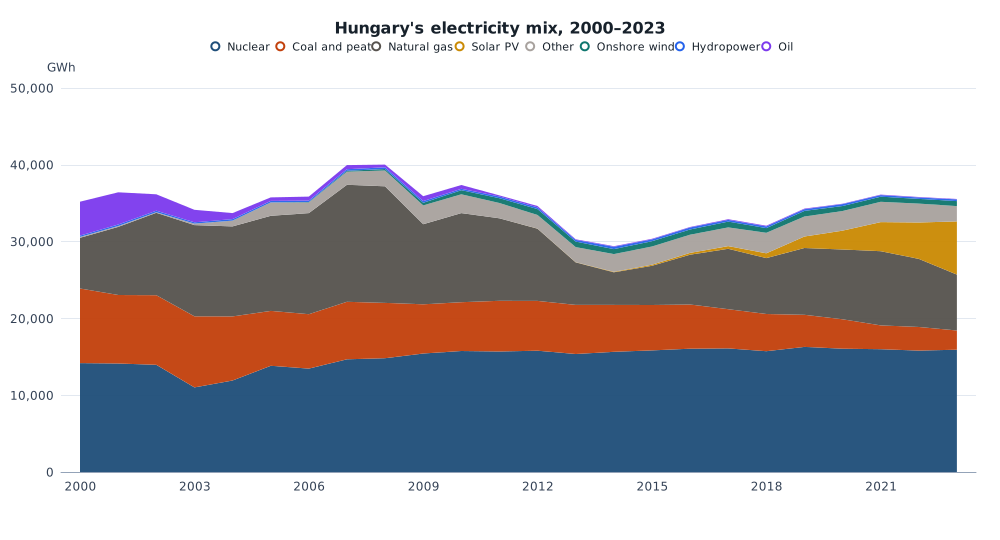
Domestic electricity generation in Hungary, gigawatt-hours, 2000–2023. Nuclear output stayed near 16,000 GWh after 2010 while solar PV rose to 6,925 GWh in 2023. Hydropower never exceeded 301 GWh. Total generation is IRENA renewable plus non-renewable electricity. Solar PV is recorded from 2007 and onshore wind from 2001; earlier years are shown as 0 GWh for those technologies. Other is the residual after nuclear, gas, coal, oil, solar PV, wind and hydro. Source: IRENASTAT country electricity generation (All grid connections).
If that nuclear output had been removed from the 2023 accounts and nothing else had increased, 55.2 percent of generation would have remained. That is an arithmetic hole, not a forecast. IRENA publishes what was generated, not spare capacity sitting idle at gas or coal plants, and not the electricity Hungary imports. Those 15,918 GWh were already being used.
The river is a cooling system, not a power station
Hydropower in Hungary is a rounding error. It produced 222 GWh in 2023 — 0.6 percent of generation — and has never been a meaningful slice of the mix in this series. The highest hydro year in the 2000–2023 file is 2014, at 301 GWh. A low Danube can stop Hungary’s reactors by starving them of cooling water. It cannot replace them with Hungarian dams.
The rest of the 2023 mix was:
| Source | GWh | Share of generation |
|---|---|---|
| Nuclear | 15,918 | 44.8% |
| Natural gas | 7,279 | 20.5% |
| Solar PV | 6,925 | 19.5% |
| Coal and peat | 2,509 | 7.1% |
| Other (residual) | 1,992 | 5.6% |
| Onshore wind | 646 | 1.8% |
| Hydropower | 222 | 0.6% |
| Oil | 55 | 0.2% |
Solar is the new fact. IRENA’s Hungarian solar-PV series begins at 0.3 GWh in 2007 and reaches 6,925 GWh in 2023, almost matching gas. Coal has gone the other way, from 27.6 percent of generation in 2000 (9,707 GWh) to 7.1 percent in 2023. Wind remains small. The summer daytime grid is less nuclear-and-coal than it used to be. Night-time baseload is still the nuclear plant.
That matters in a heatwave. Solar helps while the sun is up, which is also when air-conditioning load is highest. It does not generate after dark. Gas and coal output in these accounts is electricity that was already produced, not a measured cushion. Whether those plants could have ramped up in August 2026 is outside this dataset.
Romania’s problem is different. Bulgaria’s is similar.
France 24’s emergency was regional, not Hungarian only. Among countries that generate nuclear electricity on the Danube, the 2023 mixes do not look alike.
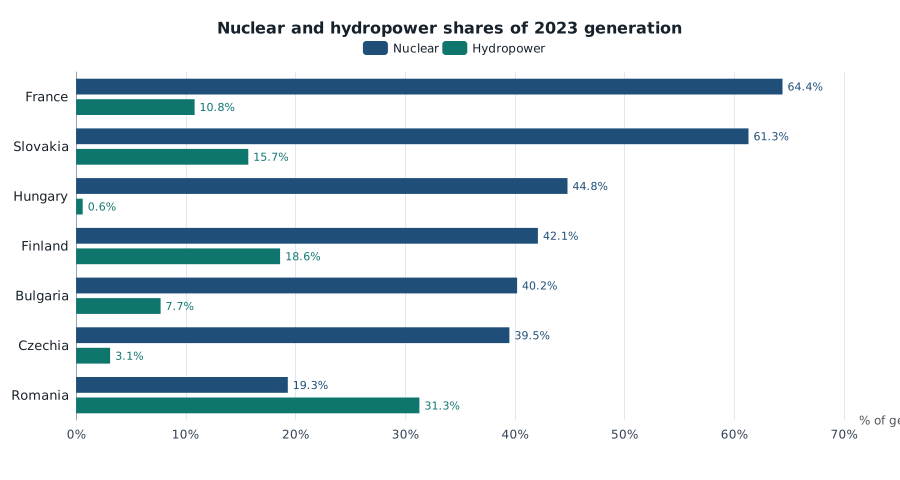
Share of 2023 electricity generation from nuclear and from renewable hydropower, percent. Hungary’s 44.8% nuclear share sits between France/Slovakia and Finland/Bulgaria/Czechia, but its 0.6% hydro share is the lowest in this set. Romania is the inverse: 19.3% nuclear and 31.3% hydro. Shares are of domestic generation, not of electricity consumed, and do not measure spare capacity. Source: IRENASTAT, 2023.
Romania’s nuclear share in 2023 was 19.3 percent — less than half of Hungary’s — on 1,300 MW of capacity, a smaller fleet. Hydropower was 31.3 percent (18,137 GWh). A low river is therefore a different kind of shock there: less concentrated in nuclear, much more exposed if rainfall and river flow also cut hydro. Not all of that hydro is the Danube, so this is not a claim that 31 percent of Romanian electricity is Danube hydropower. It is a claim that Romania, unlike Hungary, actually has a large hydro slice that a drought can hit.
That hydro slice moves around. In 2022 it was 25.0 percent (13,977 GWh); in 2023 it recovered to 31.3 percent. A 2026 drought would be landing after a relatively wet generation year, not after hydro had already collapsed in these annual figures.
Bulgaria sits closer to Hungary: 40.2 percent nuclear and 7.7 percent hydro in 2023, on 2,006 MW of nuclear capacity. Its nuclear share jumped that year partly because total generation fell (50,499 GWh in 2022 to 40,256 GWh in 2023) while nuclear output stayed near 16,000 GWh. The 2026 reporting named Hungary and Romania; Bulgaria is in the comparison because it is the other Danube-bank nuclear generator in the IRENA file.
Peer systems make Hungary’s missing hydro cushion obvious. Slovakia generated 61.3 percent of its electricity from nuclear in 2023, but 15.7 percent from hydro. France, with a large multi-plant fleet rather than a single-plant system, was 64.4 percent nuclear and 10.8 percent hydro. Finland generated 42.1 percent from nuclear, almost Hungary’s share, and 18.6 percent from hydro. Czechia was 39.5 percent nuclear and 3.1 percent hydro. Among these seven, Hungary is not the most nuclear-heavy. It is the one with almost no hydro behind the nuclear.
What 2023 cannot say about August 2026
These figures are domestic generation, not electricity consumed. Cross-border trade can make nuclear a smaller or larger share of what households and factories actually use. IRENA’s generation file does not measure imports, and it does not record whether a plant was derated for a week in August. Capacity still standing at 2,027 MW in the 2025 IRENA capacity series is consistent with a temporary cooling shutdown, not with a retirement.
The operational claim belongs to the reporting: France 24 described Hungary shutting its only nuclear plant for lack of cooling water. The statistical claim is narrower and, on its own terms, sharper. In the last complete year, that country’s nuclear output was 45 percent of electricity generation and ran near full tilt. The Danube’s contribution as a power source was 0.6 percent. Taking the plant offline is a hole in the generation stack. The river does not fill it.
Methods and sources
This is retrospective research completed on 10 September 2026, using a pinned IRENASTAT snapshot dated 24 August 2026, not an as-of reconstruction of what was knowable on 4 August 2026. Electricity generation is annual. The latest generation year in the extract is 2023; nuclear capacity runs through 2025. Observation dates are not release dates.
Total generation is IRENA “Total renewable — All” plus “Total non-renewable — All,” in gigawatt-hours, country scope. Nuclear, gas, coal, oil, solar PV, onshore wind and renewable hydropower are the matching “All” generation series. Hydropower here excludes pumped storage as a separate technology. “Other” is the residual after those named fuels; it includes bioenergy and remaining non-renewable fuels. Shares are of generation, not of capacity or consumption. The implied nuclear capacity factor uses 8,760 calendar hours and IRENA on-grid nuclear capacity. IRENASTAT is available from the IRENA data downloads and the IRENASTAT PxWeb interface.
Research Date
The displayed date matches the related news edition. Research was completed 2026-09-10.
Related news: Daily · 2026-08-04
More Research
Ghana Locked The Cocoa Trees After The Beans’ Price Tripled
Ghana criminalized converting cocoa farms after world cocoa prices tripled in the IMF series — a spike the Fund already assumes will halve.
Europe’s Oil Shock Is Back. Its Inflation Crisis Is Not.
IMF annual inflation in Germany, France, Italy and Spain has not returned to 2022. A 3 percent print is a rebound, not a second energy-crisis peak.
A Wind Giant On Land, A Rounding Error At Sea
IRENA capacity data show the United States had only 171 MW of offshore wind in 2025 — 0.11 percent of its wind fleet — so reported lease buyouts target an unbuilt ocean pipeline, not a worki