LunarWeave
Ghana Locked The Cocoa Trees After The Beans’ Price Tripled
Ghana’s parliament has given cocoa farms protected status. Converting one to another use without government approval is now a crime that, France 24 reported, can carry up to 20 years in prison. The text surfaced days after the July 30 vote, and farmers objected to being treated as potential felons for leaving a crop Accra now treats as a national asset.
The economic question is not whether cocoa matters to Ghana. It is whether the world price of the beans has done something so unusual that locking land into cocoa looks like a boom-time harvest law — and whether the same official numbers already treat that boom as temporary.
They have, and they do. In the IMF World Economic Outlook commodity block, the annual average cocoa price jumped from $2,369 a metric ton in 2022 to $7,391 in 2024 and $7,788 in 2025. That 2025 average is 3.3 times the 2022 level and the highest observation in the series back to 1980. Before 2024, the peak was $3,258 in 2023. The 2025 figure is 3.9 times the 1980–2022 mean of $1,976. This is a world price in the Fund’s commodity geography, not what Ghanaian farmers were paid at the farm gate.
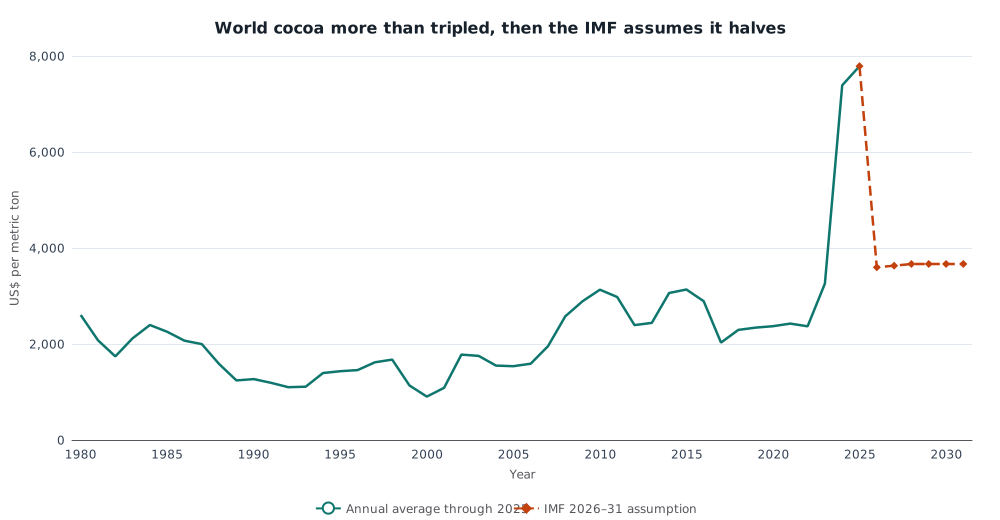
IMF World Economic Outlook cocoa price (PCOCO), US dollars per metric ton, commodity geography G001. Solid line: annual averages through 2025. Dashed line: IMF assumptions for 2026–31 in the pinned August 2026 vintage. 2025 is drawn on both series as a connector. This is not a Ghana farm-gate price. Source: IMF WEO / Primary Commodity Prices.
The spike was idiosyncratic. Over the same 2022–25 window the IMF coffee-price index rose 1.8 times, the non-fuel commodity index rose 7 percent, and the food-price index fell 14 percent. Chocolate beans did not ride a general grocery shock. They left other foodstuffs behind.
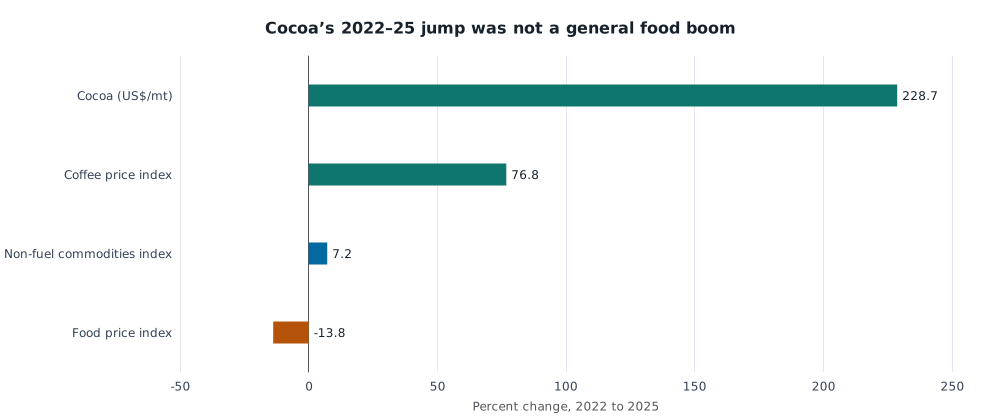
Percent change in IMF WEO annual averages, 2022 to 2025. Cocoa is in dollars per metric ton; the other three series are indexes. The comparison is the relative move, not the dollar level. Source: IMF WEO.
Ghana’s external accounts moved in the same years. The IMF’s current-account balance for Ghana swung from a 2.3 percent-of-GDP deficit in 2022 to a 1.8 percent surplus in 2024 and a 7.9 percent surplus in the 2025 estimate — a 10.2 percentage-point turnaround. The 2026 projection is 10.1 percent of GDP. That is a real shift in the national books. It is not proof that cocoa caused it. Ghana also exports gold and oil, compressed imports during a debt crisis, and sat inside an IMF program. This vintage has no Ghana cocoa-export volume, so the surplus cannot be decomposed here.
Côte d’Ivoire, the larger cocoa producer, is the check on a cocoa-only story. Its current account stayed in deficit: 8.0 percent of GDP in 2023, narrowing to 1.1 percent in 2025. If a tripling of the world price were enough, on its own, to mint an external surplus in West Africa’s cocoa belt, Abidjan should have printed one too.
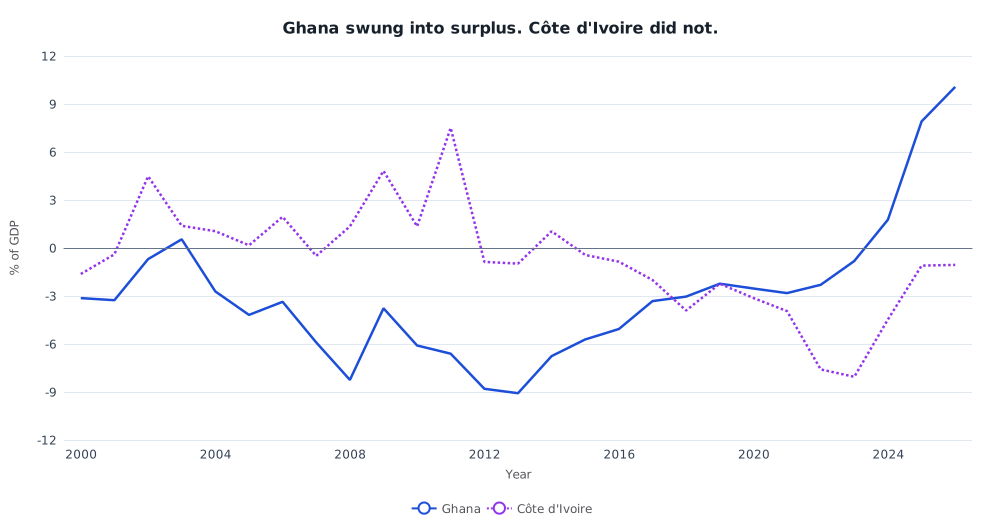
IMF WEO current-account balance, percent of GDP, 2000–2026. 2026 is a projection in this vintage. Readers choosing the live series should select Ghana or Côte d’Ivoire in the chart selector. Source: IMF WEO.
Nor did the Ghanaian state collect a larger share of output. Government revenue was 15.7 percent of GDP in both 2022 and 2025. The headline fiscal deficit did improve, from 11.8 percent of GDP in 2022 to 1.3 percent in 2025, and public debt fell from 92.7 percent of GDP to 48.8 percent. Those ratios mix a debt restructuring, a collapse in inflation from 39.2 percent in 2023 to 14.2 percent in 2025, and a 38 percent jump in dollar GDP, from $83.3 billion to $114.7 billion. Real growth recovered from 3.1 percent in 2023 to 5.8 percent in 2024 and 6.0 percent in 2025 — a rebound, not a cocoa supernova.
| Year | Cocoa, US$/mt | Ghana current account, % of GDP |
|---|---|---|
| 2022 | 2,369 | −2.3 |
| 2023 | 3,258 | −0.8 |
| 2024 | 7,391 | 1.8 |
| 2025 | 7,788 | 7.9 |
| 2026 | 3,598* | 10.1* |
*2026 cocoa is an IMF price assumption; 2026 Ghana accounts are an IMF projection. Cocoa rounded to the nearest dollar.
The same vintage that records the spike already writes it down. The IMF’s 2026 cocoa assumption is $3,598 a ton — 54 percent below 2025 — then a near-flat $3,667 from 2028 through 2031. Accra is criminalizing exit from a crop whose world price, in the Fund’s own workbook, is treated as a spike rather than a new plateau.
That does not make the law irrational. A government can want trees standing because illegal mining eats farms, because cocoa still earns foreign exchange, or because a marketing board wants volume even if farm-gate prices lag the London contract. None of those motives is in this dataset. What the numbers do show is a mismatch: farmers are being bound to cocoa after the most extreme price on the IMF’s 45-year tape, while the Fund already assumes that tape snaps back, Ghana’s tax take as a share of GDP does not rise, and the larger producer next door never swings into surplus.
Without farm-gate prices or export volumes, the evidence cannot say how much of the chocolate-bean fortune reached the people now threatened with prison. It can say the boom was real, narrow, and — in the IMF’s forward path — already over.
Methods and sources. Retrospective research on 10 September 2026 of reporting from 5 August 2026, using the pinned IMF WEO snapshot (source run 10 August 2026; normalized 24 August 2026), not an as-of reconstruction of what was knowable on digest day. Commodity prices through 2025 are annual averages in that vintage; 2026–31 are IMF assumptions (the cocoa path is literally flat from 2028). Ghana and Côte d’Ivoire 2025 figures are IMF estimates; 2026–31 are projections. Series: PCOCO, PCOFFW, PFOODW, PNFUELW, BCA_NGDPD, NGDP_RPCH, PCPIPCH, GGR_NGDP, GGXCNL_NGDP, GGXWDG_NGDP, NGDPD, NGDPDPC. Geography G001 is the dataset’s commodity block, not a country. Empty extracts for Ghana goods exports and terms of trade were not treated as zeros. Browser layout of the charts was not separately tested.
Research Date
The displayed date matches the related news edition. Research was completed 2026-09-10.
Related news: Daily · 2026-08-05
More Research
A Wind Giant On Land, A Rounding Error At Sea
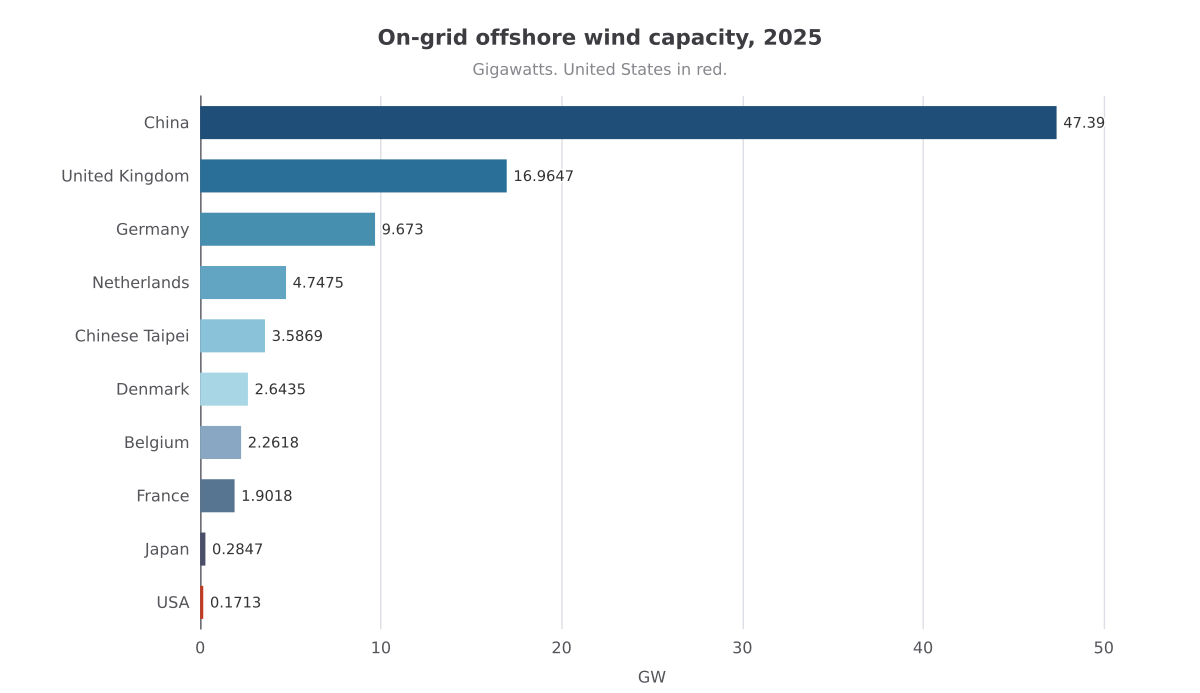
IRENA capacity data show the United States had only 171 MW of offshore wind in 2025 — 0.11 percent of its wind fleet — so reported lease buyouts target an unbuilt ocean pipeline, not a worki
The Danube Can Take Hungary’s Nuclear Plant Offline. It Cannot Replace It.
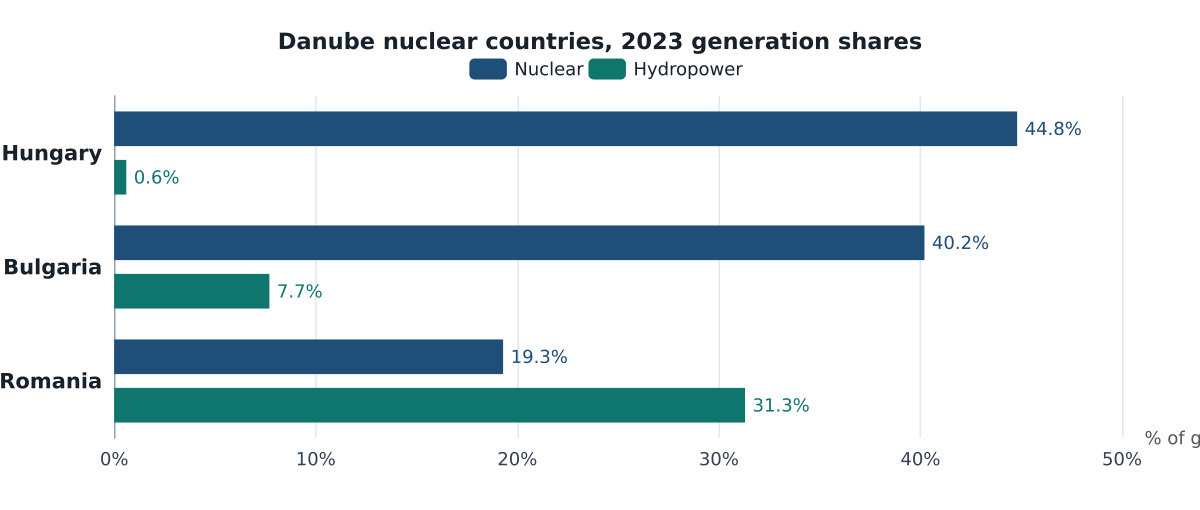
In 2023 Hungary generated 45 percent of its electricity from nuclear and 0.6 percent from hydro. A low Danube can take the plant offline; it cannot replace it.
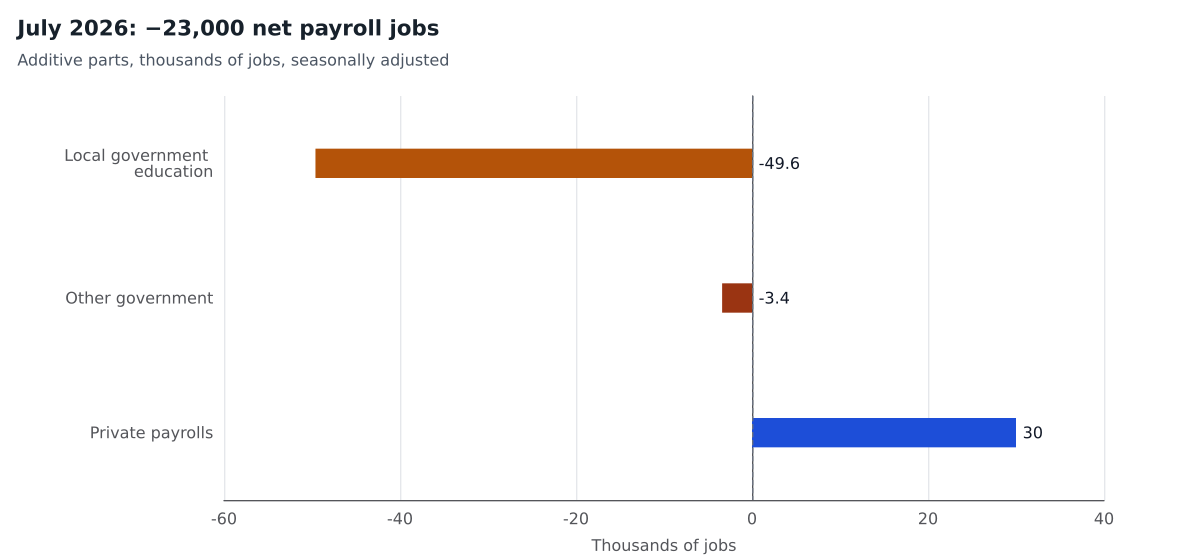
The July Job Loss Was On Local School Payrolls
July 2026’s 23,000-job loss was real in later BLS data, but private payrolls still rose. Local public education accounted for almost all of the decline, on top of a year of stall-speed hirin