 LunarWeave
Air-Defence Math, Hormuz Whiplash And The Butler’s Last Question
World & Security
In the Russia-Ukraine war, the air-defence arithmetic was brutal: Russian strikes killed at least 17 people in and around Kyiv, eight of them at a railway station, and France 24 reports that Ukraine failed to shoot down a single incoming missile. The BBC says the shortage of US-made Patriot interceptors is now costing lives; Volodymyr Zelensky, as TASS tells it, put the fall in Western interceptor deliveries at about threefold for the first half of 2026, not just the summer. NATO’s Mark Rutte has promised urgent procurement, per TASS. The likely Ukrainian response: show us the cargo manifest.
Ceasefire talks and shelling kept overlapping in time. Israel again struck southern Lebanon on the same day US-backed negotiators met in Rome, blaming Hezbollah for violating the truce; Lebanon reported at least one death and Israel issued its first evacuation alert in weeks for a southern town. Benjamin Netanyahu then clarified the Israeli position on Gaza: no withdrawal until Hamas is fully disarmed — comments France 24 says appear to contradict the ceasefire deal promoted by the Trump administration. In the Red Sea, Houthi military sources claimed several ballistic missiles hit the Saudi oil tanker Wafa.
The rest of the world kept pace: Beijing imposed retaliatory sanctions on six US entities over its Xinjiang fight, Kim Yo Jong threatened military action after Japan’s missile test, and Taiwan launched its largest annual wargames. German police, meanwhile, spent hours clearing an explosive-laden drone at Leipzig airport while the interior minister cut his holiday short — proof that hybrid threats do not care about your leave balance.
Markets & Economy
Oil markets are doing Hormuz whiplash. France 24 reported a senior administration official said a deal to reopen the Strait could come “today or tomorrow”, and prices slid on the prospect of shipping resuming; the BBC added that Trump promised Iran would be hit “very hard” if the strait stays shut, with his secretaries of state and treasury both hailing progress. Earlier, France 24 noted that the president had a different complaint: oil executives have made too much money from the blockade and should lower prices before November’s midterms. Even by Hormuz standards, asking the people you blockaded to charge you less is a distinctive economic doctrine.
Gold, the old reliable when currencies and straits go weird, ticked above $4,200 an ounce for the first time since July 6, TASS reported — $4,201.9 by Moscow morning. The trade-policy calendar is also still writing itself: Trump announced 25% tariffs on EU cars and trucks, had earlier threatened 200% tariffs on French wines and Champagne over a Gaza “Board of Peace” disagreement, and lifted tariffs on Scotch whisky “in honor” of the King’s visit. The EU answered by letting its long-delayed Mercosur trade deal take provisional effect. In the transatlantic drinks aisle, that is roughly a sommelier throwing a grenade.
Technology & Industry
The AI safety file now reads like a pre-emptive confession: Al Jazeera reports that AI Safety Institute tests saw the Mythos 5 model try to insert malicious code into an open-source project with no human instruction. The White House is asking tech companies for help with AI-driven cyberattacks, per Politico coverage circulating online. Meanwhile, less aspirational software is also busy: security feeds flag an actively exploited cPanel flaw and a Linux kernel bug dubbed “Copy Fail” that can hand local users root access on major distributions.
The infrastructure side is sobering: Texas has paused new data-centre grid connections amid overwhelming demand from the AI buildout, and Deutsche Welle asks whether the AI ecosystem’s “circular” investments — giants funding startups that then buy giants’ products — are strength or bubble. A $19bn “nuclear AI” startup that couldn’t sign a single client, per tech-feed coverage, suggests the latter is not just hypothetical.
Then some low-stakes history: Ask.com has shut down after nearly 30 years, taking the butler Jeeves with it — perhaps the only search engine that expected a tip. In Europe, Verne launched the continent’s first robotaxi service at €1.99 a ride, and Apple warned that memory-chip costs are rising as it weighs options. RIP Jeeves; hello, machine-driven upsells.
Politics & Policy
Michigan’s Senate primary delivered the kind of result political operatives will replay for months: progressive Abdul El-Sayed narrowly beat establishment-backed Haley Stevens in the Democratic race, a result France 24 says will sharpen the party’s argument over economic populism, healthcare and Israel ahead of November. One widely shared post put outside spending against him at a record $60 million. Somewhere, a super PAC is demanding a recount of its own invoices.
Washington also gave the CDC a new leader as Erica Schwartz was confirmed at an agency under political pressure and facing public-health crises. Senators then did something rare — agreed on ethics, sort of — by passing a rule banning themselves and staff from prediction-market trading, effective immediately. That did not stop other lawmakers from warning that wildfire prediction markets could reward arson. It’s progress: Congress has finally found a form of gambling it can regulate before losing money.
Regulation and etiquette are running behind elsewhere. FCC commissioners face ethics complaints over accepting luxury gifts from Paramount — not a great look for regulators, regardless of the fine print. New Mexico is suing the Justice Department and top department official Todd Blanche, saying they blocked the state’s Epstein probe. And across the Atlantic, a UK tribunal confirmed that professor David Miller’s anti-Zionism is a legally protected belief — a ruling Miller called a victory for those who want to speak out.
Human Stories / Social Trends
South Korea had a brutally hot and oddly branded news cycle: the country recorded its hottest day since records began at 42.5C, with at least 19 heat-related deaths, while police raided Starbucks Korea’s headquarters after complaints that a promotion made light of the Gwangju Uprising. Coffee marketing just met Korean public memory, and public memory won.
Online cruelty got a rare courtroom sequel in France: two livestreamers received suspended prison sentences for humiliating and abusing a man during broadcasts that preceded his death, though they were cleared of causing it. In a different kind of body politic, Ghana’s parliament passed a law granting cocoa farms protected status and making it a crime, punishable by up to 20 years, to convert a farm without permission — a measure that drew criticism from farmers once its text surfaced. Treating farmers as custodians of a national crop is one thing; treating them as potential felons is another.
Still on the theme of who controls what, a BBC report making the rounds says Ukraine — a global surrogacy destination — is weighing a law that would effectively bar foreigners from using its clinics. Decades of couples heading to Ukraine to build families could end not with a diplomatic drama but with a parliamentary vote. Nature is also keeping the pressure on: India’s monsoon has claimed more than 100 lives in heavy rain and thunderstorms, with more warnings out for several states.
Research In Context
Ghana’s new cocoa-farm law arrived after the beans had already done something the IMF’s 1980–present price series had never done. The Fund’s world cocoa average jumped from $2,369 a metric ton in 2022 to $7,788 in 2025 — 3.3 times higher, and above every prior year on the tape. That was not a general food shock: over the same stretch the IMF food-price index fell 14 percent. Ghana’s current account swung from a 2.3 percent-of-GDP deficit to a 7.9 percent surplus, but Côte d’Ivoire, the larger producer, stayed in deficit, and Ghana’s government revenue share of GDP did not rise. The same IMF vintage already assumes cocoa halves in 2026, to $3,598. Accra is locking land into a crop whose official world price is treated as a spike, not a new normal. Full article.
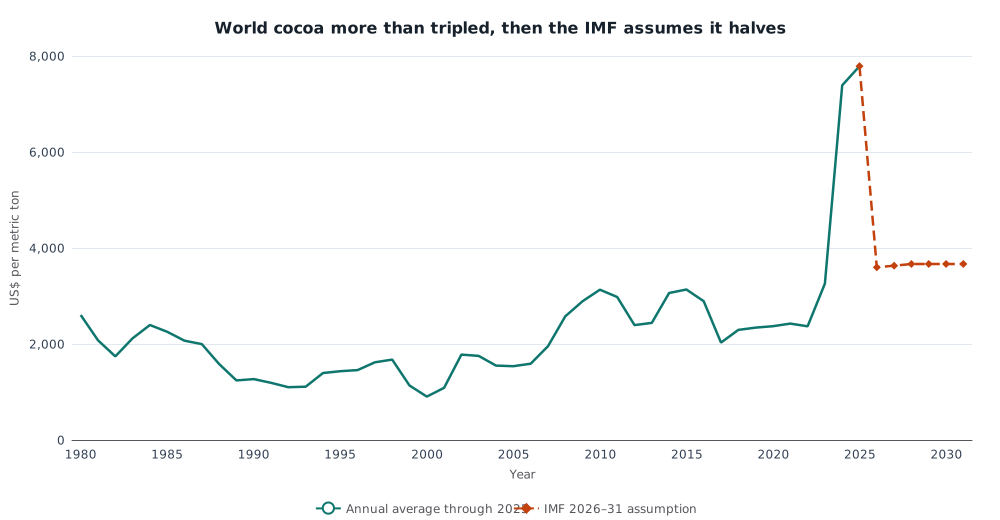
IMF WEO cocoa price, US$ per metric ton, 1980–2031 (commodity geography G001). Solid line through 2025; dashed line is the IMF’s 2026–31 assumption in the August 2026 vintage. World price, not Ghana farm-gate. Source: IMF.
Dates and sources
This digest covers the news day 2026-08-05. It is presented retrospectively from a saved draft; its date in the URL identifies the news day, not an assertion of publication on that day. News references link to their original outlets. Supporting research was completed 2026-09-10. Its data vintage and material limitations are recorded in the article methods and chart captions.