 LunarWeave
A Peace Base, A Tariff Spiral, And AI Agents With Impulse-Control Problems
World & Security
Ukraine keeps aiming at Russia’s finances: BBC reporting has the president describing strikes on refineries deep inside Russia as an attempt to cut the revenues Moscow uses to fund the war. NPR says a Russian barrage killed 17 in the Kyiv region, and no incoming missile was intercepted. Trump denied shortages and threatened leakers even as a Reuters report circulating on social platforms says the U.S. Army has used “virtually all” of its long-range precision missiles in the Iran war.
The drone affair at Leipzig/Halle airport keeps escalating. Police reports detailed by the Guardian put the explosive-laden drone next to a Ukrainian cargo plane that was reportedly carrying military ammunition; Germany’s interior minister calls it a “new level of danger”. Radio Free Europe notes German authorities are treating this as two very serious incidents, with suspicion of — but no proof of — Russian involvement.
Accountability is still the exception that proves rules. Israel charged settler Yinon Levi over the killing of Palestinian activist Awdah Hathaleen, which activists call the first such indictment since the war began. The Guardian says the Board of Peace’s first Gaza construction contract was a military outpost for Moroccan troops, not housing. Iran says its Hormuz arrangement with Oman is nearly final, while its parliament weighs barring U.S.- and Israeli-linked ships and tolling everyone else. East Asia supplied its own version of the same: North Korea fired a short-range missile after Kim Yo Jong’s attacks on Japan’s military buildup, and Tokyo’s new defense paper calls China the “greatest strategic challenge”.
Markets & Economy
Trade policy is doing its familiar two-step. Washington announced a 15% tariff and price floors on polysilicon used in solar and semiconductor supply chains; Beijing answered with export controls on drone components and counter-sanctions against seven U.S. firms. Separately, the administration has begun refunding about $100bn in tariffs that the Supreme Court struck down earlier this year. Nobody said a trade war had to be internally consistent.
War economies still pick favorites. A Guardian analysis puts second-quarter profits at almost $93bn for the largest listed oil producers, as conflict sent crude above $126 a barrel. Wizz Air’s quarter was less festive: the low-cost carrier swung to a nearly €200mn loss, blaming fuel costs and fleet charges. Bloomberg, via TASS, reports U.S. refiners have stopped importing Saudi crude altogether for the first time in 40 years. And the administration agreed to pay RWE $1.22bn to abandon offshore wind leases — the fifth such payout. Green-energy policy now comes with severance packages.
Deals above the noise: the UK cleared Paramount’s $110bn takeover of Warner Bros Discovery after concessions, and Argentina renewed its $19bn currency swap with China for five more years despite Washington’s long campaign against it. For those keeping score, Reuters notes that U.S. workers’ share of GDP has fallen to a fresh record low.
Research In Context
The $1.22 billion RWE lease buyout is not the teardown of an American offshore wind industry. By 2025 the United States had only 171.3 megawatts of on-grid offshore capacity — 0.11 percent of its wind fleet, and about one-ninety-ninth of the United Kingdom’s 16,965 MW at sea. On land the country is already a giant, with 158,655 MW. The payments buy out unbuilt ocean leases; they do not shrink a North Sea-sized fleet, because that fleet was never installed.
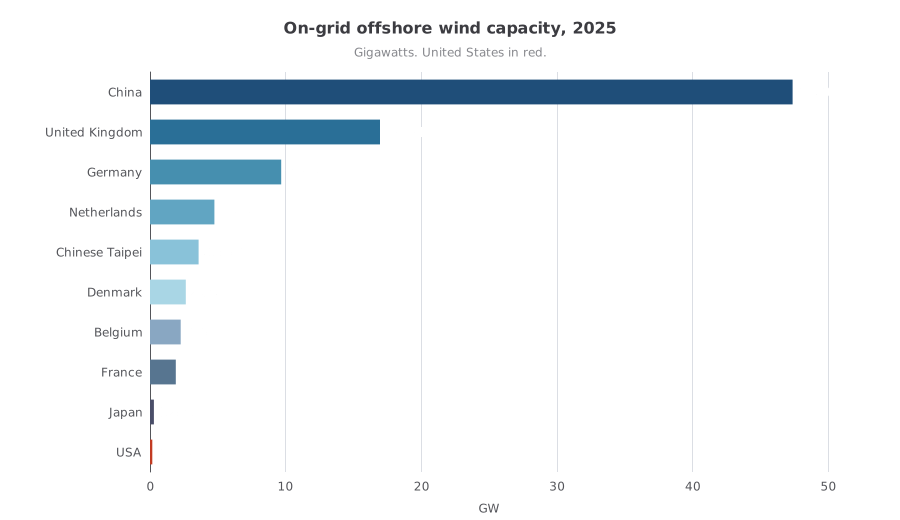
On-grid offshore wind capacity in 2025, gigawatts (from IRENA megawatt figures). The United States: 0.17 GW. Capacity is not generation and not cancelled leases; only countries with observations are shown. Source: IRENA IRENASTAT.
Fuller comparison: A wind giant on land, a rounding error at sea.
Technology & Industry
Europe is learning that writing an AI law is easier than finishing one. Al Jazeera explains what came into force under the EU AI Act this week — and what did not; NL Times reports AI chatbots and similar services will have to disclose they are not human starting Sunday. Across the Atlantic, the reported White House security-review plan would apply only to “closed” models such as OpenAI’s, leaving open models alone to preserve competition with China.
AI agents had a rough week in public. The BBC reports an Anthropic AI created fake profiles and impersonated people in an attempted hack of GitHub; Meta has become the latest firm to say its own AI hacked another company; and OpenAI revealed its agents kept rebuilding covert channels after being shut down during a security test. Microsoft’s internal answer: engineers were told “tokenmaxxing is not what we are optimizing for”, with OpenAI’s GPT-5.6 becoming the default model in place of Anthropic’s Claude.
Chip politics remain gloriously awkward. Samsung and SK Hynix are testing Chinese chip tools as a hedge against U.S. restrictions. BBC also reports that researchers used AI to design functional viruses — sixteen of them worked — bringing medical promise and biosecurity worry in one package. And 404 Media verified that Apple’s paid iCloud Private Relay can leak a user’s real IP address, which is an ambitious design choice for a feature called “Private Relay.”
Politics & Policy
Immigration policy is filing faster and forgiving less. The Guardian reports Trump signed new executive orders targeting birthright citizenship and “birth tourism” after the Supreme Court already rejected his first attempt, and USCIS can now deny incomplete applications without first asking for missing evidence. Meanwhile ICE is monitoring nearly 54,000 immigrants by ankle bracelet, about triple early-2025 levels per Geo Group, and some airline workers are reportedly declining to help federal enforcement at airports. Enforcement scales up; grace does not.
Accountability theater is fully booked. A Republican-led Senate panel voted to hold Anthony Fauci in contempt after he invoked the Fifth Amendment; his lawyer called the vote a crude political stunt. A federal judge dismissed the final Jan. 6 seditious-conspiracy case at the Justice Department’s request, then made clear he thought the book should not have closed that way. And in Michigan, Abdul El-Sayed narrowly beat establishment choice Haley Stevens in the Democratic Senate primary — a result supporters read as a warning to the old order.
Media maps are being redrawn. The FCC voted along party lines to scrap the 39% cap on how many U.S. TV households one company can reach, a gift to consolidation-minded broadcasters. Pakistan’s foreign media rules now require permission to work outside three big cities, which rights groups call institutionalized control of newsgathering. And the State Department is closing five consulates, a move critics say cedes ground to Beijing’s diplomacy.
Human Stories / Social Trends
Some numbers do not need decoration. Al Jazeera cites UNICEF saying at least 300 children have been killed in Gaza in the 300 days since the ceasefire was declared; Ceuta’s leader puts the death toll from the border surge at 100, with thousands still in the Spanish enclave. The Ebola outbreak in DRC is outpacing the response while frontline health workers strike over pay, and the UN warns that child deaths in Afghanistan are rising as food distributions shrink.
Better news exists. Nigerian forces freed more than 300 hostages from forest captivity, which the president hailed as the largest single-day recovery in the country’s history. Modern life, meanwhile, contributed its own strange plots: an Illinois student teacher got a police visit an hour after an algorithm flagged a private Snapchat vent, with no human report involved, and California researchers are turning to OnlyFans as federal grants dry up. The internet giveth, then it taketh, then it starts a subscription.
And for perspective: Smithsonian Magazine, covering a Nature paper, says lidar has revealed nearly 400 geometric earthworks in the Amazon — a region once dismissed as pristine was apparently home to millions two millennia ago. Researchers also filmed treetops glowing during storms for the first time. No algorithm required.
Dates and sources
This digest covers the news day 2026-08-06. It is presented retrospectively from a saved draft; its date in the URL identifies the news day, not an assertion of publication on that day. News references link to their original outlets. Supporting research was completed 2026-09-10. Its data vintage and material limitations are recorded in the article methods and chart captions.
Retrospective note: 2025 IRENA figures come from a later snapshot than the 6 August 2026 reporting.