 LunarWeave
Peace Plans, Oil Whiplash And The Quiet Catastrophes In Between
World & Security
The Gaza peace machine is back to performing peace without the actual peace. France 24 says the Trump-announced plan for Hamas to disarm completely is unravelling: Israel has voiced concerns, its bombing campaign continues, and far-right ministers are pressing Netanyahu against admitting international forces. Deutsche Welle frames Washington's remaining leverage as Trump being 'very disappointed' if Israel balks — foreign policy's version of a one-star review.
Washington and Tehran are negotiating through drafts, denials and one unidentified projectile. Qatar's foreign ministry says the two governments are exchanging peace documents via intermediaries; US officials quoted by Al Jazeera call a Hormuz shipping deal close even as key differences remain unresolved. Britain's UKMTO logged a cargo vessel struck by an 'unknown projectile' in the Strait, per France 24's live blog. The region is holding its breath and its oil.
Quieter crises rarely get a summit. An IFRC envoy tells France 24 that Sudan is no longer best understood through frontlines but as systemic societal collapse, with 35 million people needing assistance. Then Ethiopia's Tigray fighting flared again, the sharpest escalation since the 2022 Pretoria deal, sending people toward Sudan. The least-visible catastrophe in the world just got company.
Markets & Economy
Oil is back to trading on rumour and counter-rumour from Washington and Tehran. Al Jazeera saw stocks near record highs and oil falling after Trump said talks were under way while Tehran disagreed; the BBC traced part of the drop to signals from Rubio and Bessent that Hormuz shipments may soon resume. Tanker crews are not celebrating yet: analysts quoted by the BBC call the threat to shipping the worst since the war began (link). And Al Jazeera reports that Big Oil keeps booking record profits while the Strait is closed — the rare industry that can say 'the crisis continues' with an earnings beat.
Beneath the animal spirits, the arithmetic is less cheerful. Most G7 governments now spend more on debt interest than on defence, per Bloomberg data relayed by TASS; the United States pays more than twice as much on interest as on defence. Argentina, meanwhile, has effectively paused its grain trade as maritime pilots strike against a Milei decree, stranding more than 45 vessels. In the new vocabulary of economic shock therapy, the therapists themselves sometimes walk out.
Technology & Industry
Palantir is having a growth spurt that makes its critics and shareholders read the same numbers differently. Al Jazeera reports second-quarter revenue jumped 93 percent — 'otherworldly', in the outlet's word — while criticism over its ties to Israel and military technology continues. NATO has now given the company a more practical kind of endorsement: an official told Politico, in reporting relayed by TASS, that the alliance uses Palantir AI to manage combat operations, praising its ability to process satellite imagery. Whether that is a product review or a warning depends on whose sky you live under.
Elon Musk's SpaceX also delivered numbers this cycle: revenue up more than 90 percent and losses smaller than expected, per Al Jazeera. In an industry where most headlines involve very expensive debris, quietly beating expectations counts as a softer landing.
Nuclear power produced two very different industrial updates. Finland issued a licence for the world's first deep underground spent-fuel disposal facility, saying it meets the country's nuclear safety requirements. Hungary, meanwhile, is shutting its only nuclear plant because the Danube is too low to cool it. One country is designing for a problem that outlives its population; the other just discovered that river water is seasonal.
Research In Context
Hungary’s only nuclear plant was not a side issue in the Danube heatwave. In IRENA’s last complete generation year, 2023, nuclear supplied 44.8 percent of Hungarian electricity — 15,918 of 35,546 gigawatt-hours — while hydropower supplied 0.6 percent. The river that cools the plant is not a spare generator. Romania, also taking Danube-cooled reactors offline, is built differently: 19.3 percent nuclear and 31.3 percent hydro. Annual 2023 figures cannot confirm the August 2026 outages; they show the hole a shutdown would punch, and that solar’s rise (19.5 percent of Hungarian generation) has not replaced night-time nuclear baseload.
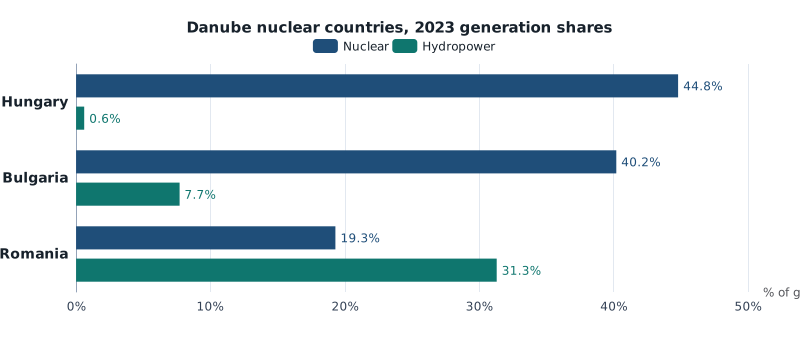
Share of 2023 electricity generation from nuclear and hydropower, percent. Hungary: 44.8% nuclear, 0.6% hydro. Bulgaria: 40.2% nuclear, 7.7% hydro. Romania: 19.3% nuclear, 31.3% hydro. 2026 shutdown reporting named Hungary and Romania; Bulgaria is the other Danube-bank nuclear generator in the file. Annual 2023 generation cannot confirm 2026 outages. Source: IRENASTAT.
Politics & Policy
Twenty-five US states have taken the tariff fight to court, arguing that the president exceeded his authority by using forced-labour rules to justify sweeping import taxes and asking for refunds to importers. Whatever one thinks of the tariffs, this is what the separation of powers looks like when it files suit.
Senate Democrats have also put banks on notice, with a report accusing major financial institutions of 'looking the other way' on suspicious Epstein-related activity and failing their legal duty to flag it. The report calls for a probe — which, after years of Epstein headlines, is roughly the financial system's version of discovering the alarm was installed but nobody ever plugged it in.
Two years after students toppled Sheikh Hasina, Bangladesh's reform story is losing its momentum. DW reports critics say political divisions are deepening and key changes have stalled — the risk of being the change you demanded is that people immediately ask for the details.
Human Stories / Social Trends
After the deadly rush at Ceuta, the human ledger is still open. France 24 reports Moroccan parents are searching for children who disappeared during the crossing, with hope and anxiety mixing as survivors come home; Spanish authorities count 72,000 people entering the enclave, with all but about 2,000 now returned. On a different stretch of water, the news was briefly better: French and British vessels rescued 157 people from a boat on fire in the Channel, one of the largest such rescue operations since 2018.
The internet continues to make itself unpleasant for women who protest. The BBC hears from Indian women involved in the 'cockroach' protest who say they have been doxxed, 'slut-shamed' and abused simply for showing up and posting about it. The intended effect of that abuse is not difficult to read.
And the AI transition has a human resources problem. Workers in the Philippines' outsourcing industry tell the BBC they feel increasingly expendable; one put it bluntly: 'I feel like I dug my own grave'. They spent years learning the script, and now the machine is reading it back to them.
Dates and sources
This digest covers the news day 2026-08-04. It is presented retrospectively from a saved draft; its date in the URL identifies the news day, not an assertion of publication on that day. News references link to their original outlets. Supporting research was completed 2026-09-10. Its data vintage and material limitations are recorded in the article methods and chart captions.