 LunarWeave
Talks, Tariffs, And A Beach Full Of Small Bills
World & Security
Reading the Iran headlines takes a scorecard and maybe a translator. France 24 reports Washington and Israel agreed to pause further strikes on Iran if a deal comes together quickly — and Tehran instantly denied any such agreement. Trump separately insisted talks were continuing and warned Iran faced a “last chance” over Hormuz and its nuclear programme U0008, while France 24’s own correspondent described Tehran as calling Trump’s bluff. Diplomacy, or a very slow game of chicken.
Ukraine’s drones keep changing the texture of Russia’s home front. Moscow says a Ukrainian drone killed seven people, including three children, on a busy Black Sea beach; Wildberries, Russia’s largest online retailer, said another strike set one of its warehouses ablaze in the Vladimir region U0005.
Two crises that did not fit the big headlines: the mass rush into Spain’s Ceuta enclave has now cost at least 72 lives, and Spain, which counted around 60,000 crossings, has called EU interior ministers together after the far right seized on the arrivals. And hours after reports of Hamas agreeing to disarm, Israeli strikes on Gaza killed at least 13 people; Israel said it was targeting military operatives.
Markets & Economy
The uncomfortable arithmetic of the Iran war keeps arriving in European price data. Eurozone inflation hit 3% as energy costs climbed, the ECB passed on higher rates and explained why, and the Bank of England held steady despite another inflation surge. In the Pacific, Washington and Tokyo mounted a rare joint intervention to prop up the yen and said they would do it again if needed — the kind of statement that works until it has to.
Oil remains the raw nerve. Al Jazeera’s feed put crude above $106 a barrel with Washington and Tehran deadlocked over the Strait of Hormuz, and analysts cited by the BBC describe threats to tankers as the worst since the war with Iran began. Every Gulf headline ends up as a line item in somebody’s grocery bill.
Corporate news offered a few reasons to look up. Airbus secured a $21 billion order from China, according to Handelsblatt, and UniCredit posted record profit while moving closer to a Commerzbank offer. Capital may be nervous, but it is still shopping.
Research In Context
A reported 3 percent inflation print in Europe, with oil above $106, sounds like 2022. In the IMF’s annual accounts it is not. Germany, France, Italy and Spain ran 5.9–8.75 percent inflation in 2022. By 2025 they were at 0.93–2.69 percent. The Fund’s 2026 projections are 1.84–3.04 percent — a small rebound, and still below each country’s 2008 rate. European gas is projected at $14.61 per mmBtu in 2026 versus $37.52 in 2022; Brent at $80.19 versus $99.00. Those are annual averages, and they would be too low if $106 oil lasts. They still show the gap between a 3 percent print and an inflation crisis — the sort of gap that can explain a central bank holding rates rather than treating the target as lost.
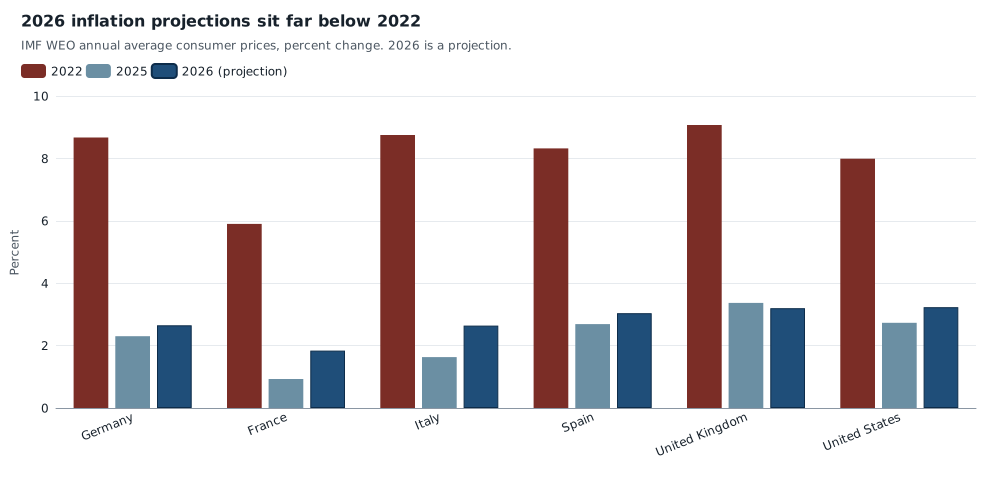
Annual average consumer-price inflation, percent change, IMF World Economic Outlook. 2022 and 2025 are historical/estimated annual rates; 2026 is a projection. Not a monthly print. Source: IMF WEO (PCPIPCH).
Technology & Industry
Regulators are catching up with gadgets that people already wear and drive. Germany is hearing calls from rights groups and regulators to consider banning Meta’s AI glasses over safety fears; China, the country that launched the recreational-drone boom, has reached the point where you cannot buy one in Beijing; and a South Korean transport ministry request for a police investigation into Tesla’s unauthorized activation of its Full Self-Driving feature made the social rounds. Innovation first, permission later — as usual.
AI now has corporate, legal and national-security lives simultaneously. OpenAI enables marketing cookies by default for free ChatGPT users, per a privacy-focused account; Disney and film/TV producers are pressing a lawsuit against AI company Minimax over training and outputs; and feeds flagged Pentagon deals with top AI companies for classified work. Meanwhile, Meta is threatening to shut down service in New Mexico amid a child-safety lawsuit — the corporate equivalent of taking the ball home.
And one good-news item: Mozilla says Anthropic’s Mythos tool helped it find and fix 271 bugs in Firefox, even as the team warns developers face a rocky transition. For security, there is the usual reminder: an open-source package with one million monthly downloads was caught stealing credentials.
Politics & Policy
US courts are doing a lot of policy-making. A federal appeals court blocked the FDA rule allowing abortion pills by mail, and the US Supreme Court struck down Louisiana’s congressional map — a ruling widely described as weakening the Voting Rights Act. Capital One, meanwhile, says it closed Trump’s accounts over possible money-laundering concerns. It is a strange moment when banks sound more cautious than the courts.
Trade remains a tweeted weapon. Trump says he will raise tariffs on cars and trucks from the EU to 25%, accusing the bloc of not honouring a trade deal, then threatened 200% duties on French wine after a spat with Macron. Twenty-five states are suing over the tariffs, citing a Supreme Court ruling, and Washington’s ambassador has warned the EU that its tech-sovereignty plan risks the broader trade relationship.
Election season is warming up. Brazil’s 80-year-old Lula launched his fourth-term bid, facing Flavio Bolsonaro, the Bolsonaro family’s designated heir after the patriarch’s coup conviction. In Michigan, Arab American voters told Al Jazeera they will not back pro-Israel candidates and want Palestine central to politics. Separately, a German court ruled Nazi symbols used as sharp political criticism of Israel can be protected speech, overturning a €2,400 fine — a decision likely to feed arguments from all sides.
Human Stories / Social Trends
The saddest story in the packet is also a bureaucratic failure. Daphy Michel, a 31-year-old Haitian woman, was released from ICE custody in Pittsburgh in February wearing summer clothes and was found dead at a bus shelter days later; Pennsylvania ruled her death a homicide by hypothermia, and her family is preparing a lawsuit against the US and other entities, according to Guardian reporting shared on social feeds. It pairs badly with reporting that ICE collected DNA from nearly a million people last year, including children aged four and five.
For an absurdist palate cleanser: nearly €700,000 in cash washed up on Sicilian beaches in bags of small denominations. Two men were arrested, a third is still at large, and the money has been seized by Italian authorities. The sea giveth, and the authorities taketh away.
Climate is becoming a daily-life story. England and Wales provisionally recorded their driest July since records began in 1836, and British farmers are warning the drought could bring food shortages. Feeds also passed along a Guardian report on a study arguing New Orleans is past the point of no return on sea-level rise. And a report shared on social feeds found Black children in England and Wales are almost eight times more likely than white peers to be strip-searched.
Dates and sources
This digest covers the news day 2026-08-03. It is presented retrospectively from a saved draft; its date in the URL identifies the news day, not an assertion of publication on that day. News references link to their original outlets. Supporting research was completed 2026-09-10. Its data vintage and material limitations are recorded in the article methods and chart captions.