 LunarWeave
A Paused War, A Fatter Tariff, And Robots Turned Away At The Oscars Door
World & Security
After weeks of threatening to hit Iran hard, Trump said the US and Israel would hold off on new strikes if a deal can be reached “rapidly”; Iran gave no immediate public reaction. Saudi Crown Prince Mohammed bin Salman reportedly nudged him toward de-escalation, and Israel’s prime minister had not commented (France 24). TASS, citing Israeli TV, described a Hormuz compromise: inbound vessels in Iranian waters, outbound vessels in Omani waters. Meanwhile, CENTCOM says the resumed blockade has redirected 35 vessels. The White House then told Congress that hostilities have “terminated”. A war that isn’t happening is nonetheless very busy.
At Europe’s edge, Al Jazeera reports migrant deaths in Ceuta have risen to 72 after more than 50,000 people crossed from Morocco. Spain installed a 500-metre sea barrier, and the EU will hold emergency talks on Tuesday. Community-shared reporting counted around 60,000 crossings, some 8,000 of them children; BBC notes the politics has been whipped up on social media. Germany’s Tagesschau says 22 member states want an urgent interior ministers’ meeting and are criticising Spain. A floating wall after a drowning crisis: European solidarity, at its most architectural.
France 24 reports that a Moscow restaurant bombing killed three people and is suspected of being linked to the war in Ukraine. And Al Jazeera says a Sudanese army drone strike in Darfur killed 35, according to a rights group. Both stories are reminders that the quiet escalation is still escalation.
Markets & Economy
Trade got a fresh coat of tariffs, with posts reporting that Trump will raise US tariffs on EU cars and trucks to 25 percent while accusing the bloc of non-compliance; one shared excerpt noted rates would rise from the 15 percent agreed last summer. German business coverage says European automakers could pull entry-level models from the US market, which is a novel way to make affordable cars even more optional. The invoice is in the mail.
Energy markets are the bigger headache. The IEA chief reportedly calls the loss of 13 million barrels a day the biggest energy security threat in history; Chevron’s CEO expects airfares to worsen; Japan’s PM said the crisis is having an “enormous impact” in the Asia-Pacific while signing energy supply deals in Australia; and Pentagon figures, via Axios, put the US blockade’s cost to Iran at $4.8 billion. When forecasts agree like that, the next quarterly reports will not be fun.
One low-cost carrier didn’t wait for the next quarter: Spirit Airlines says it is going out of business and ending operations immediately after 34 years. In slower trade news, an EU-Mercosur agreement has entered into force provisionally after more than two decades of negotiation. Slow, but signed.
Research In Context
US air-transportation payrolls have not collapsed with the fuel-and-fare scare. In July 2026 they stood at 568,400 seasonally adjusted jobs — 69,400 above January 2019, and only 7,500, or 1.3 percent, below a March peak. That is not the 2020 crash, when the same industry fell to 391,000 jobs. Shared May reports that Spirit Airlines was shutting down, and warnings that airfares would worsen, sit against an industry that is still large, more expensive to staff, and working longer hours than before Covid. The job count cannot measure ticket prices or any single carrier; it can show that the people who fly the planes have not been sent home.
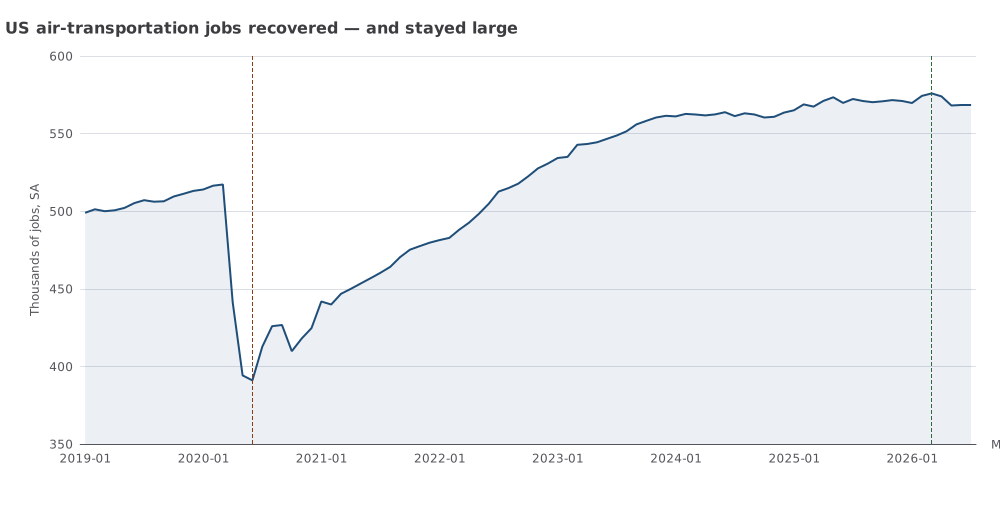
All employees in NAICS 481 air transportation, thousands of jobs, seasonally adjusted, United States, January 2019–July 2026. June and July 2026 are BLS preliminary estimates. The series does not identify individual airlines. Source: U.S. Bureau of Labor Statistics, Current Employment Statistics (CES4348100001).
This is a retrospective note using later official snapshots than 2 August 2026. Read the full analysis.
Technology & Industry
Corporate AI budgets are producing some very honest numbers. A widely shared tech item says Uber burned its entire 2026 AI budget in four months on Claude Code; Barron’s notes Samsung posted a record quarterly profit on AI demand; TechCrunch reports Meta bought robotics startup Assured Robot Intelligence to strengthen its humanoid-AI ambitions; and Apple will put hardware chief John Ternus in the CEO seat on September 1. If your new tablet costs more, the likely explanation is AI’s appetite for memory chips — the consumer gets the bill either way.
Meanwhile, security teams are patching for a living: Linux “Copy Fail,” flagged by The Verge, can give any local user root on nearly every distribution since 2017, and cPanel is being actively exploited. New EU transparency rules came into force this weekend, requiring AI-generated content to be labelled and chatbots to identify themselves; Spotify added “Verified” badges to separate human artists from AI personas; and the Academy says AI actors and screenplays are not Oscar-eligible. Machines may one day do the work; in 2026, they just aren’t invited to the ceremony.
Politics & Policy
A rare financial footnote in the Trump saga: France 24 reports Capital One defended closing more than 300 Trump-affiliated accounts by citing an anti-money-laundering review — the first time a bank has formally tied such concerns to the president’s family business. Community-shared context dates the account-closure notices to March 2021 and the family’s lawsuit to 2025, which makes the “woke banker” theory harder to square with the calendar.
Redistricting never sleeps. A report on the Supreme Court decision says it struck down Louisiana’s congressional map and weakened the Voting Rights Act; Florida’s legislature approved a new congressional map explicitly aimed at boosting Republicans in the midterms; and Kansas voters are deciding whether to elect state Supreme Court justices. The country is now arguing about the maps and the courts at the same time — what could go wrong?
Immigration policy remains the sharpest split. Polling shows half of Americans say Trump has gone too far on deportations, while most Republicans support the approach. Community-shared reporting describes ICE using mandatory check-ins and GPS ankle monitors as part of an effort touching some 350,000 Haitians after their humanitarian programme was ended; separately, a family plans to sue after a Haitian woman released by ICE froze to death. The numbers deserve better than spin.
Human Stories / Social Trends
Solitude has a new marketing department. BBC World reports on a growing crop of “loneliness influencers” spotlighting solo living — no children, no friends, no apologies — and insisting they are not lonely. Whether it is liberation or isolation with a ring light is up for debate; the phrase “we are not lonely” is doing heavy lifting.
Work’s algorithm problem isn’t confined to gig apps. An NPR piece shared on social media describes management algorithms wrecking workers’ schedules and cutting pay; bad bosses have now been automated. Food, too, has a supply-chain conscience problem: community posts tie Taylor Farms to Arizona prison labour, with a contracted rate of $4.75 an hour while incarcerated workers take home no more than $1.50. Unsurprisingly, that story travelled alongside the company’s role in cyclospora outbreak coverage.
And in a genuine human loss, a community item relaying NPR’s reporting says celebrated mountaineer Nirmal Purja and nine others died in an avalanche on Broad Peak in Pakistan. Meanwhile, Colombia’s government is proposing to euthanize 80 hippos descended from Pablo Escobar’s estate, ending decades of collective hand-wringing. The hippos, reportedly, were not consulted.
Dates and sources
This digest covers the news day 2026-08-02. It is presented retrospectively from a saved draft; its date in the URL identifies the news day, not an assertion of publication on that day. News references link to their original outlets. Supporting research was completed 2026-09-10. Its data vintage and material limitations are recorded in the article methods and chart captions.