LunarWeave
The $103,000 H-1B Fee Is 42 Weeks Of Tech-Services Pay
The United States is trying again to put a six-figure price on a new H-1B visa. The Dong-a Ilbo, citing Reuters, reported that the Department of Homeland Security planned to propose a $103,265 fee on the so-called professional visa after a federal court this summer called an earlier version an illegal tax that had skipped Congress.
That number is not a filing surcharge. In the computer-systems-design industry that does much of this work, it is most of a year’s average pay — and it would arrive after that industry’s hiring boom had already gone into reverse.
The comparison uses the Bureau of Labor Statistics Current Employment Statistics survey, not the visa file. Computer systems design and related services is the CES industry for custom programming, systems design and related information-technology services (BLS series CES6054150001). It counts payroll jobs in the United States, including workers of every citizenship. It is not a headcount of H-1B holders, and H-1B visas are also used in hospitals, universities, finance and other industries. What the payroll series can show is whether the labor market most associated with those computer jobs is still expanding, and how large $103,265 is beside typical pay there.
A long boom, then a three-year slide
In January 1990 the industry employed 409,500 people. By March 2023 it employed 2,483,500 — more than six times as many. Then the line turned down. The latest BLS estimate, still marked preliminary, is 2,366,400 jobs in July 2026: 117,100 fewer than the peak, a 4.7 percent drop. The last month not flagged as preliminary, May 2026, was 2,370,000, already 113,500 below the peak.
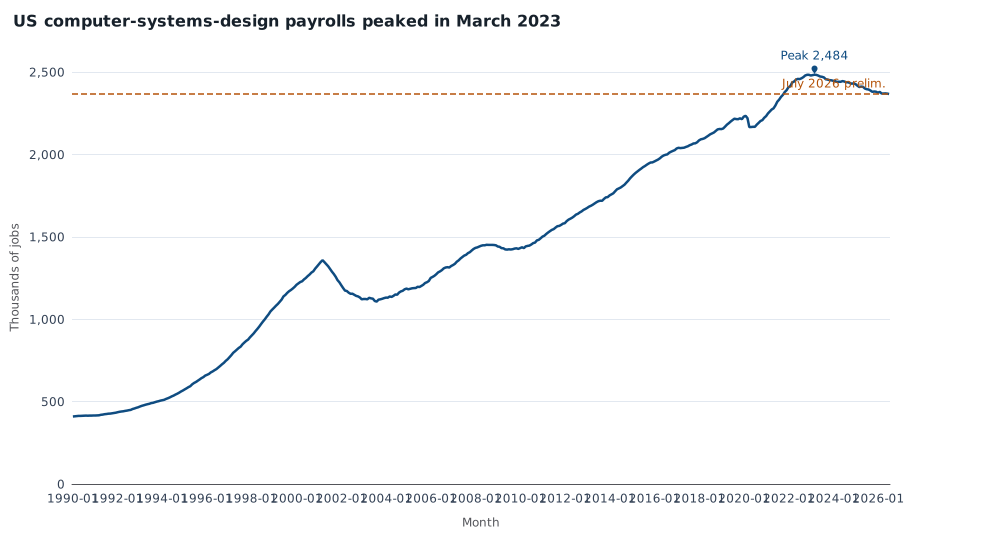
Seasonally adjusted all-employee payrolls in computer systems design and related services, United States, January 1990–July 2026, thousands of jobs. Peak: 2,483,500 in March 2023. July 2026 is a BLS preliminary estimate of 2,366,400. Source: U.S. Bureau of Labor Statistics, Current Employment Statistics series CES6054150001. Industry jobs are not a count of H-1B visa holders.
That is not a collapse, and it is not a return to the 1990s. July 2026 payrolls were still 6.9 percent above December 2019. The industry remains large: about 1.5 percent of all US nonfarm jobs. What ended is the pandemic-era surge. From December 2019 to the March 2023 peak, computer-systems-design payrolls rose 12.2 percent. Almost half of that gain has since been given back.
Average weekly hours in May 2026 were 38.6, little changed from 38.7 in December 2019. The reversal shows up as fewer jobs, not a shorter workweek.
A smaller, separate industry often lumped into “tech” did not follow the same path. Software publishers (CES series CES5051320001) peaked at 664,300 jobs in November 2022 and stood at a preliminary 659,700 in June 2026, down 0.7 percent. The cooling that matters for this fee is in computer-systems-design services, not in a vanishing software sector.
The rest of the job market kept growing
If computer-systems-design payrolls were merely tracking a weak US labor market, a visa fee would be landing on a general slump. They were not. Total nonfarm employment (CES0000000001) rose from 155.1 million in March 2023 to a preliminary 158.9 million in July 2026, a 2.4 percent increase over the same stretch in which computer-systems-design jobs fell 4.7 percent.
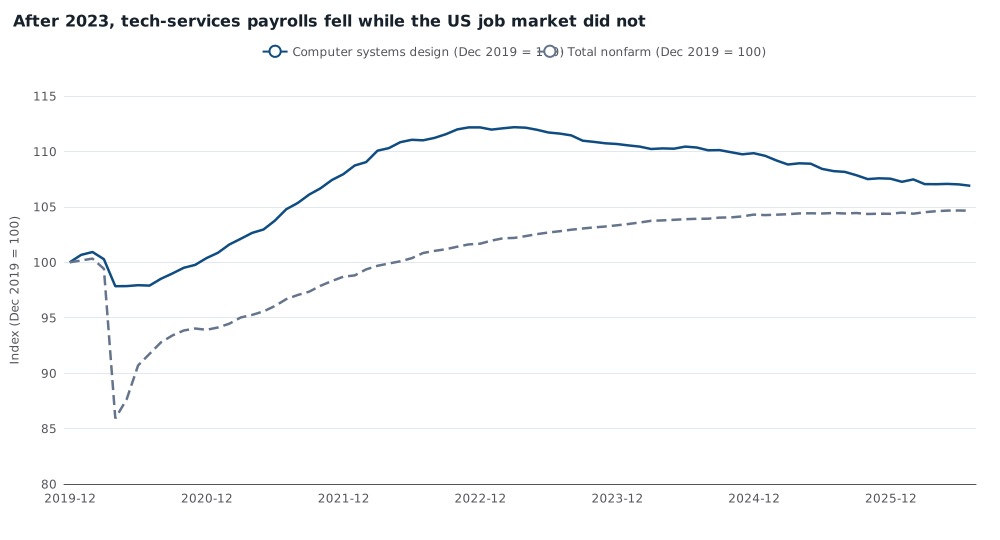
Index of seasonally adjusted payrolls, December 2019 = 100. Computer systems design and related services versus total nonfarm employment, United States, December 2019–July 2026. The vertical axis starts at 80, not 0, so the 2020 drop and the later split are readable. June and July 2026 are preliminary. Source: U.S. Bureau of Labor Statistics, CES series CES6054150001 and CES0000000001.
From December 2019 through July 2026, nonfarm payrolls were up 4.7 percent and computer-systems-design payrolls were still up 6.9 percent. The industry outgrew the rest of the economy across the whole pandemic cycle. It has underperformed since 2023. A fee sold as a way to protect American workers in a red-hot tech market would be arriving after that heat had already come off.
Forty-two weeks of average pay
The fee looks even larger once it is placed next to CES earnings, which begin in 2006 for this industry. In May 2026, the latest month not flagged as preliminary, average weekly earnings of all employees in computer systems design and related services were $2,442.61 (CES6054150011). Fifty-two times that weekly figure is $127,016. The reported $103,265 fee is 81 percent of that implied annual rate — 42.3 weeks of average pay in the industry.
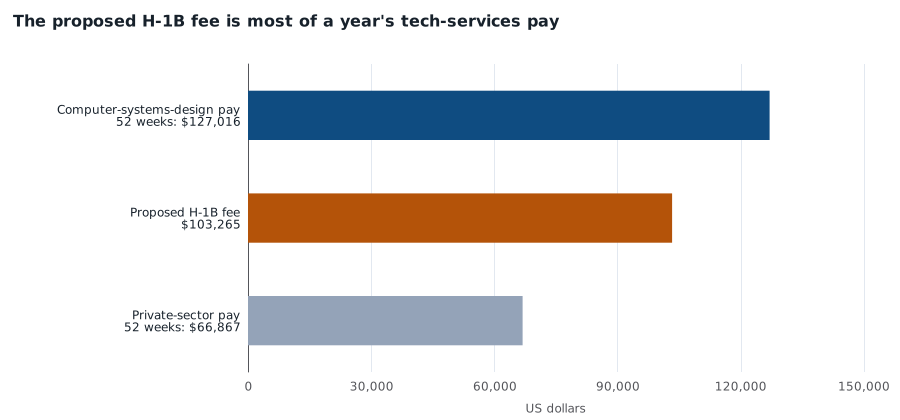
US dollars. The $103,265 H-1B figure is the Department of Homeland Security proposal as reported on 24 August 2026. Earnings are 52 times May 2026 seasonally adjusted average weekly earnings of all employees, not annual salary or total labor cost: $2,442.61 × 52 = $127,015.72 in computer systems design; $1,285.91 × 52 = $66,867.32 across the private sector. Sources: BLS CES series CES6054150011 and CES0500000011; fee as reported by Dong-a Ilbo citing Reuters.
| Measure | Value | Period |
|---|---|---|
| Computer-systems-design jobs, peak | 2,483,500 | March 2023 |
| Same series, latest estimate | 2,366,400 | July 2026, preliminary |
| Change from peak | −117,100 (−4.7%) | March 2023 to July 2026 |
| Average weekly earnings, this industry | $2,442.61 | May 2026 |
| That weekly figure × 52 | $127,016 | May 2026 |
| Proposed H-1B fee (reported) | $103,265 | 24 August 2026 |
| Fee as a share of that implied annual pay | 81% | — |
Those weekly earnings are an industry average for all employees, not H-1B wages, and multiplying by 52 is not a BLS annual-compensation series. It is still the right scale check. Average hourly earnings in the industry were $63.28 in May 2026, 1.69 times the private-sector average of $37.49. Across all private jobs, 52 weeks of average weekly earnings came to $66,867. The proposed visa fee is larger than that entire amount.
Dong-a, again citing Reuters, reported that current H-1B fees were about $2,000 to $5,000. This article does not verify the old schedule. Even as a reported contrast, the new charge is a different kind of number: it is on the order of a year of pay, not a processing bill.
What the payrolls cannot decide
None of this says whether the fee is lawful, or whether H-1B hiring undercuts US workers. CES cannot see visa status, occupation mix inside the industry, or who would write the check. A proposed fee also cannot explain a decline that began in 2023. Average pay in computer systems design is high because the jobs are skilled, not because a visa receipt has already been added to the wage.
What the official payrolls do settle is the setting. The United States is debating a $103,265 charge for new H-1B visas after computer-systems-design employment has already fallen by more than 100,000 jobs from its 2023 peak, while the broader job market has not. In that industry, the fee is not a rounding error. It is 42 weeks of average pay.
Methods and sources
This is retrospective research completed on 10 September 2026, using a pinned BLS CES snapshot whose latest month is July 2026. It does not reconstruct what was knowable on 24 August 2026, the news date that motivated the question.
Employment, hours and earnings are seasonally adjusted CES all-employee series for the United States, retrieved from the pinned MegaVedia extract of the official CES bulk files. June and July 2026 values carry BLS preliminary footnotes where shown. Industry definitions follow CES NAICS titles; computer systems design and related services is not software publishers and is not a count of H-1B petitions. Weekly earnings times 52 is an implied annual rate calculated here. The $103,265 fee is a reported Department of Homeland Security proposal, not a CES observation. BLS CES technical notes describe the survey as a sample of employer payrolls.
Research Date
The displayed date matches the related news edition. Research was completed 2026-09-10.
Related news: Daily · 2026-08-24
More Research
China’s Population Peaked In 2021. India’s Rise Is Still Much Larger.
IMF headcount shows China peaked in 2021; India’s three-year gain is still about 8.5 times China’s loss.
The United States Is Paying Italy’s Interest Bill — Without Italy’s Surplus
IMF 2024 accounts show a 3.5 percent of GDP US interest residual, matching Italy rather than Japan, on top of a still-wide primary deficit.
Qatar’s Worst Slump In A Generation Still Leaves An 11 Percent Surplus
IMF accounts already put Qatar in a worse 2026 slump than Covid, with goods exports down about a fifth — and still an 11 percent current-account surplus.