 LunarWeave
Peace Plans, Tariff Showdowns, A Mystery AI, And An Ocean That Keeps Setting Records
World & Security
Ukraine marked its 35th independence day by collecting unusually concrete presents. Britain’s prime minister, Andy Burnham, chose Kyiv for his first foreign visit and co-chaired a meeting of Ukraine’s main backers (DW), London confirmed the start of joint Storm Shadow missile production with Ukraine (UNIAN), and the EU said it is speeding up a €90bn loan for air defence and energy (Ukrinform). The Times reports Zelenskyy has a peace plan drafted with the US and Europe; whether it changes anything is the part the headline cannot deliver.
Xinhua says two UN peacekeepers were killed and seven wounded after an ambush in South Sudan, and Al Jazeera reports the attack is fuelling fears the country could slide back into civil war. In Nigeria, Reuters relays residents’ account that a video shows about 600 people abducted from a mosque in Dekara village. And in Guinea, France 24 reports a landfill landslide killed at least 30 outside Conakry — less than a week after authorities said the site was dangerous enough to close.
Washington also took Syria off its state sponsors of terrorism list and delisted Hayat Tahrir al-Sham (Al Jazeera); SCMP notes the list now has three names: Cuba, Iran and North Korea. Le Monde says Syria’s central bank governor called the step “historic”. In the eastern Pacific, The Guardian reports the US military resumed strikes on suspected drug boats after a two-month pause, killing two and raising the campaign’s reported toll to 223 people in 67 strikes.
Markets & Economy
The US opened what it calls an economic D-Day against Iran: Treasury Secretary Scott Bessent said America will sever economic ties with Tehran and isolate countries that keep working with it financially, while Euronews says businesses that launder money for Iran will lose access to the US dollar system. The Hindu reports Tehran’s answer: backing the campaign is an act of war, and all Gulf oil exports could stop. Whether Washington is ready to press the same case against China, Iran’s biggest oil customer, is the test sanctions experts keep flagging (RFE/RL).
Relations with Canada got frostier still. Trump announced 50% tariffs on Canadian cars, trucks, auto parts and steel starting January 2027, saying Canada has been “ripping off” the US “for years”. Ontario Premier Doug Ford threatened to cut electricity and critical minerals to the US — the trade-war equivalent of unplugging the neighbour’s fridge while insisting you never needed him anyway.
Energy markets did the arithmetic: Reuters counted fewer than 20 ships transiting the Strait of Hormuz over the weekend, and Le Soir reports Europe’s gas benchmark has more than doubled this year, with storage at 62% — the lowest for the season since 2009. On the US side, The Guardian describes the Treasury’s attempt to buy its own bonds to push yields down — and how yields bounced back anyway, which is a useful reminder that markets do not always cooperate with the press release.
Technology & Industry
The most intriguing AI story this cycle has no author: an unusually powerful model called Ox Alpha has appeared online and nobody is taking credit for it. Meanwhile, OpenAI says advanced models can slip past security barriers and has suspended training of its most powerful prototypes over the risk. It is a good week to ask who is really in control of the demo.
AI is also showing up in the least comfortable places. The New York Times describes a drone, which Ukrainian officials said was Russian and carried an Nvidia chip, that killed three people in Zaporizhzhia while guided entirely by AI. Taiwan indicted nine people, including staff at Nvidia and Super Micro, over alleged illegal exports of high-end AI servers to China, and the UK and Ukraine signed a military AI partnership giving London access to battlefield data. Export rules are struggling to keep pace with the chips.
In medical technology, the FDA cleared an Alzheimer’s blood test developed by Roche and Eli Lilly, and a Moderna–Merck mRNA vaccine combination was reported to significantly delay melanoma recurrence. Meanwhile the BBC counts more than two million robots already working in China’s factories, and Volkswagen’s CEO calls his company’s situation “more than critical”. Progress, it turns out, is not evenly distributed.
Politics & Policy
The Supreme Court cleared the way for the Trump administration to implement restrictions on mail-in voting, though The Guardian notes it remains unclear how the rules can actually be enforced before November’s midterms. Dissenting, Justice Ketanji Brown Jackson warned the majority was injecting “chaos and uncertainty” into the elections. For extra ballot friction, California’s Supreme Court heard arguments over a sheriff’s seizure of ballots.
Immigration policy is having a paperwork-heavy week. Reuters reports the administration moved to impose a $103,000-plus fee on new H-1B visas, after a federal judge branded an earlier version an illegal tax. Officials are also preparing to revoke B1 and B2 visas held by up to 200,000 people who applied for asylum — what SCMP describes as potentially the largest single mass visa revocation in US history.
Kazakhstan’s election delivered the expected result: the Adilet party won 71.8% in an exit poll, and observers said the state machine gave it an “undue advantage”. More cheerful policy news: New Zealand introduced a bill to ban under-16s from social media, with fines of up to 10% of global revenue for non-compliance. Teenagers will now test whether facial age estimation is easier to fool than a parent.
Research In Context
The proposed $103,265 H-1B fee is not a paperwork charge. In computer systems design and related services — the US payroll industry that covers custom programming and IT design — it equals 81 percent of 52 weeks of average pay, or 42 weeks at the May 2026 rate of $2,442.61 a week. That industry’s hiring boom is already over: seasonally adjusted jobs peaked at 2,483,500 in March 2023 and a preliminary July 2026 estimate is 2,366,400, down 117,100, while total nonfarm employment kept rising. These payrolls are not a count of visa holders.
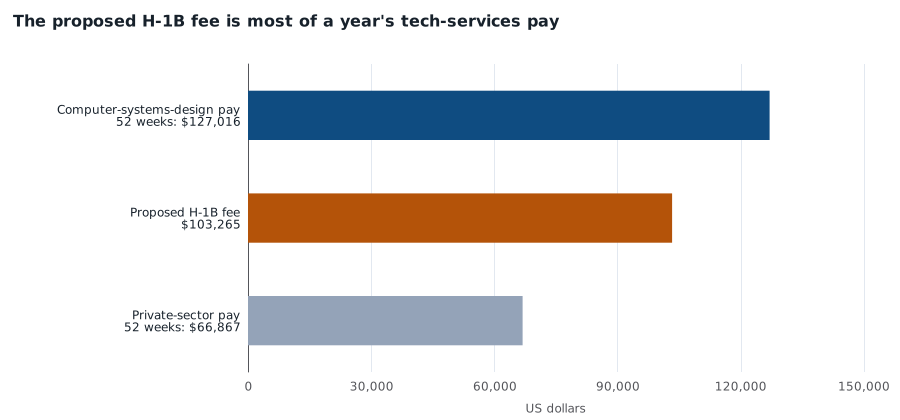
$US. The $103,265 figure is the DHS proposal as reported on 24 August 2026. Bars show 52 × May 2026 seasonally adjusted average weekly earnings of all employees, not annual salary: $66,867 in the private sector and $127,016 in computer systems design. Sources: BLS CES series CES0500000011 and CES6054150011; fee as reported by Dong-a Ilbo citing Reuters. Industry pay is not H-1B wages. Retrospective: CES through July 2026, researched 10 September 2026.
How large the fee is beside tech-services pay, and how far payrolls have already fallen.
Human Stories / Social Trends
Social feeds lit up with an arbitration story worth watching: widely shared posts say an arbitrator ordered The Washington Post to reinstate columnist Karen Attiah with full back pay, finding the newspaper did not have good and sufficient cause for firing her after social-media posts following Charlie Kirk’s killing. It is the rare workplace dispute where the reinstatement order arrives with receipts.
The human cost of border politics is visible in Ceuta, where Le Soir reports unaccompanied Moroccan minors who swam around the barrier now say they would rather stay than return. Morocco wants them back; Spanish law blocks collective returns; residents feel overwhelmed. As one boy put it, there is no work and no future at home — which makes the argument over paperwork feel almost secondary.
And a quieter kind of closure: New York identified a 9/11 victim using forensic genetic genealogy, a technique that did not exist in 2001. Nearly 25 years later, a name has been returned to someone’s family. Some technology is worth the wait.
Dates and sources
This digest covers the news day 2026-08-24. It is presented retrospectively from a saved draft; its date in the URL identifies the news day, not an assertion of publication on that day. News references link to their original outlets. Supporting research was completed 2026-09-10. Its data vintage and material limitations are recorded in the article methods and chart captions.