 LunarWeave
Trade Wars Escalate, Hormuz Gives Mixed Signals, And Dolly Takes Her Final Bow
World & Security
Syria had a reset built out of two headlines. Washington lifted the state sponsor of terrorism designation, revoked HTS’s terrorist listing and applied sanctions relief, which President Ahmed al-Sharaa called shaking off a “dark stain”. Then the Kurdish-led Syrian Democratic Forces said they would dissolve and integrate their fighters into Syrian army brigades, a merger framed as a step toward bringing the country under central government control.
On the US-Iran front, the signals pointed in several directions at once. Sources cited by Russian media described a completed ceasefire deal that would include free navigation in the Strait of Hormuz, while Iran’s deputy foreign minister said Hormuz would remain closed despite a temporary arrangement with Oman. Still, Tehran and Muscat announced a shared temporary maritime corridor and demining project, and UK maritime monitors reported an oil tanker struck off Oman. UN chiefs warned that a triple chokepoint crisis from Hormuz to the Red Sea and Black Sea is pushing the world toward mass famine.
Elsewhere, gang violence made its own headlines. The UN said at least 47 people were killed and more than 50 kidnapped by armed men in Kenscoff, with a gang leader threatening to kill the hostages. And CIA director John Ratcliffe arrived in Moscow unannounced, while Ukraine’s Kyiv Independent reported that Washington asked Kyiv to hold off striking Moscow during the visit.
Markets & Economy
Canada and the United States kept escalating a trade fight that used to be called a partnership. Ottawa announced counter-tariffs of up to 50 percent on about US$19.94 billion of American imports, roughly 700 product lines, effective Sept. 8, including steel, dairy, clothing and toilet paper, after negotiations collapsed and Washington imposed new duties on Canadian products. Trump promised a January increase to 50 percent on Canadian-made vehicles and steel, and Canada paired the retaliation with C$7.5 billion in business support.
On Iran, the Trump administration branded its campaign an “economic D-Day”, warning that countries and companies doing business with Tehran face widening sanctions even though no new penalties were actually imposed yet. The net would cover not just oil but gold, digital assets, aviation, shipping and technology. China, which buys an estimated 80 percent of Iran’s oil exports, said it would act to defend its interests. European gas benchmarks are already reacting, hitting highs not seen in about three and a half years near €67 per megawatt-hour.
Two industrial stories are worth watching under the hood. Ukrainian reports said two steel plants that produced around 72 percent of the country’s steel halted in August, threatening roughly 2 million tonnes of lost output this year. Volkswagen said roughly half of 50,000 additional job cuts would hit Germany, while unions warn the total may balloon to 140,000.
Technology & Industry
Reports say Tim Cook is stepping down after 15 years as Apple’s chief executive. The competitive thermostat in AI chips hasn’t cooled down: OpenAI says its new silicon beats Nvidia’s on tests, while Taiwanese authorities indicted nine people, including Nvidia and Supermicro employees, over alleged exports of AI servers to China.
DeepSeek’s low-cost open-weight models helped open-source AI hit a record 54 percent of token traffic on Vercel’s AI Gateway, and TeamT5 researchers say Chinese state-linked hackers have adopted DeepSeek to automate network reconnaissance. The convenience curve and the threat curve are riding the same train.
Regulators are not all cheering. Brazil’s data-protection agency fined TikTok’s local operator R$153.7 million, saying weak age controls let it process the data of perhaps 20 percent of the country’s children, which TikTok argues describes its 2021 practices. And the Trump EPA proposed letting data centers keep their air-pollution reports away from public eyes — a small revolution in how quietly a server farm can breathe.
Politics & Policy
The Supreme Court is letting the mail-voting fight run closer to the wire. In a 6-3 decision, the court lifted the injunction blocking Trump’s executive order restricting mail ballots, without deciding whether the order itself is lawful. Justice Ketanji Brown Jackson wrote that the majority was injecting chaos and uncertainty into the November midterms. The Postal Service has already laid out how it would implement the order.
Immigration policy is tightening in three gears at once. The State Department plans to revoke the non-immigrant visas of foreigners who arrived as visitors and then applied for asylum, reportedly as many as 200,000 people. A regulatory proposal would charge employers about $103,000 for each H-1B worker they sponsor, which immigration lawyers say could shut the program to most qualified workers. ICE arrests hit nearly 50,000 in July.
Beyond the US, Nikol Pashinyan said Armenia would formally apply for EU membership and hold a referendum, and Brussels says it is interested. Russia’s Justice Ministry launched a test version of its “temporary restrictive measures” registry — what Meduza describes as an “enemies of the people” list.
Human Stories / Social Trends
Dolly Parton died at 80, with reports citing recent health problems and a cancelled Las Vegas residency. She spent six decades turning out songs like Jolene, 9 to 5 and I Will Always Love You and building projects like the Imagination Library children’s book program — a legacy with more staying power than most headlines.
Measles made a brutal public-health comeback. Two unvaccinated people died in Pennsylvania, the state’s first measles deaths in 35 years, with the national outbreak approaching 3,000 cases. Maryland declared an outbreak in three counties a day earlier. The relevant science is settled: measles is extremely contagious, and a highly effective vaccine exists.
Then Afghanistan delivered a UNICEF warning that around one million children face life-threatening malnutrition, amid funding gaps and shuttered treatment centers. The long-term ledger looks no kinder: young Chinese are increasingly skipping marriage and children, and two economists calculate global fertility has fallen below replacement, with world population expected to peak around 2056.
Research In Context
Young Chinese people are turning away from marriage, and a paper in the same coverage put any world population peak in the 2050s. The IMF’s annual headcount already shows a narrower fact: China peaked in 2021 at 1,412.6 million people and was 4.32 million smaller by 2024. That is a real turn, not a crash. Over the same three years India added 36.73 million people — about 8.5 times China’s loss — and overtook China in 2021. A global “era of decline” is not yet visible in these country totals.
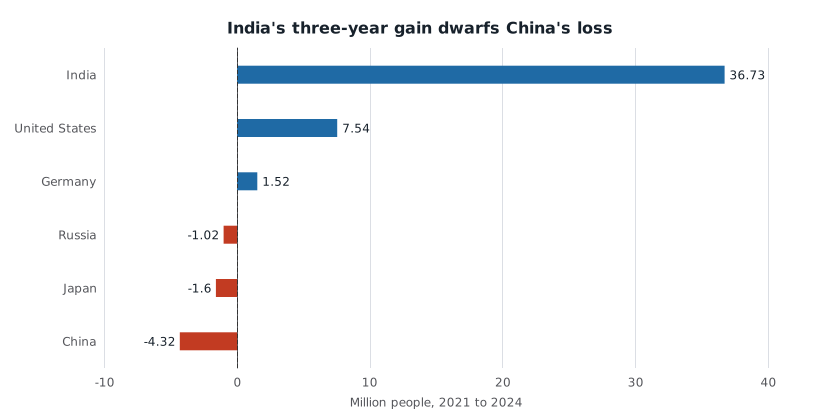
Change in IMF World Economic Outlook annual population, million people, 2021 to 2024. India +36.73 million; United States +7.54 million; Germany +1.52 million; Russia −1.02 million; Japan −1.60 million; China −4.32 million. These six countries are not a world total; 2025–2031 WEO estimates are omitted. Source: IMF WEO population (LP).
Retrospective research; the 2024 comparisons and source note are in China’s population peaked in 2021.
Dates and sources
This digest covers the news day 2026-08-25. It is presented retrospectively from a saved draft; its date in the URL identifies the news day, not an assertion of publication on that day. News references link to their original outlets. Supporting research was completed 2026-09-10. Its data vintage and material limitations are recorded in the article methods and chart captions.