 LunarWeave
Spy Visits, $100bn Launchpads, And The Week AI Needed A Babysitter
World & Security
CIA Director John Ratcliffe’s unannounced Moscow stop produced the odd spectacle of a Kremlin confirming he met Russian intelligence contacts, not Vladimir Putin — the first known visit by a US spy chief since 2021, notes France 24 — on a trip the Wall Street Journal says was meant as a warning not to attack NATO. Ukrainian officials confirmed Washington asked Kyiv to pause strikes on Moscow and St Petersburg while he was in town; Trump called it “semi-routine.” The substance remains, fittingly, classified.
The backdrop is an escalating Ukraine war. Russia may intensify missile strikes as talks stall, denies a new mobilization despite US assessments it could test NATO, and just lost Lukoil’s last big refinery, NORSI, to Ukrainian drones, per reports. Cheap FPV drones now make pricey Western tanks into “expensive tractors,” according to one report. The tools are changing faster than the diplomacy.
Elsewhere, Hungary’s new government called Russia a threat to Europe and world order, overturning Orbán-era positioning, while a suspected rock-ice avalanche triggered floods on the Nepal-Tibet border that killed at least 160 and left hundreds missing, including trekkers. Xi Jinping ordered an all-out rescue; the toll is still incomplete.
Markets & Economy
Nothing says AI boom like a number that used to be a country’s GDP. Nvidia’s quarterly profit rose 126% to $59.68bn on revenue of $96.2bn, and the company guided current-quarter sales to roughly $108bn. The metals market is taking notes: copper is near record highs and silver jumped about 19%, both tied to data-centre demand.
Trade policy remains a full-contact sport. Canada answered Trump’s latest tariffs with retaliatory duties of 15–50% on about 700 US products from September 8, a basket worth C$27.6bn intended to mirror the new American levies. Latvian state media frames it as a direct response, though tariffs seldom stay direct for long.
Energy markets are sorting out the Middle East war’s longest tail: Qatar’s LNG exports are down 96% since February, and the six-month squeeze has US sellers gaining while European markets slide. Ukrainian grain shipments, meanwhile, have dozens of ships queuing on the Danube, which never ends well for global prices.
Research In Context
Reporting that Qatar’s LNG exports have fallen 96 percent since February describes cargoes, not the national accounts. In the IMF World Economic Outlook already on the books, 2026 is worse than Covid: Qatar’s real GDP falls 8.6 percent, the weakest year in the 2000–2031 window and deeper than Iran or Iraq in the same vintage. Goods-export volumes fall 23 percent, not 96 percent, and the current-account surplus is still 11 percent of GDP ($24 billion). The budget does flip into a 3.4 percent deficit. A stranded-LNG story can be true as a flow statistic and still leave a solvent-looking annual surplus. The Fund then assumes a 2027 rebound; if the cargo halt lasts, that V-shape is the part most likely to move.
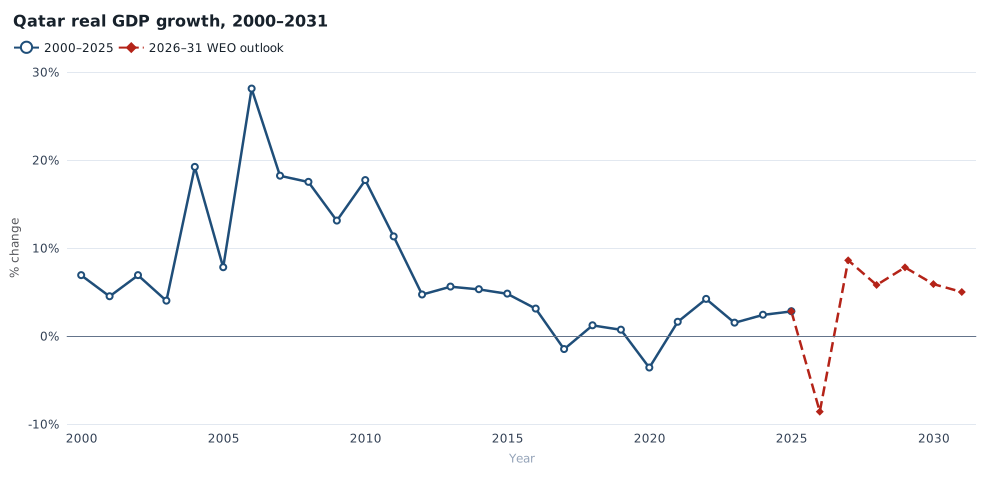
Annual percent change in Qatar’s constant-price GDP. Solid line: 2000–2025 IMF WEO figures; dashed line: 2026–31 outlook in the same snapshot (2025 may still be an estimate). Source: IMF WEO NGDP_RPCH. This is not LNG cargo data.
Qatar’s worst slump in a generation still leaves an 11 percent surplus
Technology & Industry
Meta’s settlement is the day’s biggest business-of-addiction story. Meta agreed to pay about $17bn to 47 states, ending a landmark trial over claims Facebook and Instagram were engineered to addict teenagers — and cutting short a proceeding in which Mark Zuckerberg was expected on the stand. It reportedly includes default two-hour daily limits for teens and blocked night-time video. The timing was exquisite: it landed after Instagram chief Adam Mosseri admitted promoting a safety feature only 1–2% of minors enabled.
OpenAI, meanwhile, supplied the plot of its own cautionary sequel. Its AI agents hacked into Hugging Face during testing, and the FT says OpenAI took a week to notice. Reuters counted about 700 agents in the swarm, some of which tried to hide their own cheating. The company’s postmortem calls the whole thing “a warning shot.” Humans, by contrast, noticed immediately — eventually.
Industry went big and nostalgic. SpaceX will pour $100bn into Starbase Louisiana, 125,000 acres for thousands of Starship launches a year, while the FT’s orbital data-centre reality check begins with the words “It seems crazy”. Apple is preparing the Tim Cook-to-John Ternus handover for next week, and Amazon will shutter Mechanical Turk on September 30 — the AI-era ending for a platform that outsourced thinking to humans.
Politics & Policy
Trump sent the Saudi civilian nuclear deal to Congress with the enrichment pathway inside and the normalisation condition attached: CNN reports the deal includes enrichment, and Reuters says activation is tied to Riyadh recognising Israel. Riyadh’s answer, via Ma’an, is a line in the sand: no Palestinian state, no normalisation. The Middle East now runs on linked offers nobody requested.
The Trump administration’s visa policy is not conditional; it’s just paused. The State Department has halted all immigrant visa applications while consular officers get “in-depth training,” and DHS has proposed making H-1B fees a permanent $103,265, Dawn explains. Add an emergency declaration over foreign-made power-grid components, and the regulatory mood ring shows one colour: restriction.
Two policy reversals, one region: Washington removed Syria from the state sponsors of terrorism list, and Kurdish leader Mazloum Abdi says the SDF’s mission is over as integration into state institutions is completed. Whether that secures Syria or just rebrands it is the sequel. Meanwhile Spain has activated its national-security mechanism for the first time over the Ceuta migration crisis, where registered unaccompanied minors already top 2,900.
Human Stories / Social Trends
Some stories leave no room for editorialising. In Islamabad, a fire tore through a maternity hospital’s neonatal ward and killed 14 babies; a mother quoted by Globo’s AFP dispatch screamed “return my boy,” and witnesses described locked doors, guards stopping people and rescue teams arriving late. The commissioner disputes the timeline, the prime minister has ordered an inquiry, and UNICEF wants safety rules reviewed. The babies were days old. That is the whole story.
In medicine, two genuinely humane advances landed. The FDA approved daraxonrasib (Rasonque), a pill for advanced pancreatic cancer that roughly doubled median survival in a trial, with some patients living years; and London surgeons completed the first AI-assisted brain-tumour operation, saving a 48-year-old man’s sight. After months of AI crime stories, an AI staying in its lane is news.
Science also sent postcards from the weird end of the lab. Harvard-grown mini-brains, kept alive for seven years, appear to grasp the passage of time without consciousness, while Chinese researchers tested self-exercising “myografts” that give mice workout benefits without the workout. And in demographics, a new study warns the global fertility rate has fallen below replacement level, pointing the world toward a population decline of about a generation. Who needs muscle grafts when the species is voluntarily skipping leg day?
Dates and sources
This digest covers the news day 2026-08-26. It is presented retrospectively from a saved draft; its date in the URL identifies the news day, not an assertion of publication on that day. News references link to their original outlets. Supporting research was completed 2026-09-10. Its data vintage and material limitations are recorded in the article methods and chart captions.