LunarWeave
The United States Is Paying Italy’s Interest Bill — Without Italy’s Surplus
title: "The United States is paying Italy’s interest bill — without Italy’s surplus" description: "IMF accounts show a 3.5 percent of GDP US interest residual in 2024, close to Italy and far above Japan, while the primary deficit remained wide."
When US public debt is described as having passed $40 trillion, the number is meant to sound terminal. A Times of India market note circulating in late August 2026 added two more shocks: a deficit still widening toward $1.8 trillion, and interest costs that had overtaken Medicare. The implication is that America has entered a Japan-style debt trap, only louder.
The IMF World Economic Outlook books tell a sharper, and in one respect more uncomfortable, story. The United States does not have the rich world’s largest debt ratio. What it does have is an Italy-sized interest bill sitting on top of a still-large primary deficit — the gap that remains after interest is stripped out. Japan, with a much heavier debt stock, pays almost nothing to service it. Italy pays about as much interest as the United States, but by 2024 it had already moved into a small primary surplus. Washington is doing both things at once: borrowing for everything except interest, and paying a lot of interest.
Two deficits, not one
In the Fund’s general-government accounts, the 2024 overall balance was a deficit of 7.9 percent of GDP. That is about $2.30 trillion on the IMF’s $29.3 trillion current-dollar GDP figure — larger than the $1.8 trillion federal headline, because the IMF consolidates federal, state and local government rather than the US Treasury’s federal budget.
The more useful split is between the primary balance and what is left. The primary balance excludes interest payable. In 2024 it was still a 4.4 percent of GDP deficit, about $1.28 trillion. The residual — primary minus overall — was 3.5 percent of GDP, about $1.02 trillion. Call that residual implied interest. It is not a Treasury auction statistic, and it is not a test of the Medicare comparison, which these accounts do not contain. It is the interest cost that has to be true if the IMF’s overall and primary balances are on the same basis.
That 3.5 percent share is no longer a rounding error. It was 2.3 percent of GDP in 2019, before the pandemic and the subsequent rise in yields. It absorbed 9.2 percent of general-government expenditure in 2024, up from 6.4 percent in 2019. Interest now accounts for a little more than two-fifths of the entire overall deficit.
The path was not a straight COVID hangover. In 2022 the overall deficit briefly narrowed to 3.7 percent of GDP and the primary gap to 1.0 percent, while implied interest was already 2.7 percent. Then the non-interest gap reopened. By 2023–24 the United States was again running a 4–5 percent of GDP primary deficit and an interest residual that had climbed above 3 percent of GDP.
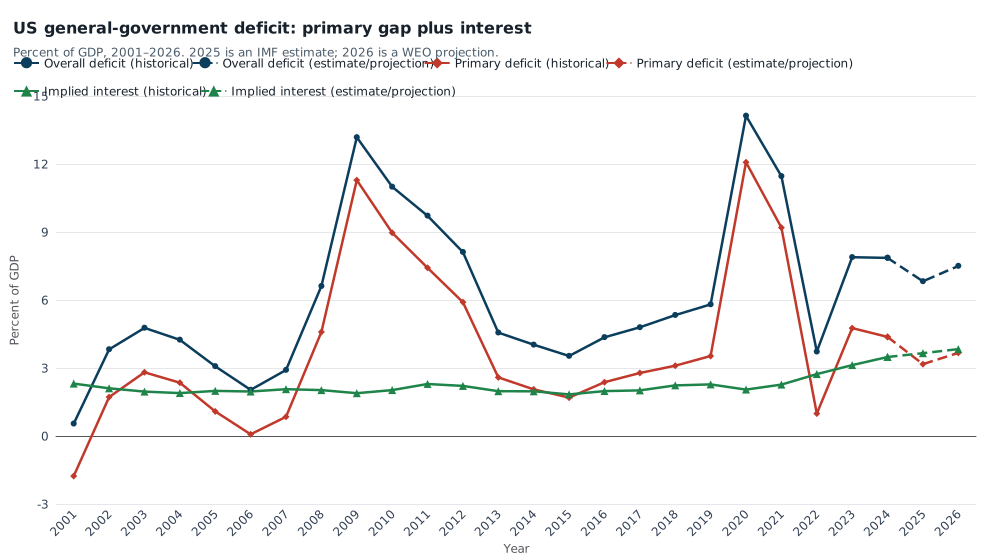
United States general-government overall deficit, primary deficit and implied interest, percent of GDP, 2001–2026. Implied interest is the IMF primary balance minus the overall balance. Solid lines are historical; dashed lines are the 2025 IMF estimate and 2026 WEO projection in the pinned August 2026 snapshot. Source: IMF World Economic Outlook.
Japan has the debt. Italy has the interest. America has both problems in the wrong combination.
Place that 3.5 percent interest residual among other large rich economies in 2024 and the United States does not look like Japan. It looks like Italy.
Italy’s implied interest was 3.6 percent of GDP — a hair higher than the US figure — on gross debt of 135 percent of GDP. The difference is the primary balance: Italy ran a 0.26 percent of GDP surplus. Its remaining 3.4 percent overall deficit was, in the IMF arithmetic, almost entirely interest. The United States ran a 4.4 percent primary deficit on 122 percent debt. Britain (2.0 percent interest, 4.0 percent primary deficit) and France (1.8 percent interest, 4.0 percent primary deficit) sit in between. Germany’s interest residual was 0.8 percent of GDP.
Japan is the warning poster that the $40 trillion headline quietly invokes, and it does not fit. Japanese general-government gross debt was 214 percent of GDP in 2024 — 92 percentage points above the United States — yet the implied interest residual was 0.12 percent of GDP. Ultra-low borrowing costs, not the debt ratio alone, are what keep Japan’s service bill tiny. A country can carry a larger stock more cheaply than a smaller one if it does not pay market rates.
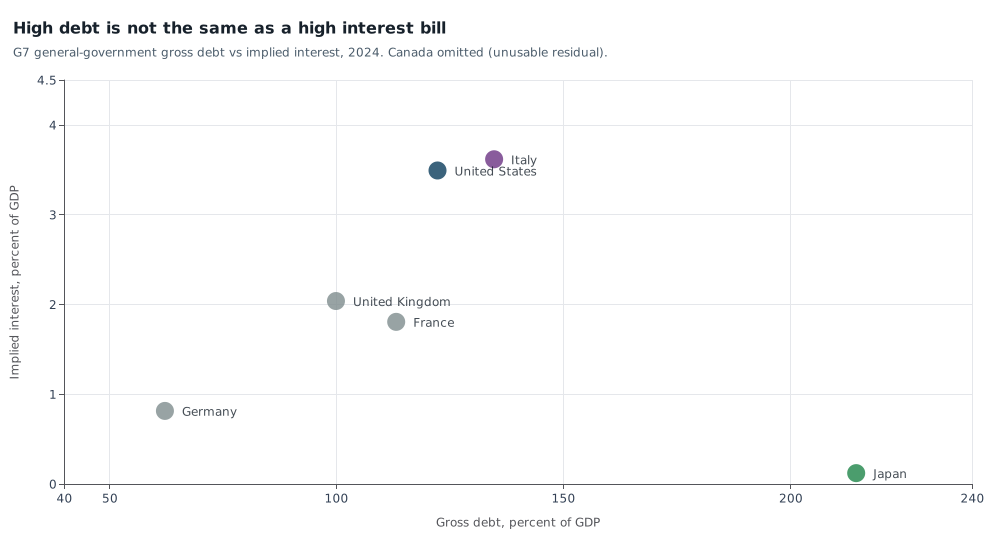
G7 general-government gross debt versus implied interest, both percent of GDP, 2024. Canada is omitted because its primary-minus-overall residual is near zero and changes sign, so it is not treated as an interest cost. Source: IMF World Economic Outlook.
| Country | Gross debt | Primary balance | Implied interest | Overall deficit |
|---|---|---|---|---|
| United States | 122.3 | −4.37 | 3.49 | 7.86 |
| United Kingdom | 99.9 | −4.02 | 2.03 | 6.06 |
| France | 113.2 | −3.99 | 1.80 | 5.79 |
| Italy | 134.7 | +0.26 | 3.61 | 3.35 |
| Germany | 62.2 | −1.85 | 0.81 | 2.66 |
| Canada | 110.0 | −2.12 | — | 2.12 |
| Japan | 214.5 | −1.55 | 0.12 | 1.67 |
2024, percent of GDP. Overall deficit is minus net lending/borrowing. Implied interest is primary minus overall; Canada’s residual is not shown. Source: IMF WEO.
The $40 trillion stock is the wrong hill to die on
On the IMF definition, US general-government gross debt was 122 percent of GDP in 2024, about $35.8 trillion. That is not the $40 trillion federal-debt headline, which counts a different perimeter (gross federal debt outstanding, including intragovernmental holdings) on a different calendar. The two figures are the same order of magnitude; they are not the same object. The Fund’s 2026 projection puts general-government debt at 126 percent of GDP, about $40.7 trillion — close to the headline, one or two years later, still on the IMF’s books.
What the projection does not show is a closing of the flow. The 2026 overall deficit is still 7.5 percent of GDP, with a 3.7 percent primary deficit and an interest residual of 3.8 percent. If those figures hold, implied interest would be about $1.24 trillion on $32.4 trillion of GDP. The United States would still be borrowing, in the primary sense, even after paying an Italy-sized service bill.
None of this proves that interest has overtaken Medicare. Medicare is a federal programme; these balances are general government; the residual is not a line item from the Monthly Treasury Statement. It also does not prove that bond markets must revolt, or that gold must rally. Correlation between a wide deficit and a rising metal price is a market story, not a finding from these accounts.
It does show why the stock-of-debt comparison with Japan is the wrong frame. Japan’s problem is a huge debt ratio financed at almost no running cost. Italy’s recent problem is a large interest bill on a debt ratio only a little higher than America’s, against which it has already pushed the primary balance into surplus. The United States in 2024 combined Italy’s interest share with a primary deficit still larger than Germany’s overall deficit. That combination, not the round number on the debt clock, is what the IMF books actually flag.
Sources and methods
This article is retrospective. It was researched on 10 September 2026 against a pinned IMF WEO snapshot dated 24 August 2026 (raw run 10 August 2026), later than the 23 August 2026 news it is used to contextualise. Years through 2024 are treated as historical; 2025 as an IMF estimate; 2026 as a WEO projection. The snapshot cannot establish what was knowable on 23 August.
Overall balance is WEO code GGXCNL_NGDP. Primary balance is GGXONLB_NGDP. Gross debt is GGXWDG_NGDP. Dollar figures multiply those ratios by NGDPD (GDP at current US dollar prices). Implied interest is primary minus overall, in percentage points of GDP. In this catalogue the display names of the primary and structural-balance series are swapped; the calculations follow the IMF codes, which match the usual pattern (US and Italian residuals of 3–4 percent of GDP; a Japanese residual near zero). Canada is excluded from interest rankings because its 2024 residual is 0.01 percentage point and flips sign in 2025. General government is not the federal budget, and a residual is not a Treasury interest series. MacroVedia pages for the overall balance and gross debt match the 2024 US values used here; readers need to select the United States in the chart. The live portal title for GGXONLB_NGDP currently says “structural balance,” so that page is not linked.
Research Date
The displayed date matches the related news edition. Research was completed 2026-09-10.
Related news: Daily · 2026-08-23
More Research
The $103,000 H-1B Fee Is 42 Weeks Of Tech-Services Pay
The proposed $103,265 H-1B fee equals 42 weeks of average pay in computer systems design, an industry already 117,000 jobs below its 2023 peak.
Germany’s 0.5% Forecast Is A Stalled Recovery, Not A New Crash
Germany’s reported 0.5% 2026 growth forecast follows two IMF contraction years, not a new crash.
China’s Population Peaked In 2021. India’s Rise Is Still Much Larger.
IMF headcount shows China peaked in 2021; India’s three-year gain is still about 8.5 times China’s loss.