LunarWeave
Germany’s 0.5% Forecast Is A Stalled Recovery, Not A New Crash
When Berlin cut its 2026 growth forecast to 0.5% and blamed a Middle East energy shock, the number sounded like a sudden blow to Europe’s largest economy. In the IMF’s real GDP growth accounts, it does not. Germany already shrank in 2023 and 2024. A half-percent expansion would be a weak year by the standards of the 2010s. It would not be the slump.
The 0.5% figure itself is a reported government forecast, circulated in AFP copy as a halving of the previous outlook. This article does not verify the unpublished prior forecast that “halved” implies. It asks a narrower question the Fund’s books can answer: if 0.5% is the year Germany now fears, how does that compare with the growth Germany has already posted, and with the IMF’s own 2026 projection?
Two down years, then almost nothing
In the IMF World Economic Outlook, German real GDP fell 0.9% in 2023 and another 0.5% in 2024. Those are the first consecutive contraction years since 2002–03. Compounded, the two years cut the level of real output by 1.4%. Add the Fund’s 0.2% estimate for 2025 and the three-year compound change is still −1.1%.
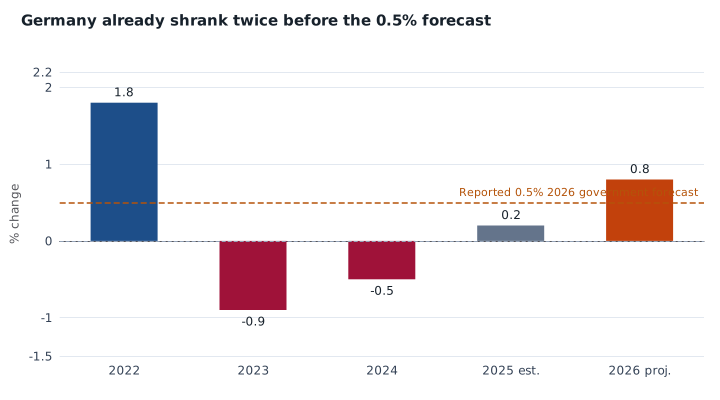
IMF World Economic Outlook real GDP growth for Germany, percent change, annual. 2022–2024 are historical WEO estimates; 2025 is an IMF estimate; 2026 is an IMF projection (0.8%). The dashed line is the 0.5% 2026 figure reported as the German government’s revised forecast, not an IMF value. Source: IMF WEO, NGDP_RPCH.
Against that backdrop, 0.5% in 2026 would be an improvement on the two contraction years, not a collapse relative to them. The IMF, in the same vintage, is a little more optimistic: it projects 0.8% growth in 2026 and 1.2% in 2027. That is still a crawl. It is not a war-shock crash sitting in the 2026 column.
Readers should choose Germany in the chart selector on the constant-price GDP growth series; the page does not pre-fill a country.
Slow even before this war
Germany was not a 2% economy waiting to be knocked over. From 2010 through 2019, real growth averaged 2.0% a year. From 2000 through 2019 the average was 1.4%, dragged down by the early-2000s stall and the 2009 crash. The 2023–24 sequence is rare in that longer record: the only other two-year contraction in the 1991–2024 window is 2002–03. The 2009 and 2020 slumps were deep, and they were one-year events in these annual accounts.
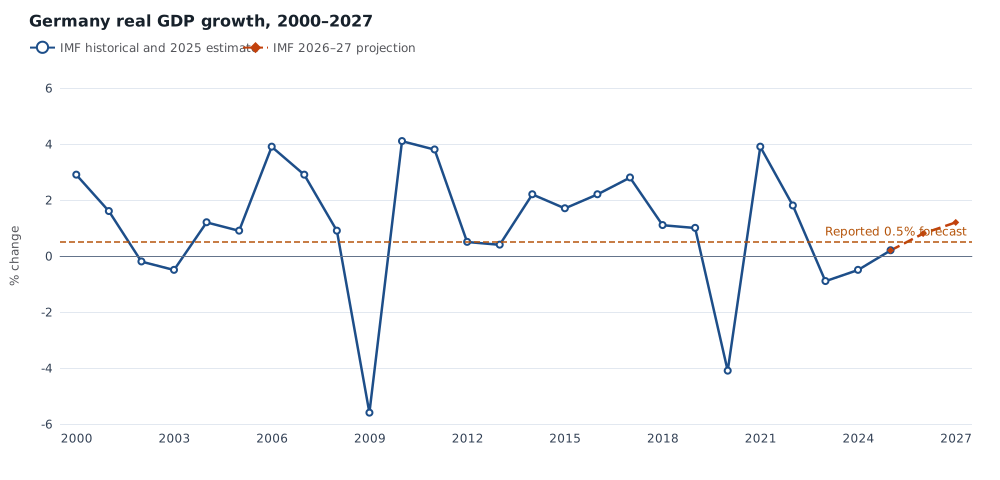
IMF World Economic Outlook real GDP growth for Germany, percent change, annual, 2000–2027. The solid line is IMF historical estimates through 2024 plus the 2025 estimate; the dashed line is the IMF projection for 2026–27. The horizontal dashed line marks the reported 0.5% 2026 German government forecast. Source: IMF WEO.
A 0.5% year would land in the same neighbourhood as 2012 (0.5%) and 2013 (0.4%) — the euro-crisis crawl — not as 2009 (−5.6%) or 2020 (−4.1%). The distinctive fact about the mid-2020s is persistence: two shrinking years and then a rounding-error recovery, rather than a single crash and rebound.
Not the whole of Europe, and not the United States
The stall is also not a uniform rich-world story. In the same IMF vintage, only Germany and Austria among the economies compared here contracted in both 2023 and 2024. The Netherlands shrank in 2023 (−0.6%) and grew again in 2024 (1.1%). France stayed positive. So did Italy, though its 2026 projection rounds to 0.5% — a reminder that a half-percent year is already the Fund’s baseline for some large euro economies, not a German special case invented this month.
Spain is the clearest contrast: 3.5% in 2024, with the IMF still projecting 2.1% in 2026. The United States is projected at 2.3%.
| Economy | 2023 | 2024 | 2025 (est.) | 2026 (proj.) |
|---|---|---|---|---|
| Germany | −0.9 | −0.5 | 0.2 | 0.8 |
| Austria | −0.8 | −0.7 | 0.6 | 0.7 |
| France | 1.6 | 1.1 | 0.9 | 0.9 |
| Italy | 0.9 | 0.8 | 0.5 | 0.5 |
| Spain | 2.5 | 3.5 | 2.8 | 2.1 |
| United States | 2.9 | 2.8 | 2.1 | 2.3 |
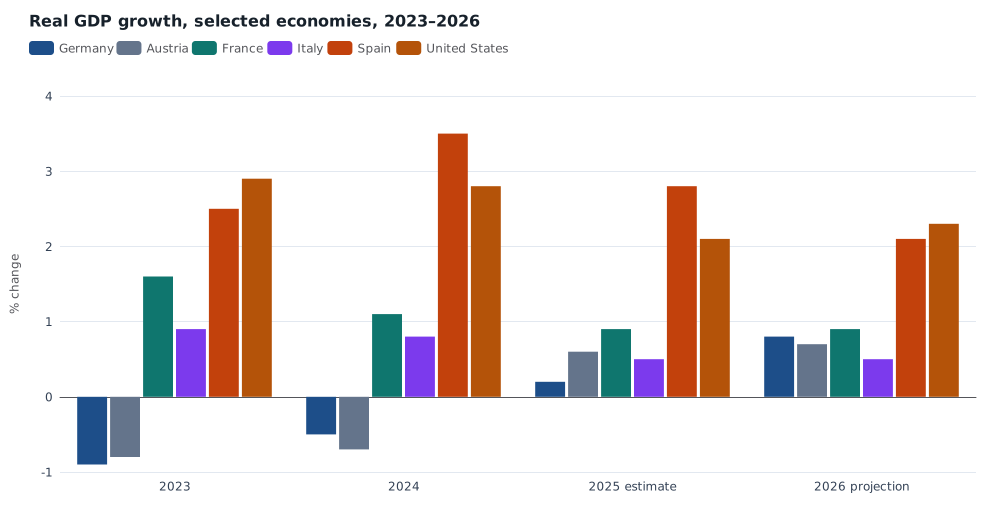
IMF World Economic Outlook real GDP growth, percent change. 2025 is an IMF estimate; 2026 is a projection. Figures rounded to one decimal place. Source: IMF WEO, NGDP_RPCH.
The comparison does not prove that energy prices “caused” Germany’s two down years, or that Spain was insulated. It does show that a 0.5% German forecast is being written onto an economy that has already underperformed these peers, not onto a 2% trend that an oil spike has just broken.
What the oil assumption does — and does not — say
The government forecast was reported as a response to a Middle East war energy shock. The IMF’s own 2026 Brent assumption in this vintage is $80 a barrel, up from $68 in 2025 and well below the $99 annual average in 2022. Annual averages cannot time a 2026 disruption inside the year, and they are not a German import-price index. They are enough to bar one leap: the Fund is not writing 2026 as a repeat of 2022’s oil year. Germany’s 2023–24 contractions already sit on the far side of that earlier spike.
What 0.5% would actually mean
If the reported government number is the year Germany gets, it would still leave real output lower than before the 2023–24 slide, because a 0.5% rebound does not replace a 1.4% two-year decline. It would also leave Germany far below its 2010s average. The IMF’s 0.8% 2026 projection is only a few tenths kinder.
The news in the 0.5% forecast is therefore not that a healthy German expansion has been cut in half by this year’s energy shock. It is that Berlin is now describing, in round numbers, a recovery that the IMF already treats as thin — and that follows two years in which Germany, almost uniquely among large rich peers, actually shrank.
Sources and methods
This is retrospective research dated 10 September 2026, using a pinned IMF World Economic Outlook snapshot ingested on 10 August 2026, after the 22 August 2026 news day. Later WEO revisions can change estimates. Years 1991–2024 are treated as IMF historical estimates, 2025 as an estimate for a completed year that may still be revised, and 2026–27 as projections. The snapshot does not encode an IMF “estimates start after” flag. Growth rates are annual percent changes in constant-price GDP (NGDP_RPCH); they are not per-person figures and are not summed across countries. Rounding in the text and charts is to one decimal place; exact values are in the saved extracts. The 0.5% government forecast is a reported claim, not an IMF observation. Browser and mobile layout were not separately tested beyond SVG rendering.
Official source: IMF World Economic Outlook.
Research Date
The displayed date matches the related news edition. Research was completed 2026-09-10.
Related news: Daily · 2026-08-22
More Research
The United States Is Paying Italy’s Interest Bill — Without Italy’s Surplus
IMF 2024 accounts show a 3.5 percent of GDP US interest residual, matching Italy rather than Japan, on top of a still-wide primary deficit.
Half Of America’s Budget Hole Is Now Interest. The Rest Never Closed.
IMF books show the 2025 US general-government deficit split almost evenly between a still-open primary gap and a larger interest bill — a different story from the $40 trillion headline.
The $103,000 H-1B Fee Is 42 Weeks Of Tech-Services Pay
The proposed $103,265 H-1B fee equals 42 weeks of average pay in computer systems design, an industry already 117,000 jobs below its 2023 peak.